About Museumsquartier Halle E
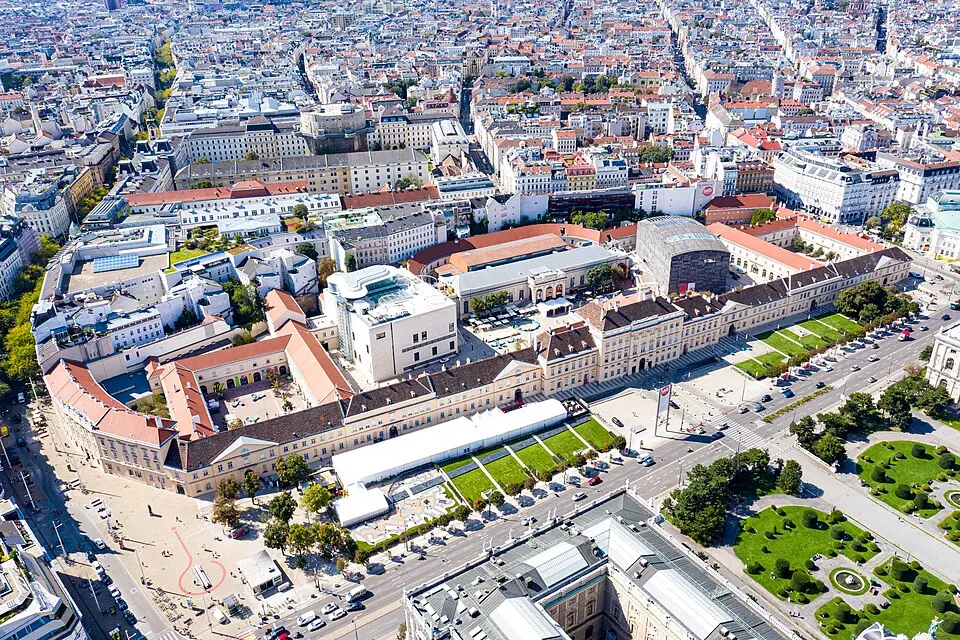
The MuseumsQuartier in Vienna is a sprawling cultural complex in the seventh district, stretching out beyond Maria-Theresien-Platz and bordered by the Ringstrasse and Mariahilfer Strasse. It is considered one of the most important venues for contemporary culture in the Austrian capital and combines historic buildings with modern architecture. The complex is not only home to major museums but also serves as a public urban space, a production site for creative projects, and an example of culture-driven urban development. Here you will find a mix of visual art, music, theater, dance, literature, and new media, all presented in an architecturally ambitious setting.
The history of the site goes back to the 18th century, when it was built as the imperial court stables. In 1713, Emperor Charles VI commissioned Johann Bernhard Fischer von Erlach to design the complex, which was completed after his death by his son Joseph Emanuel. For centuries the complex served the court, before it lost its original purpose after World War I. In the 1920s, the site was converted into the Messepalast (Exhibition Palace), which was used for exhibitions and trade fairs until the 1960s. During the Nazi era, propaganda events were held here, before the Vienna trade fair resumed operations after World War II.
The transformation into today's cultural center began in the 1980s, when the concept for a cultural forum was developed. After an international architecture competition that drew numerous entries, the firm Ortner & Ortner won the commission. The planning was controversial from the start, particularly because of the idea of a tall reading tower meant to serve as a landmark. After heated public debate and protests from artists and architects, this plan was eventually dropped. Instead, the project was scaled down, giving greater consideration to historic preservation and integrating the new buildings into the historic courtyard structure.
Construction began in 1998, and the complex opened in two stages in 2001. The total cost of the conversion was around €150 million, funded by the Republic of Austria and the City of Vienna. During construction there was criticism of accessibility, which has largely since been addressed. The result is a complex considered one of the largest cultural centers in the world. Ortner & Ortner's architecture combines the Baroque facades of the former court stables with modern museum buildings, with the contrast between old and new serving as a central design element.
A striking feature of the MuseumsQuartier is its freely accessible courtyards and passageways, which serve as urban gathering spaces. These areas are not merely thoroughfares but places to linger, meet, and socialize informally. In summer, modern outdoor furniture is set up here, which visitors use to relax or catch up with friends. The courtyards also host seasonal programs, concerts, and events, making the complex a lively meeting point for locals and tourists alike.
The design of the new buildings is deliberately restrained so as not to overshadow the historic fabric. The Leopold Museum is a cuboid building of white shell limestone that blends harmoniously into the courtyard complex. The Museum of Modern Art, or MUMOK for short, is a cubic building of volcanic basalt that was originally planned to be taller but was shifted below ground to preserve the complex's silhouette. These architectural decisions reflect the compromise reached between modern demands on museum design and the preservation of the historic cityscape.
The MuseumsQuartier is home to nine major cultural institutions, including the Leopold Museum, MUMOK, Kunsthalle Wien, Architekturzentrum Wien, and Tanzquartier Wien. These institutions cover a broad range of art forms, from classical painting to digital media and performance art. Alongside the permanent museums, there are numerous smaller initiatives, galleries, and creative businesses operating as cultural tenants in the complex. This diversity makes the MuseumsQuartier a dynamic place that is constantly evolving and generating new ideas.
A special highlight is the MQ Libelle, a rooftop terrace on the Leopold Museum that opened in 2020. It offers an impressive view over the rooftops of Vienna and serves as both an event venue and a place to relax. The terrace is reached by elevator and has a food and drink kiosk. With this addition, the complex opened upward for the first time, taking the use of public space to a new level. The MQ Libelle is an example of how the MuseumsQuartier expands its functions and creates new experiences for visitors.
The complex is accessible from all sides through passageways designed as thematic micro-museums. These passages connect the various courtyards and offer changing exhibitions on topics such as literature, comics, street art, and sound art. The ceiling paintings and installations in these walkways invite you to discover art on your way from one place to another. This integration of art into everyday space makes the MuseumsQuartier a unique experience, in which art is present not just in the museums but everywhere.
Besides its museum offerings, cultural production plays an important role at the MuseumsQuartier. An international artist-in-residence program gives artists from around the world the chance to live and work in the complex for several months. The program fosters exchange between international and local cultural figures and enriches Vienna's cultural life. The artists use the spaces to develop new projects, which are often presented in the complex's public areas.
The MuseumsQuartier is also a venue for events and festivals held throughout the year. In winter, mobile pavilions run by food and drink vendors are set up in the main courtyard, while in summer concerts and open-air events take place in the courtyards. These seasonal programs keep the complex lively in every season. The combination of cultural offerings, restaurants and cafés, and public spaces makes the MuseumsQuartier an indispensable part of Viennese city life.
All in all, the MuseumsQuartier is an example of the successful union of history and modernity, of institution and freedom, of museums and urban space. It is a place where art is not just viewed but experienced. Its open design, the variety of its offerings, and its integration into the urban fabric make it a special destination for anyone interested in culture, architecture, and urban life. The complex remains a place of encounter and dialogue that shapes and continues to develop Vienna's cultural identity.
At a glance
- Category
- Museum › Contemporary art
- Rating
- no reviews yet · write a review
- Address
- Museumsplatz 1
1070 Vienna, Austria - District
- Katastralgemeinde Neubau
- Phone
- +4315235881
- Website
- www.mqw.at
- —
- Coordinates
- 48.20379° N · 16.35788° E
- Data quality
- confidence 0.69
- Identifier
- ID c2cd4a61-64f…
Location & surroundings
Toggle layersRatings & comments
none yetNear Museumsquartier Halle E
closest 5 per category · 2 kmSights
Restaurants
Museums
Hotels
More:Museums in Katastralgemeinde Neubau (23)All museums in Vienna (308)
300 places within 2 km loaded.
You need a free account to leave reviews and photos – that keeps comments genuine and lets you edit them later.