About Albertina
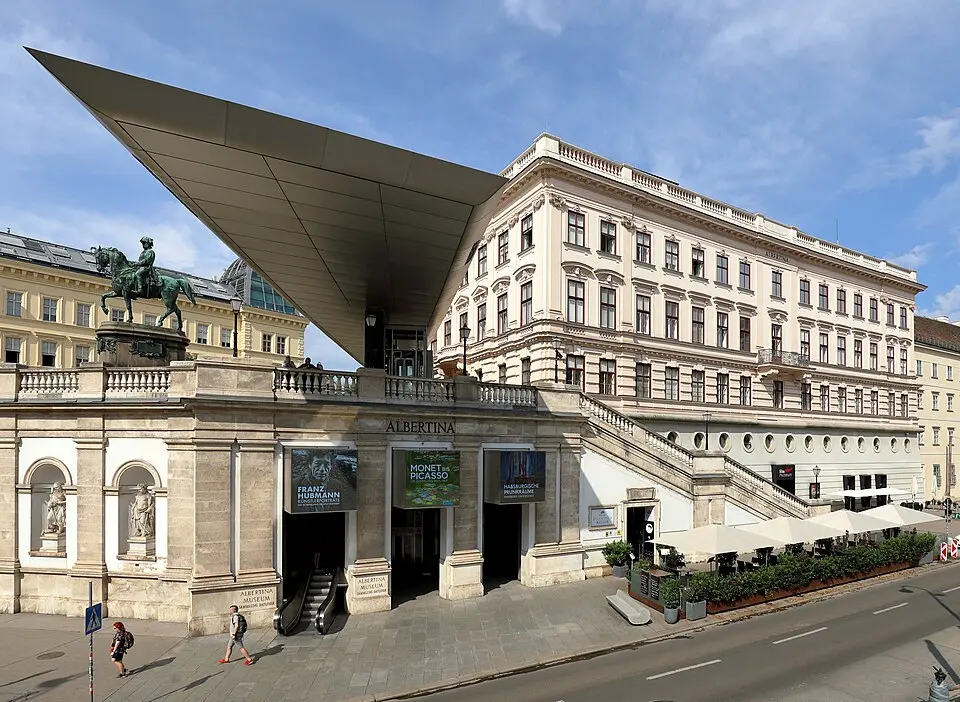
The Albertina is one of the world's most important art museums, located in the heart of Vienna in the First District, the Innere Stadt. The museum is housed in a historic palace that once served as a Habsburg residence. Today it holds one of the most comprehensive collections of graphic art anywhere, spanning the Gothic period to the present day. Besides the famous main building on the Augustinerbastei, the institution now includes two other locations: Albertina Modern in the Künstlerhaus on Karlsplatz and Albertina Klosterneuburg, which is dedicated to art after 1945. This three-part structure gives you a broad overview of art history, from classic masterpieces to contemporary positions.
The museum takes its name from Duke Albert Casimir of Saxe-Teschen, son-in-law of Empress Maria Theresa. He founded the collection in 1776 in Pressburg, where he resided as the empress's representative for the Kingdom of Hungary. With the support of his art-loving wife, Archduchess Maria Christina, who also backed him financially, he built up an encyclopedic collection over several decades. Through a Europe-wide network of dealers and auctions, he acquired thousands of drawings and prints. Many of these works, including famous pieces by Michelangelo, Albrecht Dürer, and Peter Paul Rubens, rank among the icons of art history.
The palace itself has a eventful history. It was originally built in 1744 for a close adviser to Maria Theresa. When Duke Albert and his wife returned to Vienna from the Netherlands in 1792, Emperor Francis II gave them the building. The duke had it adapted for his collection and extended with an imposing wing. The long façade was meant to demonstrate the financial strength and self-confidence of the ducal couple. The state rooms were furnished with furniture, wall paneling, and other fittings from their former palace in Brussels, complemented by silk wall coverings, inlaid parquet floors, and gilded crystal chandeliers.
In 1816, Duke Albert designated his graphic art collection in his will as an indivisible entailed estate. After his death it passed to his adopted son, Archduke Charles, and was subsequently administered by other Habsburg archdukes. With the end of the monarchy in 1918 and the introduction of the Habsburg Law, the building and the collection became the property of the Republic of Austria in April 1919. This made the collection inviolable cultural property of the state, which ensured its complete preservation to this day.
The period after World War I, however, was one of decline for the palace. Habsburg history was systematically suppressed, and the once magnificent state rooms were converted into offices, libraries, or storage rooms. The careful treatment of the precious decorations was lost, and the building suffered from neglect. Only after World War II, when the Albertina reopened in 1952, did a slow process of restoration begin, though for a long time it focused on the scholarly character of the collection, while public presentation played a secondary role.
A turning point came in the late 1990s and early 2000s. Under the direction of Klaus Albrecht Schröder, the museum was comprehensively renovated and modernized. The restoration included reconstructing the façades and restoring the neoclassical state rooms, which were opened to the public for the first time in eighty years. Many of the original furnishings that had been scattered after the war could be bought back. The exhibition space was dramatically enlarged, and a modern underground depot with an automated high-bay storage system was built to safely house the more than one million artworks.
One architectural hallmark of the redesign is the so-called Soravia Wing, a far-projecting roof canopy designed by the architect Hans Hollein. This striking structure, with an escalator and a panoramic elevator, connects street level with the elevated museum entrance on the bastion. Although the design was controversial, it symbolizes the museum's modern approach of combining historic fabric with contemporary infrastructure.
The Albertina's collections are diverse. Besides the graphic art collection, which comprises around 950,000 drawings and prints, there is an architecture collection with plans and models as well as a photography collection. Since 2007, the Batliner Collection has been on display as a permanent loan, presenting important works of classical modernism from Monet to Picasso. This expansion allowed the Albertina to transform from a pure graphic art cabinet into a comprehensive art museum.
Today you can experience the historic atmosphere of the Habsburg era in the restored state rooms, while the exhibition halls show artworks spanning six centuries. The presentation ranges from Renaissance masterpieces through the Baroque and the 19th century to classical modernism and contemporary art. The Albertina has become one of Vienna's most visited sights, drawing over a million visitors a year who enjoy the combination of historic splendor and modern art exhibitions.
With the opening of Albertina Modern in the Künstlerhaus and the reopening of the Klosterneuburg site as Albertina Klosterneuburg in 2024, the museum is broadening its profile further. The Klosterneuburg location is dedicated specifically to art after 1945 and also houses storage depots and conservation workshops. This strategic expansion underscores the Albertina's ambition to be an internationally recognized, contemporary museum that makes art a fresh experience and addresses current social issues through its exhibitions.
At a glance
- Category
- Museum › Art museums
- Rating
- no reviews yet · write a review
- Address
- Albertinapl. 1
1010 Vienna, Austria - District
- Innere Stadt
- Phone
- +431534830
- Website
- www.albertina.at
- info@albertina.at
- Coordinates
- 48.20466° N · 16.36825° E
- Data quality
- confidence 1.00
- Identifier
- ID a4eacc02-9ff…
Part of the tour
Art from Klimt to Dürer: A Museum Day in Vienna →Location & surroundings
Toggle layersRatings & comments
none yetNear Albertina
closest 5 per category · 2 kmSights
Restaurants
Museums
More:Art museums in Vienna (52)Museums in Innere Stadt (86)All museums in Vienna (308)
300 places within 2 km loaded.
You need a free account to leave reviews and photos – that keeps comments genuine and lets you edit them later.
Once a palace, it is now the most popular exhibition space in Vienna, mainly for traditional modern art. The building itself is an experience as well. It is home to a valuable drawing collection, including many works of the German Renaissance painter, Dürer.
Source: Wikivoyage, „Vienna/Innere Stadt“ · authors per page history · CC BY-SA 4.0