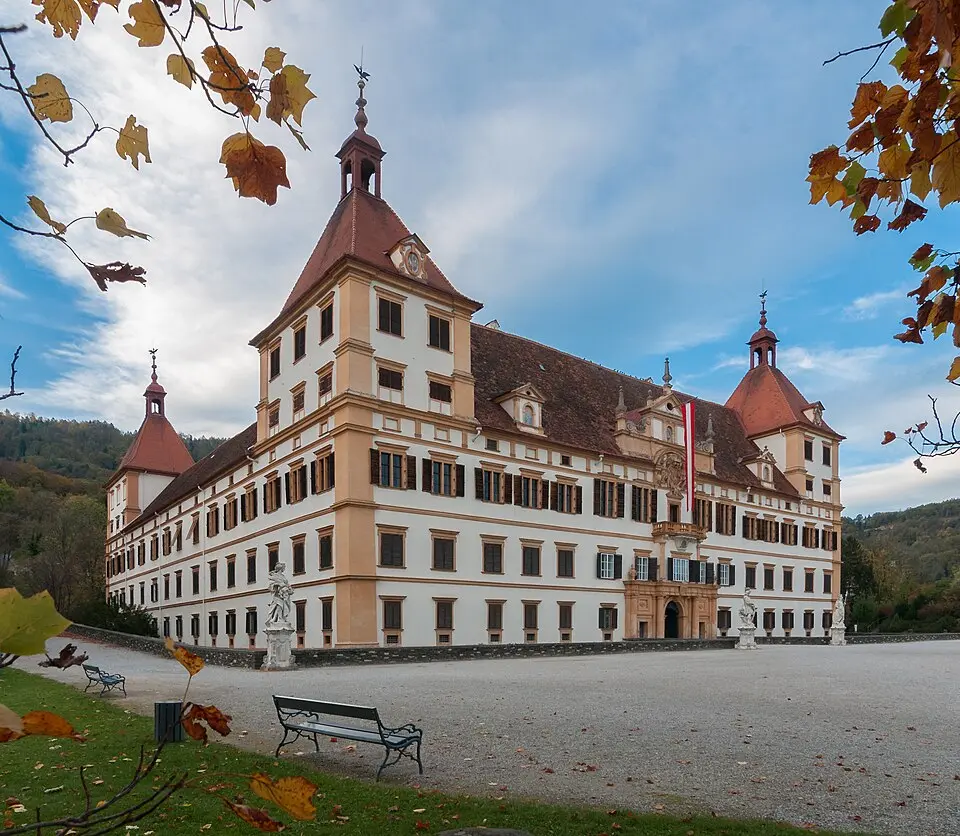
About Eggenberg Palace, Graz
Eggenberg Palace in Graz is considered the largest and most significant Baroque palace complex in Styria. One of Austria's most valuable cultural treasures, the building impresses with its largely preserved original furnishings, its extensive landscaped park, and the collections of the Universalmuseum Joanneum housed within it. The complex once served as the ancestral seat of the Eggenberg noble family, one of the most powerful families in the region. The history of the palace's construction and furnishing is a striking record of this dynasty's changing fortunes and its patronage of the arts. In 2010, the palace was added to the existing UNESCO World Heritage listing for the historic center of Graz, underscoring its special cultural importance.
The historic core of the palace dates back to the late Middle Ages. Between 1460 and 1463, Balthasar Eggenberger acquired a fortified manor house, which took on the family's name and was expanded over the following decades. Before 1470, a chapel was built in a freestanding tower; a Roman cardinal's indulgence from 1470 serves as evidence of it. The owner donated a magnificent winged altarpiece for this room, and its panels are still in their original location today. In the 16th century, the late medieval building, probably L-shaped, was enlarged several times to reflect the family's rising social status. Features of these early phases, such as certain window surrounds, corner quoins, and biforate windows, can still be seen on the building today.
The fundamental conversion into a grand Baroque palace began in 1625 under Prince Hans Ulrich von Eggenberg. He commissioned the court architect Giovanni Pietro de Pomis to draw up the plans. De Pomis, who came from Lodi near Milan, was a versatile artist whose style was shaped by northern Italian Mannerist architecture and the buildings of Palladio. The palace's floor plan strongly recalls the Palazzo Thiene, while its exterior shows parallels to the Escorial near Madrid. Both buildings share an emphasis on horizontality and tower-like raised corners. De Pomis directed the construction work until his death in 1631, after which Laurenz van de Sype and later Pietro Valnegro and Antonio Pozzo completed the shell by 1635 or 1636. The finishing work by stonemasons and carpenters followed from 1641 to 1646.
The palace was completed in the spirit of Baroque splendor from 1666 under Johann Seyfried von Eggenberg. In just seven years, the ceiling cycle of roughly 600 paintings in the state rooms was executed. When the bride of Emperor Leopold I visited in 1673, the house was considered finished, with the exception of the painted decoration of the festival hall. This was not completed until between 1678 and 1684/85 by Hans Adam Weissenkircher, who turned the room into the Planetensaal (Planetary Hall). After the Eggenberg male line died out, the rooms fell into disrepair for a time. Not until Count Johann Leopold Herberstein, husband of the last princess, was a comprehensive renovation in the Rococo style carried out between 1754 and 1762. The state rooms were modernized, East Asian cabinets were installed, and the old palace theater was replaced by a palace chapel, while the Planetary Hall and its ceiling paintings were left unchanged.
The palace's architectural concept is based on a profound philosophical and astronomical program meant to represent the universe. The three-story building stands on a rectangular plan whose geometric center is the tower with the Gothic chapel. The palace's four corners rise like towers by an extra story and a half and are aligned with the cardinal directions, symbolizing the four seasons and elements. A wide dry moat with stone bridges surrounds the complex. The system of the Gregorian calendar reform was built into the design: the palace has 365 exterior windows for the days of the year, 52 windows on the piano nobile for the weeks, and 31 rooms per floor for the maximum number of days in a month. On the second floor, 24 state rooms are arranged in a ring, symbolizing the hours of a day, with the building's symmetry reflecting the halves of day and night.
The Planetary Hall is the culmination of this program, at the center of the ring of 24 state rooms. The ceiling painting cycle created by Hans Adam Weissenkircher depicts the seven classical planets, which also stand for the alchemical metals, the days of the week, and important family members. The four elements appear in the corners of the vault, while the wall surfaces between the windows show large-format oil paintings of the twelve zodiac signs, representing the months. This allegorical depiction conjures an image of a Golden Age under the rule of the Eggenberg family. The 24 state rooms of the piano nobile tell the story of humankind, mythology, and the Old Testament through their ceiling paintings, which date from 1666 to 1683.
In the 18th century, the rooms of the piano nobile were refurnished in the Rococo style. In addition to new furniture, chandeliers, and faience stoves, the rooms received single-color silk damask wall coverings. Five halls in the north wing were fitted with painted canvas wall hangings showing subjects such as social scenes, hunting, and pastoral games. Particularly valuable are the three built-in East Asian cabinets. Two of them are adorned with Imari porcelain plates and Chinese silk painting. The third cabinet contains eight panels of a precious Japanese folding screen showing Osaka Castle and the fortified city. These screen panels date from the first half of the 17th century and, because views from this period are so rare, are of great historical importance.
The palace park covers 17.9 hectares (about 44 acres) and has historically always been regarded as an element equal in importance to the palace itself. Originally a strictly organized Italian garden with parterres and fountains, it was redesigned in the 18th century as a French Rococo garden. From 1802, it was transformed into a Romantic landscape garden in the English style, with winding paths, carefully planned vistas, and a Rosenhügel (Rose Hill) as a viewpoint. After a period of neglect in the 20th century, the park was reconstructed from 1993 as a cultural monument of the Romantic era. The Rose Hill and the Herrschaftsgarten (Manor Garden) were restored to preserve the original character of Biedermeier garden art.
In the north of the palace park lies the Planetengarten (Planetary Garden), which was newly laid out in 2000. It takes up the planetary doctrine of signatures from the palace's program in a contemporary garden design. The Lapidarium, which houses the Joanneum's collection of Roman stones, is also located here. Also in the northwest of the garden is the Archaeology Museum, opened in 2009 and set deep into the terrain. It displays significant finds such as the Strettweg Cult Wagon from the Hallstatt period, as well as excavations from Styria and Egypt. The park is also a European protected area that serves, among other things, as a hunting ground for the strictly protected greater horseshoe bat. Eggenberg Palace thus offers visitors a comprehensive look at the history, art, and nature of the region.
At a glance
- Category
- Museum › Art museums
- Rating
- no reviews yet · write a review
- Address
- —
Graz, Austria - Phone
- —
- Website
- fa.wikipedia.org
- —
- Coordinates
- 47.07390° N · 15.39130° E
- Data quality
- confidence 0.74
- Identifier
- ID c05f0aa5-144…
Part of the tour
Graz in One Day: Old Town, Schlossberg, and Eggenberg Palace →Location & surroundings
Toggle layersRatings & comments
none yetNear Eggenberg Palace, Graz
closest 5 per category · 2 kmSights
Restaurants
Hotels
Cocktail bars
None within 2 km.
69 places within 2 km loaded.
You need a free account to leave reviews and photos – that keeps comments genuine and lets you edit them later.
Early Baroque architecture with lavish state rooms. There is a €2 fee for entering the park surrounding the castle, which they likely will not charge if you say you intend to take the castle tour. The castle guided tour is highly recommended though, as it contains dramatic wall and ceiling paintings, elaborate ceramic stoves, and inlaid wood floors. Eggenberg Castle is closed from 1 January till 23 March.
Source: Wikivoyage, „Graz“ · authors per page history · CC BY-SA 4.0 · as of 2/15/2018