About Schloss Eggenberg: Alte Galerie
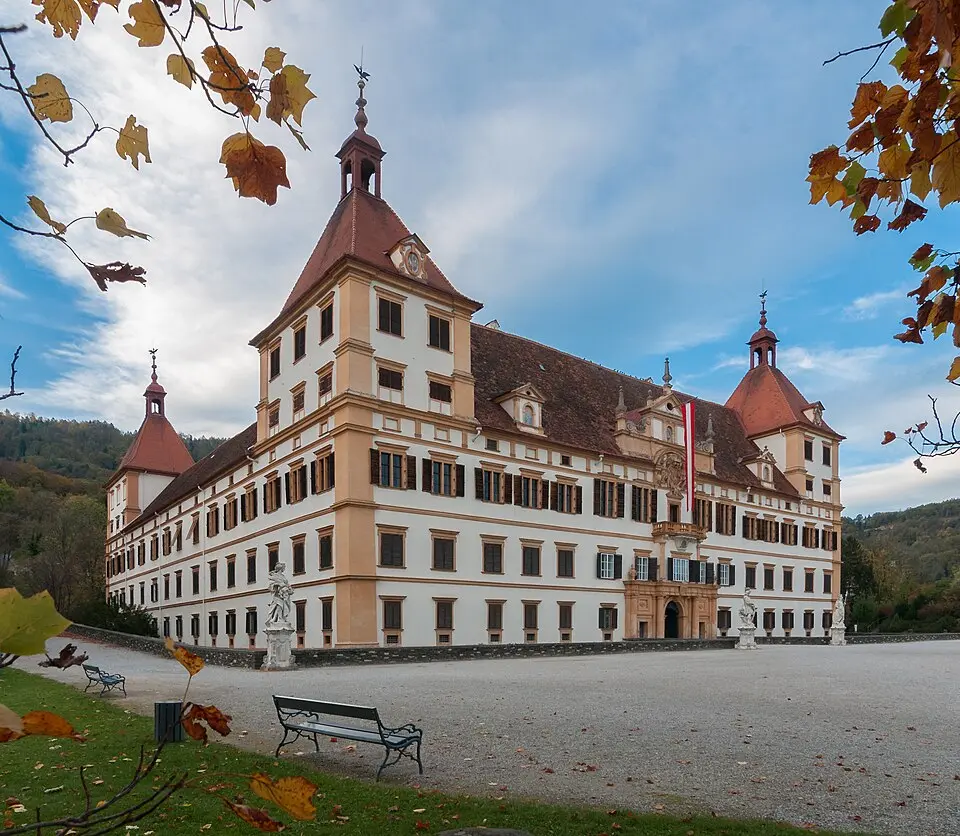
Eggenberg Palace in Graz is considered the largest and most important Baroque palace complex in Styria. As the ancestral seat of what was once the region's most powerful noble family, it embodies the transformation and patronage of the Eggenberg dynasty. Thanks to its preserved original furnishings, its expansive landscape garden and the collections housed within, the complex ranks among Austria's most valuable cultural treasures. In 2010, the palace was added as an extension to the existing UNESCO World Heritage Site "City of Graz – Historic Centre." The complex lies in the west of the state capital at the foot of Plabutsch Mountain and offers visitors not only a tour of the historic state rooms but also the chance to explore several museums and collections of the Universalmuseum Joanneum.
The building's history goes back to the 15th century, when Balthasar Eggenberger acquired a fortified manor house and had it remodeled. As early as 1470, a chapel was set up in a freestanding tower; it still exists today as a Gothic element at the center of the complex. In the 16th century, the building was expanded several times to reflect the family's rising social standing. The fundamental conversion into today's palace, however, did not begin until 1625 under Prince Hans Ulrich. The court architect Giovanni Pietro de Pomis designed the new residence, skillfully integrating older sections into the new building in order to preserve the family's ancestral home. The architect's style, shaped by northern Italian Mannerism and the austere Herrera style, shows parallels to famous buildings such as the Palazzo Thiene and the Escorial monastery.
After de Pomis died in 1631, other master builders continued the work until the shell of the building was completed in the mid-1630s. The true unfolding of splendor, however, did not occur until 1666 under Johann Seyfried von Eggenberg. In just seven years, the extensive ceiling cycle of the state rooms was completed. When the emperor's bride arrived as a guest in 1673, the house was largely finished; only the festival hall still lacked its painted decoration. The court painter Hans Adam Weissenkircher closed this gap by 1684 with the design of the so-called Planetary Hall. This brought the first major phase of furnishing to an end and made the palace an architectural masterpiece of the Baroque.
The concept of the complex is based on a deep connection between architecture, astronomy and alchemy. Prince Hans Ulrich wanted to create a well-ordered system representing the universe. The three-story building on a rectangular floor plan follows strict mathematical and symbolic rules. The four tower-like raised corners stand for the cardinal directions, seasons and elements. A remarkable feature is the number of windows and rooms: the palace has 365 exterior windows, one for each day of the year. The piano nobile has 52 windows for the weeks, and each floor contains 31 rooms for the maximum number of days in a month. On the second upper floor, 24 state rooms are arranged to symbolize the hours of a day.
The highlight of this program is the Planetary Hall, located on the central axis above the gateway passage. The hall is dominated by a cycle of paintings by Hans Adam Weissenkircher, an allegory of the Golden Age under the rule of the Eggenbergs. On the ceiling are seven oil paintings of the classical planets, which also stand for alchemical metals, days of the week and important family members. The wall surfaces between the windows show the twelve signs of the zodiac, representing the months. The four elements are depicted in the corners of the vault. This room unites the architectural program with the pictorial decoration into a powerful symbolic whole.
The remaining 24 state rooms of the piano nobile are arranged in a ring and feature a ceiling program of around 600 individual scenes. These paintings tell the story of humankind, mythology and the Old Testament. The framing stucco dates from between 1666 and 1683. After the Eggenberg male line died out, the palace was renovated in the Rococo style in the 18th century. Under Count Herberstein, the rooms were furnished with new furniture, faience stoves and silk damask wall coverings. Five halls in the north wing received painted canvas wall coverings with themes such as hunting, social scenes and pastoral games.
Particularly valuable are the three East Asian cabinets built into the sequence of rooms. Two of them are decorated with precious Imari porcelain and Chinese silk painting. The third cabinet houses eight panels of a precious Japanese folding screen showing the castle and the fortified city of Osaka. These screen panels date from the first half of the 17th century and are of great historical importance, since very few views of Osaka survive from this period. They offer a unique glimpse of the city in the Toyotomi era.
The palace park covers 17.9 hectares and has a varied history. Originally laid out as a strictly structured Italian garden, it was redesigned in the 18th century as a French Rococo garden. In the 19th century, influenced by the Enlightenment and a new awareness of nature, it was transformed into a Romantic landscape garden in the English style. Mazes and strict geometries were replaced by winding paths, carefully planned sight lines and individual trees. A highlight of this phase was the Rosenhügel (Rose Hill), from which you could survey the garden. After decades of neglect, the park was systematically restored starting in 1993 to bring back the character of the Romantic landscape garden.
In the north of the park is the Planetary Garden, a modern flower garden laid out anew in 2000. It takes up the guiding idea of the planetary doctrine of signatures, which also plays a role in the palace's pictorial program. A lapidarium was built on the foundations of the former orangery, providing a home for the Joanneum's collection of Roman stones. Also in the northwest of the garden is the Archaeology Museum, which opened in 2009. This building, set deep into the terrain, displays important finds such as the Strettweg Cult Wagon from the Hallstatt period as well as excavations from Styria and Egypt.
Since 1939, the complex has belonged to the state of Styria, which had it restored after war damage and opened it to the public in 1953. Today, Eggenberg Palace is not only a museum but also a protected nature reserve. The park is home to, among others, the strictly protected greater horseshoe bat, a bat species that roosts in the palace and the garden. The care of the garden and the palace takes these ecological requirements into account, which helps preserve both the historic building fabric and the natural surroundings. At Eggenberg, you experience a unique blend of Baroque architecture, artistic furnishings, historic gardens and living nature.
At a glance
- Category
- Museum › History museums
- Rating
- no reviews yet · write a review
- Address
- Eggenberger Allee 90
8020 Graz, Austria - Phone
- 031680179770
- Website
- www.museum-joanneum.at
- —
- Coordinates
- 47.07406° N · 15.39160° E
- Data quality
- confidence 0.99
- Identifier
- ID 17ee00c5-d6e…
Location & surroundings
Toggle layersRatings & comments
none yetNear Schloss Eggenberg: Alte Galerie
closest 5 per category · 2 kmSights
Restaurants
Hotels
Cocktail bars
None within 2 km.
69 places within 2 km loaded.
You need a free account to leave reviews and photos – that keeps comments genuine and lets you edit them later.