About Grazer Landhaus
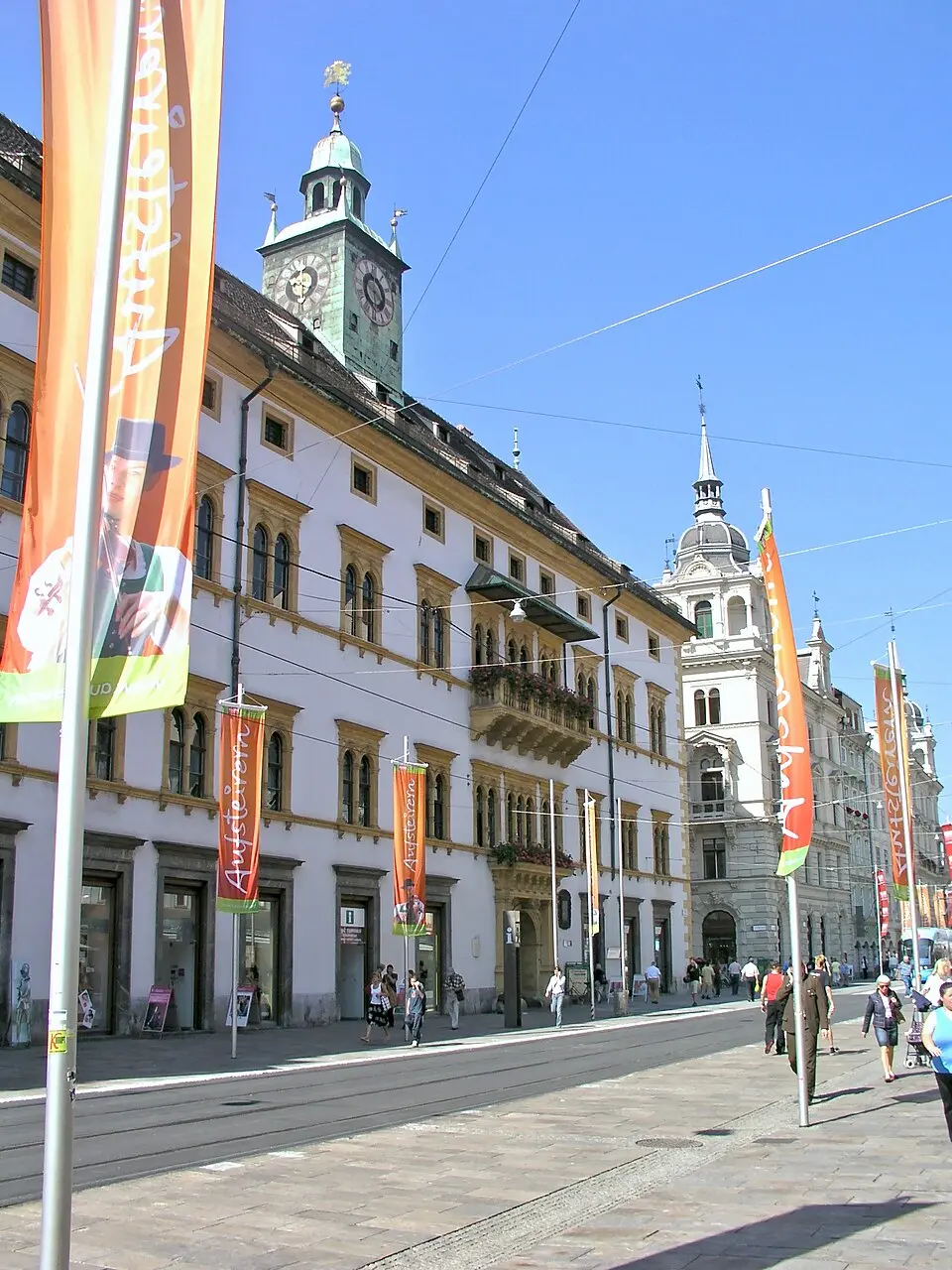
The Landhaus in Graz, on Herrengasse, is one of the most important Renaissance buildings in Central Europe and historically served as the seat of the Styrian provincial estates. The history of the complex goes back to 1494, when the estates acquired a townhouse that was later expanded and added to several times until it became a large ensemble. The Knights' Hall wing (Rittersaaltrakt) was built between 1527 and 1531 to plans by the master-builder brothers Walch, while the magnificent main wing was constructed starting in 1557 from designs by the Italian architect Domenico dell'Allio. This part of the complex impresses with its elaborate round-arched windows, framed by pinched baluster columns, and with an airy, three-story arcaded courtyard. Despite the different building phases and architectural styles, the building retains a remarkable unity, because the later additions were carefully integrated into the existing structure.
Today you can explore the imposing courtyards, which are characterized by Tuscan pilasters and groin vaults. The large Landhaus courtyard is dominated by a figural fountain from 1590, whose bronze basin ranks among the outstanding works of Mannerism outside Italy. The Knights' Hall on the second floor (the first floor in European usage) features Baroque stucco work and reliefs created in the 18th century, while the so-called Stone Hall houses a historic fireplace. The Landhaus chapel in the northwest corner of the arcaded courtyard is another architectural highlight, with a rectangular floor plan and an altar dating from the Counter-Reformation.
The Baroque Landstube, designed around 1740, now serves as the meeting hall of the Styrian Provincial Parliament. The room is richly decorated with stucco ceilings alluding to historic wars, and it contains allegorical paintings as well as gilded tiled stoves. Besides its political function, the Landhaus is also a cultural gathering place, as events are held regularly in the arcaded courtyard. A special attraction is the copper-plate Rumortafel (noise board) next to the entrance, which since 1588 has banned banging and shouting during sessions of the provincial parliament, offering a humorous glimpse into the city's parliamentary history.
At a glance
- Category
- Sight › Historic sites
- Rating
- no reviews yet · write a review
- Address
- Herrengasse 16
8010 Graz, Austria - District
- Innere Stadt
- Phone
- +433168776309
- Website
- www.museum-joanneum.at
- zeughaus@museum-joanneum.at
- Coordinates
- 47.07008° N · 15.43938° E
- Data quality
- confidence 0.98
- Identifier
- ID eb8fe331-bfe…
Part of the tour
Graz in One Day: Old Town, Schlossberg, and Eggenberg Palace →Location & surroundings
Toggle layersRatings & comments
none yetNear Grazer Landhaus
closest 5 per category · 2 kmRestaurants
Museums
Hotels
More:Historic sites in Graz (78)Sights in Innere Stadt (36)All sights in Graz (96)
223 places within 2 km loaded.
You need a free account to leave reviews and photos – that keeps comments genuine and lets you edit them later.