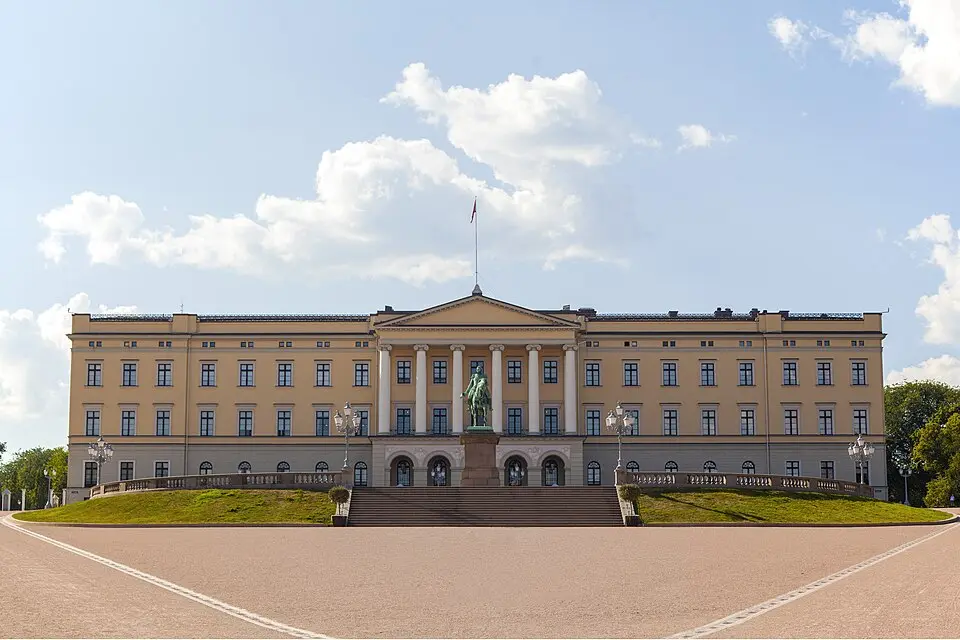
About The Royal Palace
The Royal Palace in Oslo, known in Norwegian as Det kongelige slott, is the central residence of the Norwegian royal family and an important symbol of the state. Built in the neoclassical style, the building stands at the end of Karl Johans gate and is surrounded by an expansive park. It serves not only as the monarchy's home but also houses the royal household's administration and acts as an important guesthouse for visiting foreign heads of state. The architecture consists of a three-winged complex of plastered brick. The three-story main wing is articulated by projecting bays, with the central bay standing out thanks to a striking colonnaded front. The two two-story side wings frame the ensemble. With a total of 173 rooms, the palace is one of the smaller royal residences in Europe, yet it is fully in use from the basement to the roof.
The history of the building begins during the union between Sweden and Norway. King Charles III John, who had previously resided in Stockholm, needed a suitable residence in the Norwegian capital Christiania, today's Oslo. After the Paléet, which had been used until then, was deemed inadequate, Parliament decided in 1822 to build a new palace. The Danish architect Hans Linstow was commissioned to design it, and his original plan called for an H-shaped building. The foundation stone was laid in 1825, but construction was marked by financial difficulties and political disputes. Because Norway had too few skilled craftsmen, specialists had to be brought in from abroad. When Parliament initially halted funding, Linstow drastically simplified the plans to cut costs, which led to the elimination of the colonnaded front and a reduction of the wings. Only after an interruption of several years and further funding could construction continue, and the main building was raised by one story.
The interior was designed after the architect had made an extensive study trip through Europe's major cities. The result was a mixture of different styles, including a neo-rococo-style design for the White Salon and influences from Karl Friedrich Schinkel in the ballroom. The furniture for the state rooms was made in Stockholm and Berlin, while simpler pieces were produced domestically. The palace opened in 1849 with a grand ball. In the following decades the building was expanded to meet the growing needs of the royal family, which also led to the monumental colonnaded front being added later. After the dissolution of the union with Sweden in 1905 and the election of Haakon VII as king, the palace became the permanent royal residence. Extensive modernization in 1906 and 1907 created a shared family apartment and installed central heating and modern plumbing.
During World War II, the palace served as headquarters of the German occupying forces, which caused considerable damage and neglect. After the liberation and the accession of Olav V in the 1950s, a new phase of restoration began, focusing on restoring the historical decorations rather than redesigning the rooms in a contemporary style. Under King Harald V, another comprehensive renovation was carried out in the 1990s to replace outdated technical systems. Today the royal couple lives in a modern apartment with a conservatory on the third floor of the south main wing. The most important official rooms, such as the Great Ballroom, the Mirror Salon, and the Great Dining Room, are available for state occasions. The Council of State meets on the ground floor, and the palace chapel is in the north side wing.
You can visit the palace during the summer months, from June to August, on guided tours. The surrounding palace park, an English landscape garden with ponds and diverse vegetation, contains several monuments, including statues of the mathematician Niels Henrik Abel and the writer Camilla Collett. In front of the palace lies a large square, divided into two areas by an equestrian statue of Charles John. A particular highlight for culture lovers is the Queen Sonja Art Stable, housed in the restored stable buildings. It hosts changing exhibitions of artworks and everyday objects from the royal collections, including historic costumes and vehicles. The palace is thus not only a living seat of the monarchy but also an important part of Norway's national heritage.
At a glance
- Category
- Sight › Palaces
- Rating
- no reviews yet · write a review
- Address
- Slottsplassen 1
0010 Oslo, Norway - District
- Sentrum
- Phone
- +4722048700
- Website
- www.kongehuset.no
- nina.hoye@slottet.no
- Coordinates
- 59.91708° N · 10.72757° E
- Data quality
- confidence 0.86
- Identifier
- ID 9dc02f58-363…
Part of the tour
Oslo in a Day: Palace, Fortress, and Fjord Waterfront →Location & surroundings
Toggle layersFAQ about The Royal Palace
quick answersWhat is the Royal Palace in Oslo?
The Royal Palace (Det kongelige slott) in Oslo is the central residence of the Norwegian royal family and an important symbol of Norway's state representation. It is located at Slottsplassen 1 in the Sentrum district at the end of Karl Johans gate and is surrounded by an expansive palace park. In addition to serving as the monarchy's home, the palace houses the administration of the royal household and acts as a guest residence for foreign state visits.
When was the Royal Palace in Oslo built?
The Royal Palace in Oslo was built between 1825 and 1849 and opened in 1849 with a grand ball. Parliament approved the new building in 1822 for King Charles III John, because the Paléet in Christiania, today's Oslo, which had been used until then, was considered inadequate. The design came from the Danish architect Hans Linstow, who had to simplify the plans considerably at times because of financial difficulties. After the dissolution of the union with Sweden in 1905, the palace became the permanent residence under King Haakon VII and was modernized in 1906–1907.
How is the Royal Palace in Oslo built, and how big is it?
The Royal Palace in Oslo is a neoclassical three-wing complex of plastered brick with a total of 173 rooms. The three-story main wing is articulated by projecting bays, with the central bay standing out thanks to a striking colonnaded façade; two two-story side wings frame the ensemble. Inside, different styles mix, such as a neo-Rococo-style White Salon and a ballroom influenced by Karl Friedrich Schinkel. Although it counts among Europe's smaller royal residences, the palace is in full use from the basement to the roof.
What can you see around the Royal Palace in Oslo?
Around the Royal Palace in Oslo, several museums, monuments, and historic sites are within walking distance. travelguide195 lists, among others, De Kongelige Samlinger at about 60 meters, the Karl Johan monument at about 87 meters, and the IBSEN Museum & Theatre at about 222 meters away. A bit farther are the Queen Sonja Art Stable art museum (about 271 meters), Victoria Terrasse (about 315 meters), and the Haakon VII statue (about 338 meters).
Are there restaurants and tours around the Royal Palace in Oslo?
Yes, you'll find numerous restaurants near the Royal Palace in Oslo, and the palace is part of a tour. travelguide195 lists about 69 restaurants within 500 meters of the palace in the Sentrum district. If you'd like to combine the palace with other destinations, the tour "Oslo Compact: Palace, Fortress, and Fjord Shore in One Day" includes this site.
Ratings & comments
none yetNear The Royal Palace
closest 5 per category · 2 kmSights
Restaurants
Museums
Hotels
More:Sights in Sentrum (35)All sights in Oslo (394)
269 places within 2 km loaded.

You need a free account to leave reviews and photos – that keeps comments genuine and lets you edit them later.
The Palace is the residence and offices of the king, Norway's head of state. Council of State meetings are held there every Friday. When new members of cabinet have been appointed by the king they appear in the front of the palace for photo sessions and interivews. Building of the Palace began in 1824 and completed in 1849. The Palace sits within an elegant park on a small mount at the end of Oslo main street, Karl Johans gate, named after the Swedish/Norwegian king at the time. It was built just outside the city in neoclassical style, after Oslo's rapid expansion the palace is now surrounded by the city centre. Tours inside the palace are arranged in summertime, starting in June 21. Tickets for the tour must be bought in advance from a post office. If there are vacant spots in a tour, they sell the remaining tickets at the Palace to people waiting in line who don't already have tickets. Don't count on getting tickets on the spot unless you are quite ahead in the line since a lot of people buy them at the post offices. There are about 2 tours in English on weekdays. The palace is guarded by the Royal Guards, an infantry battalion of the Norwegian army easily recognized when in their fine uniforms.
Source: Wikivoyage, „Nordic monarchies“ · authors per page history · CC BY-SA 4.0