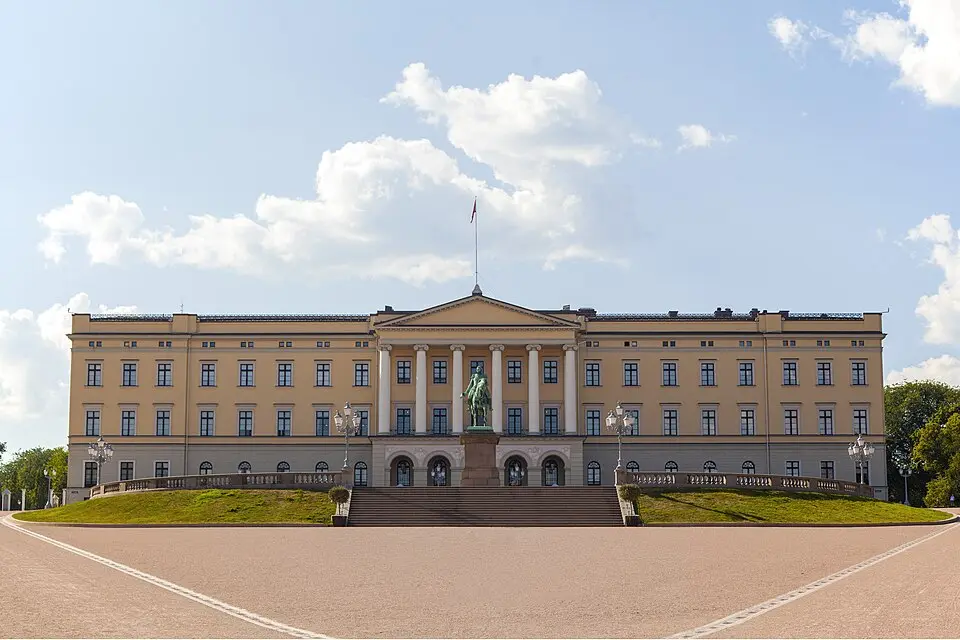
About Det Kongelige Slott
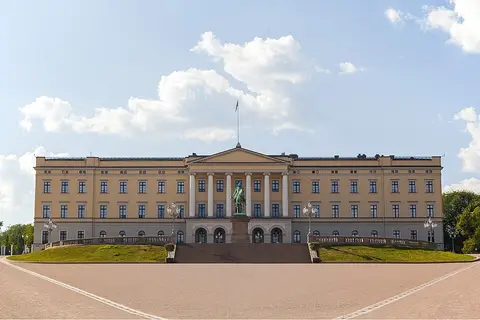
The Royal Palace in Oslo, known as Det Kongelige Slott, is the main residence of the Norwegian monarch and a central symbol of the state. The imposing building stands at the end of Karl Johans gate and is surrounded by extensive palace grounds. It serves not only as the home of the royal family but also houses the administration of the monarchy and acts as the principal guesthouse for visiting heads of state. The architecture follows the Neoclassical style and consists of a three-winged complex of plastered brick. The three-story main wing is articulated by three projecting central bays, with the middle one standing out for its striking columned front. Despite its grand size, the palace, with its 173 rooms, is considered one of the smaller royal residences in Europe.
The building's history is closely tied to Norway's constitutional and union history. After the founding of the joint kingdom with Sweden in 1814, the monarch needed a permanent residence in the capital, Christiania, today's Oslo. In 1823, King Charles III John commissioned the architect Hans Linstow to draw up the design. The foundation stone was laid in 1825, but construction dragged on because of a lack of funds and political resistance in parliament. Linstow had to revise his plans several times and cut costs, which led to a simplified facade. Only after King Oscar I took the throne in 1844 were funds made available to upgrade the architecture, allowing the monumental columned front to be built and the side wings to be extended. The fully furnished palace was formally opened on July 26, 1849, with a grand ball.
Inside, the palace reflects the changing needs of royal living. Separate apartments for the king and queen were originally planned and were later merged into a shared family residence. The interior, completed between 1839 and 1848, is characterized by a mix of different styles. The ballroom was designed under the influence of Karl Friedrich Schinkel, while the White Drawing Room is the first Neo-Rococo interior in Norway. Today the main floors house the state rooms, including the Great Ballroom, the Great Dining Room, and the Mirror Room. The Council of State meets on the ground floor, and the palace chapel is located in the north wing. Modern living quarters for the royal couple and guest suites are on the second floor, while the basement is used for logistics and the kitchen.
The palace's surroundings are just as significant as the building itself. The adjoining park was laid out beginning in 1840 as an English landscape garden with ponds and varied vegetation. It is home to monuments honoring notable figures such as the mathematician Niels Henrik Abel and the writer Camilla Collett, both created by Gustav Vigeland. The palace square in front of the building is divided into two levels by an equestrian statue of Charles John. A particular highlight for visitors is the Queen Sonja Art Stable, housed since 2017 in the restored stable buildings. It hosts changing exhibitions of artworks and everyday objects from the royal collections, including historic crowns and vehicles. Since 2000, guided tours of the palace have been offered during the summer months, providing insight into the living use of this historic residence.
At a glance
- Category
- Sight › Historic sites
- Rating
- no reviews yet · write a review
- Address
- Slottsplassen 1
0010 Oslo, Norway - District
- Sentrum
- Phone
- +4722048700
- Website
- www.kongehuset.no
- post@slottet.no
- Coordinates
- 59.91710° N · 10.72791° E
- Data quality
- confidence 1.00
- Identifier
- ID 91884bad-634…
Part of the tour
Oslo on Foot: From Castle Hill to the Harbor →Location & surroundings
Toggle layersRatings & comments
none yetNear Det Kongelige Slott
closest 5 per category · 2 kmSights
Restaurants
Museums
Hotels
More:Historic sites in Oslo (377)Sights in Sentrum (35)All sights in Oslo (394)
269 places within 2 km loaded.

You need a free account to leave reviews and photos – that keeps comments genuine and lets you edit them later.
The Palace is the residence and offices of the king, Norway's head of state. Council of State meetings are held there every Friday. When new members of cabinet have been appointed by the king they appear in the front of the palace for photo sessions and interivews. Building of the Palace began in 1824 and completed in 1849. The Palace sits within an elegant park on a small mount at the end of Oslo main street, Karl Johans gate, named after the Swedish/Norwegian king at the time. It was built just outside the city in neoclassical style, after Oslo's rapid expansion the palace is now surrounded by the city centre. Tours inside the palace are arranged in summertime, starting in June 21. Tickets for the tour must be bought in advance from a post office. If there are vacant spots in a tour, they sell the remaining tickets at the Palace to people waiting in line who don't already have tickets. Don't count on getting tickets on the spot unless you are quite ahead in the line since a lot of people buy them at the post offices. There are about 2 tours in English on weekdays. The palace is guarded by the Royal Guards, an infantry battalion of the Norwegian army easily recognized when in their fine uniforms.
Source: Wikivoyage, „Nordic monarchies“ · authors per page history · CC BY-SA 4.0