About Oslo Royal Palace
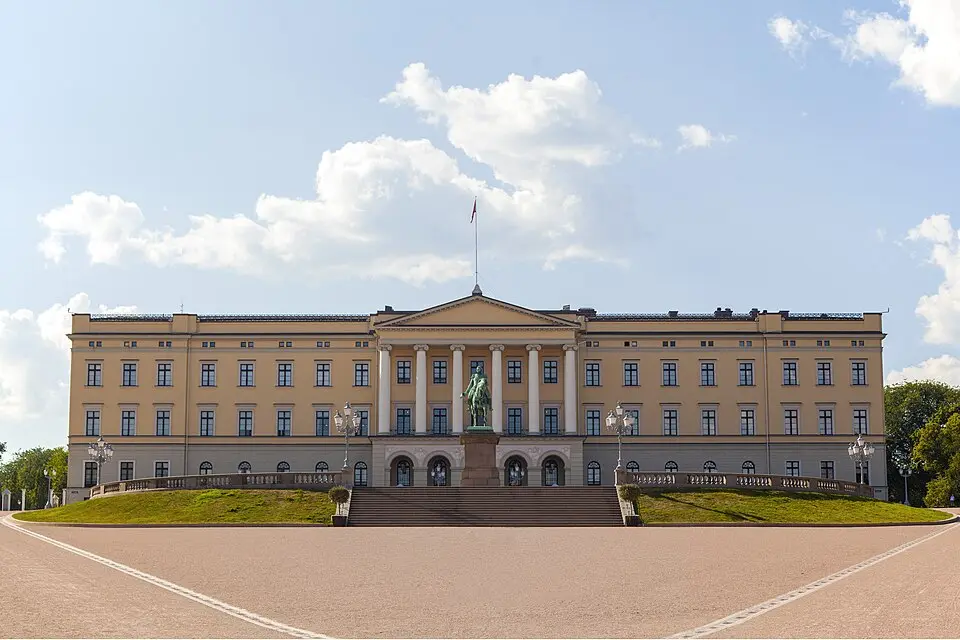
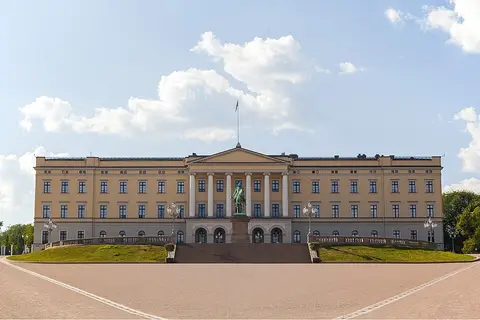
The Royal Palace in Oslo, known in Norwegian as Det kongelige slott, is the official main residence of the Norwegian king. The imposing building stands at the end of Karl Johans gate and is surrounded by an expansive 22-hectare (54-acre) palace park. It serves not only as the home of the royal family but also as a central venue for state representation, the administration of the monarchy, and a hospitable house for high-ranking visitors from Norway and abroad. Architecturally, the palace is a three-winged complex of plastered brick in the neoclassical style. The three-story main wing is divided by three projecting bays, with the central one standing out in particular thanks to a striking colonnaded front. With a total of 173 rooms, the residence is one of the smaller royal palaces in Europe, yet it is put to practical use all the way down to the lower levels and up into the attic.
The history of the building is closely tied to the founding of the Norwegian state. After the union with Sweden in 1814, the king needed a permanent residence in what was then the capital, Christiania, today's Oslo. In 1823, King Charles III John commissioned the architect Hans Linstow to draw up the design, and the foundation stone was laid in 1825. Construction proved sluggish, however, as Parliament initially refused to approve the necessary funds, leading to an interruption lasting several years. To save money, the original plans were simplified, though the main building was raised by one story. After work resumed in 1836, the building was roofed and weatherproofed that same year. The interior furnishings, completed between 1839 and 1848, were strongly influenced by European styles, including the neo-Rococo of the White Salon and elements reminiscent of Schinkel's work in Berlin. In 1849, the palace was ceremonially opened with a grand ball.
Over time, the palace had to be adapted to the changing needs of the royal family. After the dissolution of the union with Sweden in 1905 and the election of Prince Carl as King Haakon VII, the residence became permanently inhabited. In the years that followed, it was modernized, including the creation of a shared family apartment and the installation of modern heating and plumbing. During the Second World War, the palace served as headquarters during the German occupation, which resulted in considerable damage and neglect. After liberation and the accession of Olav V in the 1950s, a new era of restoration began, with a deliberate focus on restoring the historic decorations rather than redesigning the rooms in a contemporary style.
Under King Harald V, a comprehensive overhaul was carried out in the 1990s to replace the outdated technical systems. A modern apartment with a conservatory was created for the royal couple on the second floor of the southern main wing, and they moved in in 2001. The state rooms on the main floor now house important official halls such as the Great Ballroom, the Great Dining Room, and the Mirror Salon. The Council of State meets on the ground floor, while the palace chapel is located in the northern side wing. The basement is used for supply and administration. This functional layout makes the palace a living example of the modern use of historic building fabric.
Visitors can tour the Royal Palace during the summer months, from June to August, on guided tours. A particular highlight is the Queen Sonja Art Stable, housed since 2017 in the restored stable buildings. It hosts changing exhibitions of artworks and everyday objects from the royal collections, including historic clothing and vehicles. The surrounding park, an English landscape garden with ponds and diverse vegetation, invites you to stroll. Statues of well-known figures such as Niels Henrik Abel and Camilla Collett adorn the grounds. The palace square in front of the building, structured by an equestrian statue of Charles John, forms the urban setting of this historic site.
At a glance
- Category
- Sight › Historic sites
- Rating
- no reviews yet · write a review
- Address
- Slottsplassen 1
0010 Oslo, Norway - District
- Sentrum
- Phone
- +4748204107
- Website
- www.royalcourt.no
- post@slottet.no
- Coordinates
- 59.91681° N · 10.72885° E
- Data quality
- confidence 0.79
- Identifier
- ID aef4bf57-884…
Location & surroundings
Toggle layersRatings & comments
none yetNear Oslo Royal Palace
closest 5 per category · 2 kmSights
Restaurants
Museums
Hotels
More:Historic sites in Oslo (377)Sights in Sentrum (35)All sights in Oslo (394)
270 places within 2 km loaded.

You need a free account to leave reviews and photos – that keeps comments genuine and lets you edit them later.
The Palace is the residence and offices of the king, Norway's head of state. Council of State meetings are held there every Friday. When new members of cabinet have been appointed by the king they appear in the front of the palace for photo sessions and interivews. Building of the Palace began in 1824 and completed in 1849. The Palace sits within an elegant park on a small mount at the end of Oslo main street, Karl Johans gate, named after the Swedish/Norwegian king at the time. It was built just outside the city in neoclassical style, after Oslo's rapid expansion the palace is now surrounded by the city centre. Tours inside the palace are arranged in summertime, starting in June 21. Tickets for the tour must be bought in advance from a post office. If there are vacant spots in a tour, they sell the remaining tickets at the Palace to people waiting in line who don't already have tickets. Don't count on getting tickets on the spot unless you are quite ahead in the line since a lot of people buy them at the post offices. There are about 2 tours in English on weekdays. The palace is guarded by the Royal Guards, an infantry battalion of the Norwegian army easily recognized when in their fine uniforms.
Source: Wikivoyage, „Nordic monarchies“ · authors per page history · CC BY-SA 4.0