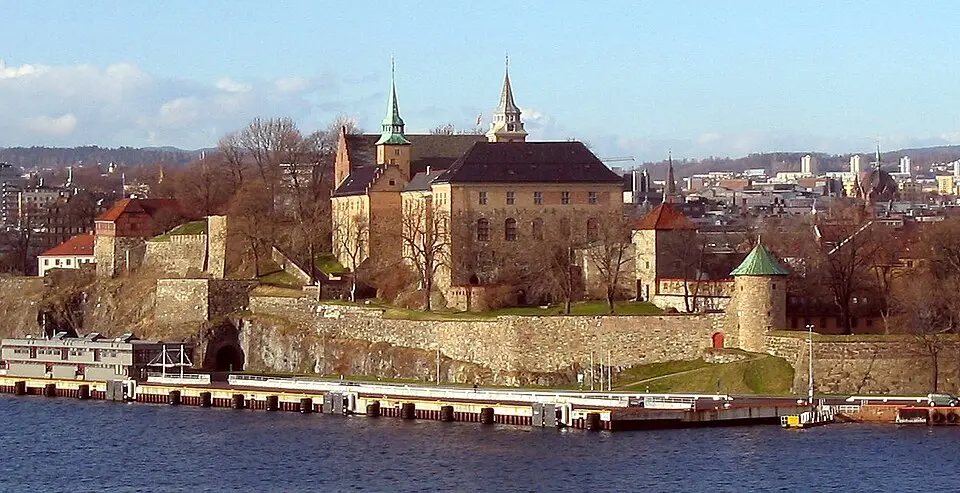
About Akershus festning
Akershus Fortress is one of the most significant historic sites in Norway and sits in the heart of the capital, Oslo. It towers over the Akersneset peninsula right on the shore of the Oslofjord and has shaped the city's skyline for centuries. A striking landmark, the fortress is visible from far away and draws visitors from around the world. The complex has lived through a turbulent history: it was besieged nine times and spent a period under German occupation. It was also known as a feared national prison. Today the magnificent castle building serves the Norwegian government for official functions, while the outer fortress grounds, the Hovedtangen, continue to fulfill military functions and also serve as a park and recreation area for the public.
The exact origins of the castle are not documented, but historians believe it was built between 1287 and 1300. It is possible that a fortification already existed at this strategically important spot. Construction is attributed to King Håkon V, who may have had the castle built after a jarl plundered Oslo in 1287. The first documentary mentions date from 1300, when the castle was already being used to store important documents. This suggests that the complex was already manned and operational by that time. Whether the castle was built in full over a short period or expanded gradually over many years remains unclear.
The medieval castle made clever use of the natural features of the rocky terrain. To the south and west, the curtain wall bordered a steep rock edge that dropped straight into the Oslofjord, providing natural protection. To the north and east the ground rose, which is why tall walls were built here. The core of the defenses was the mighty keep, Vågehalstårnet, along with various wing structures. The main entrance was through the Jomfrutårn, a gate tower with a drawbridge. A special feature of the defensive architecture was the angled passageway known as Mørkegang, which ran partly underground. This bend made it impossible for attackers to maneuver heavy siege equipment such as battering rams around the corner. Above this passage ran a second, hidden passage, the Lønngang, which allowed the guards to communicate and keep watch quickly.
Over the centuries, Akershus was the scene of numerous conflicts. In the 14th and 15th centuries the castle withstood several sieges, including an attack by the Swedish Duke Erik Magnusson in 1308. The fortress served not only as a military base but also as a royal residence. King Håkon V moved his seat of government to Oslo, so Akershus replaced Bergenhus Fortress as the royal seat. Later kings such as Håkon VI had the castle expanded further and furnished royal chambers. The complex was often the target of disputes over the throne and noble uprisings, which led to fierce fighting for control of the castle.
With advances in weapons technology in the 16th century, the medieval walls were no longer sufficient to protect the fortress effectively. Under commanders such as Peder Hansen Litle and Christen Munk, extensive alterations were carried out. Towers were raised, new gun emplacements were built, and the entrances were adapted. The castle church was established, and makeshift defensive works were put in place to counter the new threat of artillery. This phase marked the transition from a medieval castle to an early modern fortress.
In the 17th century, Akershus saw its greatest expansion. King Christian IV commissioned Dutch engineers such as Hans van Steenwinkel, who adapted the Italian bastion system to local conditions. Large earthen ramparts, bastions, and curtain walls were built to harden the fortress against modern siege techniques. At the same time, the castle was converted into a splendid Renaissance-style palace. Royal halls with gilded leather wall coverings and marble fireplaces were created, and the complex served as a ceremonial residence. The new town of Christiania, present-day Oslo, was founded near the fortress so that it could be defended more easily and would offer the enemy no cover.
The fortress also survived the siege by the Swedish King Charles XII in 1716. Despite the powerful Swedish army, which took the surrounding town, the fortress held out. The defenders used the strong walls and artillery to repel the attackers. The siege ended with the Swedes' withdrawal after a Danish fleet cut the attackers' supply lines. This episode cemented the fortress's reputation as impregnable.
In the 18th century the castle building fell into steady decay, while the outer fortress area continued to be expanded. The castle served at times as a grain store and military depot, which caused considerable damage. Not until the 1730s did extensive renovation work begin to restore and preserve the building. Parts of the old structures were torn down, others were renovated, and new functions such as the Supreme Court were installed. The fortress reached its greatest extent during this period before gradually losing its military significance.
Today Akershus Fortress is a popular destination for tourists and locals alike. You can tour the historic buildings and learn more about Norway's military history in the museums, the Norwegian Resistance Museum (Norges Hjemmefrontmuseum) and the Armed Forces Museum (Forsvarsmuseet). The Resistance Museum is devoted to the World War II era, while the Armed Forces Museum documents the development of military equipment and strategy. The Royal Mausoleum holds the burial place of Norway's kings of modern times, which lends the site additional historical and cultural value.
The outer grounds of the fortress, the Hovedtangen, offer a pleasing contrast to the historic splendor of the castle. There are broad stretches of lawn here, enjoyed by walkers and families. The site is a place of calm and relaxation in the middle of the lively capital. The combination of historical significance, architectural beauty, and natural surroundings makes Akershus Fortress an unforgettable experience for every visitor. It is a place where Norway's history comes alive and transports you back to centuries past.
At a glance
- Category
- Sight › Historic sites
- Rating
- no reviews yet · write a review
- Address
- Myntgata 2
0151 Oslo, Norway - District
- Sentrum
- Phone
- +4723093917
- Website
- www.forsvarshistoriskmuseum.no
- akershusfesting@mil.no
- Coordinates
- 59.90744° N · 10.73761° E
- Data quality
- confidence 0.99
- Identifier
- ID c39c2da2-fa9…
Part of the tour
Oslo in a Day: Palace, Fortress, and Fjord Waterfront →Location & surroundings
Toggle layersFAQ about Akershus festning
quick answersWhat is Akershus Fortress in Oslo?
Akershus Fortress (Akershus festning) is a medieval castle and fortress complex in Oslo's Sentrum district and one of the most important historic sites in Norway. It sits on the Akersneset peninsula right on the Oslofjord, at Myntgata 2. Today the Norwegian government uses the castle building for official functions, while the outer fortress grounds, the Hovedtangen, continue to serve military purposes and also function as a park and recreation area.
When was Akershus Fortress built?
The exact year Akershus Fortress in Oslo was built is not known; historians believe it was constructed between 1287 and 1300. Construction is attributed to King Håkon V, who may have had the castle built after a nobleman plundered Oslo in 1287. The castle is first mentioned in written records in 1300, when it was already being used to store important documents.
What is the history of Akershus Fortress?
Over the course of its history, Akershus Fortress in Oslo was besieged nine times, served as a royal residence, and spent a period under German occupation. In 1308 it withstood an attack by the Swedish Duke Erik Magnusson. After King Håkon V moved his seat of government to Oslo, Akershus replaced Bergenhus Fortress as the royal seat. Later, the complex was also known as a dreaded state prison.
Which parts of the medieval Akershus Fortress are noteworthy?
Among the most striking features of Akershus Fortress in Oslo are the castle tower Vågehalstårnet, the gate tower Jomfrutårn, and the passages Mørkegang and Lønngang. The Jomfrutårn, with its drawbridge, was the main entrance to the castle. The angled, partly underground Mørkegang prevented attackers from maneuvering battering rams around the corner, and the hidden Lønngang for the guards ran above it.
What can you see around Akershus Fortress in Oslo?
Around Akershus Fortress in Oslo, several museums are within a short distance. travelguide195 lists, among others, the Norwegian Resistance Museum (Norges Hjemmefrontmuseum) at about 120 meters, The National Museum at about 209 meters, the Norwegian Museum of Architecture (Norsk Arkitekturmuseum) at about 282 meters, and the Armed Forces Museum (Forsvarsmuseet) at about 377 meters. travelguide195 also lists around 41 restaurants within 500 meters, and the fortress is part of the tour "Oslo Compact: Castle, Fortress and Fjord Shore in One Day."
Ratings & comments
none yetNear Akershus festning
closest 5 per category · 2 kmSights
Restaurants
Museums
Hotels
More:Historic sites in Oslo (377)Sights in Sentrum (35)All sights in Oslo (394)
267 places within 2 km loaded.

You need a free account to leave reviews and photos – that keeps comments genuine and lets you edit them later.
A medieval castle that served as the principal Norwegian residence of the king during the years of union with Denmark. In the absence of the king (who was primarily based in Denmark), it served as the residence of the Steward of Norway. After the original city of Oslo was destroyed in a fire, it was rebuilt in a new location adjacent to the castle and named Christiania after King Christian IV of Denmark. The name of the city was reverted to Oslo following Norwegian independence.
Source: Wikivoyage, „Danish Empire“ · authors per page history · CC BY-SA 4.0