
Discover Okayama: Kōrakuen, Crow Castle, and Momotarō
Travel guide · editorialIn front of the train station, a boy with a dog, a monkey, and a pheasant waits for arriving travelers: Momotarō, the Peach Boy from Japan's best-known fairy tale, is Okayama's mascot. This sunny city on the Seto Inland Sea has one of Japan's three great gardens, a black castle, and a location that makes it an ideal starting point for trips to Kurashiki, Naoshima, or Shikoku. A visit to Okayama is short, but surprisingly varied.
Castle Town of the Ikeda
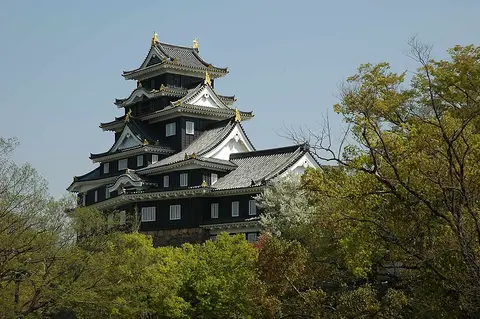
In the late 16th century, the warlord Ukita Hideie had Okayama Castle built. The Ikeda family later took over, ruling until the end of the Edo period and turning the city into a center of learning and culture: the Shizutani School, one of Japan's first schools for commoners, was founded here. The castle burned down in World War II; its main keep was reconstructed in concrete in 1966. The region around Okayama, the ancient Kibi, was already a powerful realm in early history, as burial mounds and shrines attest. Many locals also place the legend of Momotarō, who defeated demons on an island, here.
Things to See in Okayama
Kōrakuen, completed around 1700 under Ikeda Tsunamasa, is one of Japan's three great gardens. Wide lawns, ponds, teahouses, a small hill as a viewpoint, and even rice and tea fields make it a strolling garden with views of the castle. The castle stands on the other side of the Asahi River and is nicknamed "Crow Castle" for its black wooden cladding. Inside, an exhibition tells the history of the Ikeda, and in summer the castle glows during evening light shows. If you have more time, you can cycle the Kibiji Cycling Route through rice fields to ancient shrines such as Kibitsu Shrine with its long covered corridor.
Museums and Culture
The museums are concentrated around Kōrakuen and the castle. The Hayashibara Museum of Art displays the collection of the Ikeda princely family, with armor, swords, and Noh costumes. The Orient Museum is devoted to the ancient Near East, and the Yumeji Art Museum honors Takehisa Yumeji, a painter born in Okayama and famous for his melancholy portraits of women. The Okayama Prefectural Museum of Art shows works by the ink painter Sesshū, who grew up in the region. In February, the Saidaiji Eyō, a naked festival at Saidai-ji Temple in Higashi Ward, draws thousands of men in loincloths who scramble for sacred wooden sticks.
Eating in Okayama: Fruit and Barazushi
Thanks to its sunny climate, Okayama is known as the "fruit kingdom." White peaches and muscat grapes are grown here at a quality that makes them sought-after gifts; in summer, cafés serve elaborate parfaits. For something heartier, try barazushi, a colorful rice dish with seafood and vegetables eaten at festivals, and demi-katsudon, a cutlet on rice with demi-glace sauce instead of egg. For souvenirs, there's kibidango, small, soft rice dumplings, exactly the kind Momotarō used to win over his animal companions. You'll find good restaurants and small bars around the station and the Omotechō shopping street.
Nightlife and City Life
In the evening, life centers on the alleys southeast of the station and around Omotechō, where izakaya, wine bars, and restaurants serving fish from the Seto Inland Sea are packed close together. Many menus feature local sake and craft beer from nearby breweries. The Nishigawa Canal in the middle of downtown, with its green spaces, is a popular spot for an evening walk under cherry and willow trees. In August, the city celebrates the Momotarō Festival with dances and fireworks.
Getting Around Okayama and Day Trips
Okayama sits on the Sanyō Shinkansen line: Osaka is about 45 minutes away, Hiroshima about 40 minutes. Trains cross the Seto-Ōhashi Bridge to Shikoku. From Okayama Airport, the city center is about half an hour by bus. The streetcar takes visitors from the station to Kōrakuen and the castle. The old town of Kurashiki, with its white storehouses along the canal, is only about 15 minutes away by train, and the art island of Naoshima can be reached via the port of Uno. The best times to visit are spring and fall; in summer, the peaches are a draw, and the region is considered one of the driest in Japan.