About Okayama Castle
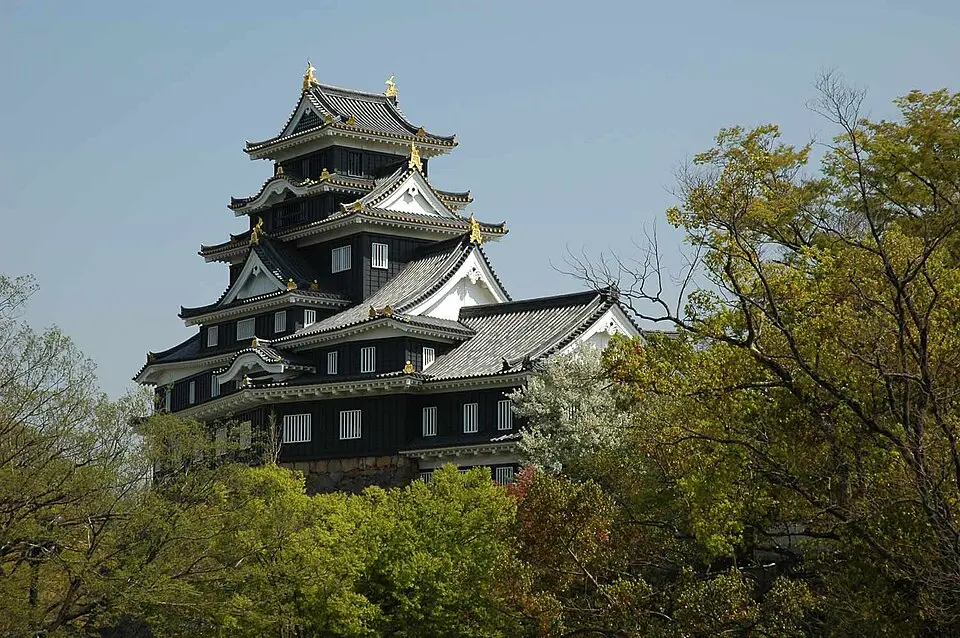
Okayama Castle sits in the city of the same name in Okayama Prefecture and is one of the best-known historic sites in Japan. Because of its distinctive black exterior, it goes by the poetic nickname "Crow Castle" or "Raven Castle." The complex is an impressive example of Japanese castle architecture and spreads across a hill that gives way to the plain of the Asahi River. This setting gave the fortress strategic importance, since it began on elevated ground and grew out into the surrounding riverscape. For visitors, the castle offers a fascinating glimpse into the history of the samurai era and the complex architecture of medieval Japanese defensive works.
The castle's history goes back to the era of civil war, when the warlord Ukita Naoie built a predecessor on Ishiyama Hill. His son, Ukita Hideie, expanded the complex on the neighboring Okayama Hill on the orders of Toyotomi Hideyoshi. The main keep was completed around 1597. The political situation changed dramatically after the Battle of Sekigahara, however, in which Hideie was on the losing side. After his defeat and exile, the domain passed to Kobayakawa Hideaki, who greatly expanded the castle and added a large outer moat. Soon afterward, the Ikeda family, closely tied to the Tokugawa through family bonds, took over the domain. The Ikeda ruled the castle until the end of the Edo period in 1871 and left a lasting mark on the city's development.
The castle's architecture follows the hirayama type, which transforms an entire hill into a fortification. The complex is intricately laid out and divided into several areas, including the innermost Honmaru, the middle Ni-no-maru, and the outer San-no-maru. These areas are arranged in tiers and separated from one another by moats and ramparts. The Honmaru, the central and highest area, is still clearly visible today and is surrounded by an inner moat. This is where the most important buildings stood, including the castle keep and administrative buildings. Access to the different levels was guarded by gates and steep staircases that made it harder for attackers to advance.
The castle keep, known as the tenshu, is the landmark of the complex. The current building was reconstructed in 1966 after the original tower was destroyed by bombing in World War II. The tower has six floors, which from the outside appear as five roof levels. It is clad in black-lacquered wooden boards, which give it its striking look. Gilded roof tiles were found during excavations, pointing to the high status of the castle's lord under Toyotomi Hideyoshi. For this reason, the castle is sometimes also called the "Golden Crow Castle." The reconstruction restored these gilded elements in prominent spots to honor the historic splendor.
Besides the keep, you can still see remains of the original fortifications. Almost all of the stone-faced ramparts of the inner area have survived, as has the inner moat. Some watchtowers and gates have also been reconstructed, while others are visible only as foundations. The Tsukimi Turret, a unique survivor from the Edo period, guards the northern part of the Honmaru. The stone foundations of the keep are laid out in the park-like inner grounds and give an impression of the complex's original size. You can explore the well-preserved ramparts and moats along paths and experience the historic atmosphere.
Farther out around the castle, you'll find more remnants of the former complex. In the Ni-no-maru area, you can still see stretches of wall and parts of watchtowers embedded in the modern city layout. One highlight is the reshaped Ishiyama Hill, which now appears as an elevated position with stone ramparts. On the other side of the river lies the famous Koraku-en strolling garden, which originally belonged to the castle grounds and is now regarded as a separate attraction. The combination of the historic castle and the adjoining garden gives visitors a rich experience of Japanese culture and history.
Today, Okayama Castle is an important site for preserving Japan's cultural heritage. Despite the destruction of World War II and the reconstruction of the main keep, the complex remains an impressive testament to the past. The careful preservation of the stone ramparts and moats makes it possible to trace the castle's original structure. For travelers, Okayama Castle is an essential stop for discovering the history of the region and the architectural masterpieces of the samurai era. The quiet atmosphere of the grounds invites you to take your time enjoying the historical significance of the place and to feel the connection between past and present.
At a glance
- Category
- Sight › Castles
- Rating
- no reviews yet · write a review
- Address
- 2 Chome-3-1 Marunouchi
700-0823 Okayama, Japan - Phone
- +81862252096
- Website
- okayama-kanko.net
- —
- Coordinates
- 34.66518° N · 133.93606° E
- Data quality
- confidence 0.93
- Identifier
- ID c17cfe40-386…
Location & surroundings
Toggle layersFAQ about Okayama Castle
quick answersWhat is Okayama Castle?
Okayama Castle is a historic Japanese castle complex in the city of Okayama, in Okayama Prefecture, and one of the best-known historic sites in Japan. It stands at 2 Chome-3-1 Marunouchi and is a hirayama castle, meaning a fortification that turns an entire hill into a stronghold and blends into the plain of the Asahigawa River. The castle is divided into the innermost area, the Honmaru, the middle Ni-no-maru, and the outer San-no-maru, which are separated by moats and ramparts. The Honmaru with its inner moat is still clearly visible today.
Why is Okayama Castle called the "Crow Castle"?
Okayama Castle is known as the "Crow Castle" or "Raven-Black Castle" because its main keep is clad in black lacquered wood. Excavations have also uncovered gilded roof tiles, which point to the high status of the castle's lord under Toyotomi Hideyoshi, which is why it is sometimes also called the "Golden Crow Castle." The present castle tower (tenshu), with six floors and five exterior roof levels, was reconstructed in 1966 after the original was destroyed by bombing in World War II.
How old is Okayama Castle and who built it?
The main keep of Okayama Castle was completed around 1597. A predecessor was built during the Warring States period by the warlord Ukita Naoie on Ishiyama Hill; his son Ukita Hideie expanded the complex on the neighboring Okayama Hill on the orders of Toyotomi Hideyoshi. After the Battle of Sekigahara, Kobayakawa Hideaki enlarged the castle and laid out a large outer moat. After that, the Ikeda family, allied with the Tokugawa, ruled the castle in Okayama until 1871.
What can you see around Okayama Castle?
Within about a kilometer of Okayama Castle you'll find several historic sites and an art museum. travelguide195 lists, among others, the castle's moon-viewing turret 岡山城月見櫓 (Tsukimi-Yagura) about 87 meters away, as well as the historic sites 廉池軒 (Renchiken, about 182 meters), 延養亭 (Enyōtei, about 315 meters), 慈眼堂 (Jigendō, about 352 meters), and 鶴鳴館 (Kakumeikan, about 353 meters). The Hayashibara Museum of Art is about 306 meters from Okayama Castle.
Are there restaurants near Okayama Castle?
Yes, you'll find a wide choice of restaurants near Okayama Castle. travelguide195 lists about 52 restaurants within 500 meters of the castle in the Marunouchi district of Okayama.
Ratings & comments
none yetNear Okayama Castle
closest 5 per category · 2 kmMuseums
More:All sights in Okayama (137)
189 places within 2 km loaded.

You need a free account to leave reviews and photos – that keeps comments genuine and lets you edit them later.
Popularly known as Crow Castle (烏城 U-jō), it is so named for its striking black color, rare among Japanese castles (which tend to be white, like neighboring Himeji Castle). Only a few protruding bits and the occasional lucky fish-gargoyle (金の鯱 kinnoshachihoko ) are gilded. With the exception of one external turret, the current version dates from 1966, but the outside is much more accurate than most Japanese castle replicas, as the original blueprints were used to rebuild it. In the tower is a museum documenting the castle's history, although English explanations are few and far between. On the first floor of the castle, you can also make your own Bizen pottery for an extra fee.
Source: Wikivoyage, „Okayama“ · authors per page history · CC BY-SA 4.0