About Propyläen
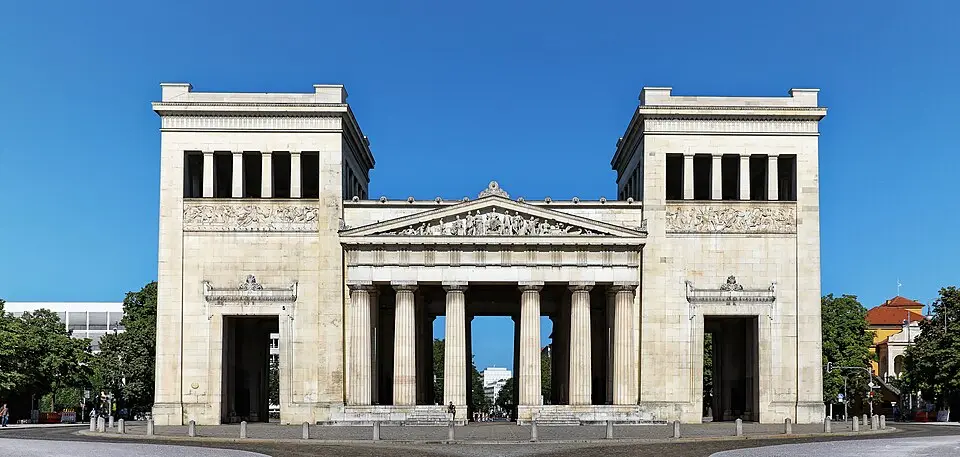
The Propylaea on Munich's Königsplatz are an outstanding example of Neoclassical architecture and serve as a dignified entrance to this ensemble of urban design. Designed by Leo von Klenze and built between 1846 and 1862, the structure takes its inspiration from the historic gateway buildings of the Acropolis in Athens. It was commissioned by King Ludwig I of Bavaria, who dedicated it as a monument to the Greek War of Independence against Ottoman rule and in honor of his son, King Otto of Greece. The building closes off the western side of the square and, together with the Glyptothek and the State Collections of Antiquities, forms a harmonious architectural canon that unites the Doric, Ionic, and Corinthian orders of columns.
Visitors experience the monumental impact of the gatehouse, which is built of large stone blocks laid almost without visible joints. Two massive towers flank the structure; the outer sections are marked by Doric columns, while inside, Ionic columns support the roof beams. A special feature is the extensive sculptural program by Ludwig von Schwanthaler, which depicts the history of the Greek independence movement on the façades and in the pediments. You can see scenes such as the oath of the Greeks, the liberation of the country, and naval battles, complemented by laurel wreaths on the narrow sides. The names of freedom fighters and organizations that distinguished themselves in the wars are also carved into the inner walls of the passageway.
After suffering heavy war damage, the building was reconstructed largely true to the original in the 1950s and 1960s. The original pediment sculptures, which survived only in fragments, can now be viewed in the Königsplatz subway station, while the sculptures visible on the building are copies. The Propylaea are not only an architectural highlight but also an urban link, as they frame the sight line to the Residenz and other historic squares in Munich. As the city's last purely Neoclassical structure, they bear witness to the ambitious design of Königsplatz as a center of art and culture.
At a glance
- Category
- Sight › Monuments
- Rating
- no reviews yet · write a review
- Address
- Luisenstraße 31
80333 Munich, Germany - District
- Kunstareal
- Phone
- +498923396500
- Website
- de.wikipedia.org
- —
- Coordinates
- 48.14612° N · 11.56424° E
- Data quality
- confidence 0.86
- Identifier
- ID 1b027b89-a3d…
Location & surroundings
Toggle layersFAQ about Propyläen
quick answersWhat are the Propylaea in Munich?
The Propylaea are a neoclassical gateway on the west side of Königsplatz in Munich, in the Kunstareal (Art Quarter) at Luisenstraße 31. King Ludwig I of Bavaria commissioned them as a monument to the Greek War of Independence against Ottoman rule and in honor of his son Otto, King of Greece. Together with the Glyptothek and the State Collections of Antiquities, they bring together the Doric, Ionic, and Corinthian orders of columns on Königsplatz.
Who built the Propylaea at Königsplatz in Munich?
The Munich Propylaea were designed by the architect Leo von Klenze and built between 1846 and 1862. The model was the historic entrance structures of the Acropolis in Athens. The gateway is built of large, almost seamlessly fitted blocks of stone and is flanked by two massive towers. Doric columns define its exterior, while inside, Ionic columns support the roof beams.
What do the sculptures on the Propylaea in Munich depict, and where are the originals?
The sculptures on the Munich Propylaea are by Ludwig von Schwanthaler and tell the story of the Greek independence movement, including the Greeks' oath, the liberation of the country, and naval battles. The names of freedom fighters and organizations are also carved into the passageway. After heavy war damage, the building was largely reconstructed true to the original in the 1950s and 1960s. The pediment figures you see today are copies; the originals, which survive only in fragments, can be seen at the Königsplatz subway station.
What can you visit around the Propylaea in Munich?
Several museums are within walking distance of the Propylaea on Munich's Königsplatz. travelguide195 lists the Lenbachhaus municipal gallery (about 240 ft), the State Collections of Antiquities (about 375 ft), the Glyptothek (about 400 ft), and the Geological Museum Munich (about 490 ft), among others. Slightly farther away are the Museum of Casts of Classical Sculptures (about 765 ft) and the NS Documentation Center Munich (about 870 ft).
Are there restaurants near the Propylaea in Munich?
Yes, you'll find a wide selection of restaurants around the Propylaea in Munich's Kunstareal. travelguide195 lists around 129 restaurants within 500 meters (about 1,640 ft) of the gateway at Luisenstraße 31.
Ratings & comments
none yetNear Propyläen
closest 5 per category · 2 kmSights
Restaurants
Museums
Hotels
More:Monuments in Munich (68)All sights in Munich (375)
300 places within 2 km loaded.
You need a free account to leave reviews and photos – that keeps comments genuine and lets you edit them later.