About Glyptothek
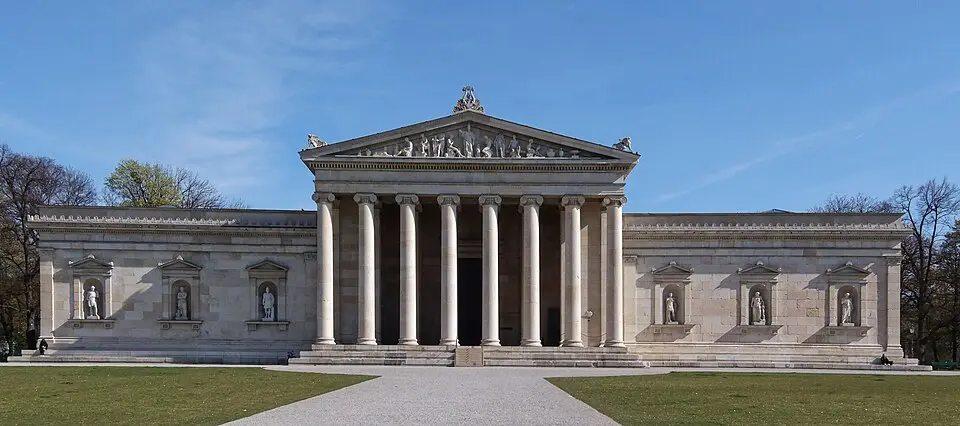
The Glyptothek is a major museum of ancient sculpture in Munich's Kunstareal (art district). The building was commissioned by Crown Prince Ludwig, later King Ludwig I, and stands on Königsplatz. Its name comes from Ancient Greek and literally means a place for keeping sculptures. The collection spans works from the Archaic period to late Roman times and is the result of intensive collecting, largely driven by King Ludwig I. Only a small part of the holdings comes from the old possessions of the Wittelsbach family; most of it was assembled through the king's deliberate purchases.
The building was designed by the architect Leo von Klenze and constructed between 1816 and 1830. Klenze conceived Königsplatz as an ancient forum, with the Glyptothek forming its north side. The architecture is marked by a monumental portico with twelve Ionic columns facing the square. Above the entrance sits a pediment group depicting Athena as protector of the art of sculpture. The exterior walls are decorated with niches holding statues of mythical and historical figures from the arts, including Daedalus, Prometheus, Phidias, and sculptors of the Renaissance and the 19th century such as Bertel Thorvaldsen and Antonio Canova.
Inside the museum, thirteen halls are arranged around a central courtyard. The vestibule in the central section is taller than the other rooms and serves as the entrance area. The inner walls of this anteroom bear Latin inscriptions that document the history of the building. They honor King Ludwig I as founder, the painter Peter Cornelius for the original decoration, and Leo von Klenze for overseeing construction. The walls were originally adorned with important frescoes by Peter Cornelius, but these were damaged in World War II and never restored.
The building's history has been shaped by destruction and rebuilding. The Glyptothek was partly destroyed in the air raids on Munich in April 1944. Reconstruction began in 1947, and the museum reopened in 1972. A comprehensive renovation that started in October 2018 led to another reopening on March 26, 2021. For the exemplary restoration of its historic façade, the museum received the Bernhard Remmers Prize in 2022 and the City of Munich's Façade Prize in 2023. The Assyrian Hall once built in the courtyard was not rebuilt after the war; the reliefs displayed there and a Babylonian lion are now in the State Collection of Egyptian Art.
The Glyptothek's collection is rich in masterpieces of Greek and Roman sculpture. Among the best-known pieces are the Barberini Faun, the so-called Drunken Old Woman, the Boy with the Goose, and the statue of Eirene with the child Ploutos. Of particular note are the pediment figures from the Temple of Aphaia on Aegina, known as the Aeginetan Marbles, which were acquired in 1813. Archaic statues of youths such as the Munich Kouros and the Apollo of Tenea are also part of the collection. The Roman section presents a rich selection of portraits, including likenesses of Augustus, Nero, Antoninus Pius, and Septimius Severus.
King Ludwig I pursued his collecting with great care and legal precision. His art agent Johann Martin von Wagner acquired the Barberini Faun in Rome, a purchase that dragged on for years before export was approved. The Aeginetan Marbles were bought in Greece, while Leo von Klenze bid on statues such as the Eirene in Paris. Ludwig I himself acquired the Ilioneus in Vienna, from the collection of Emperor Rudolf II in Prague. This systematic approach helped make the Glyptothek one of the world's most important collections of ancient sculpture.
Today the Glyptothek is run as part of a museum group that also includes the State Collections of Antiquities on the south side of Königsplatz. These house ancient everyday and art objects such as pottery, bronzes, and gold jewelry. Greco-Roman sculpture from the period after the conquest of Egypt can be seen at the nearby Museum of Egyptian Art. The neighboring Museum of Casts of Classical Sculpture rounds out the offering with plaster casts of ancient works. The Glyptothek remains a central place for engaging with ancient art and its reception in modern times.
At a glance
- Category
- Museum › History museums
- Rating
- no reviews yet · write a review
- Address
- Katharina-von-Bora-Straße 10
80333 Munich, Germany - District
- Kunstareal
- Phone
- +498928927502
- Website
- www.antike-am-koenigsplatz.mwn.de
- email@antike-am-koenigsplatz.mwn.de
- Coordinates
- 48.14639° N · 11.56583° E
- Data quality
- confidence 0.99
- Identifier
- ID 7d6d21e9-c57…
Location & surroundings
Toggle layersRatings & comments
none yetNear Glyptothek
closest 5 per category · 2 kmSights
Restaurants
Museums
Hotels
More:All museums in Munich (164)
300 places within 2 km loaded.
You need a free account to leave reviews and photos – that keeps comments genuine and lets you edit them later.
This houses King Ludwig I's huge collection of Greek and Roman sculpture: he was determined to make Munich into a new Athens, if necessary by removing the original Athens piece by piece. The principal sculptures are the Aeginetes, excavated in the 19th century from the temple on the island of Aegina. The building, in neo-classical style of course, was completed in 1830. It was bombed out during the Second World War but the sculptures had been taken to safety. There's an attractive courtyard with cafe.
Source: Wikivoyage, „Munich/Maxvorstadt“ · authors per page history · CC BY-SA 4.0 · as of 10/28/2022