About Haus der Kunst
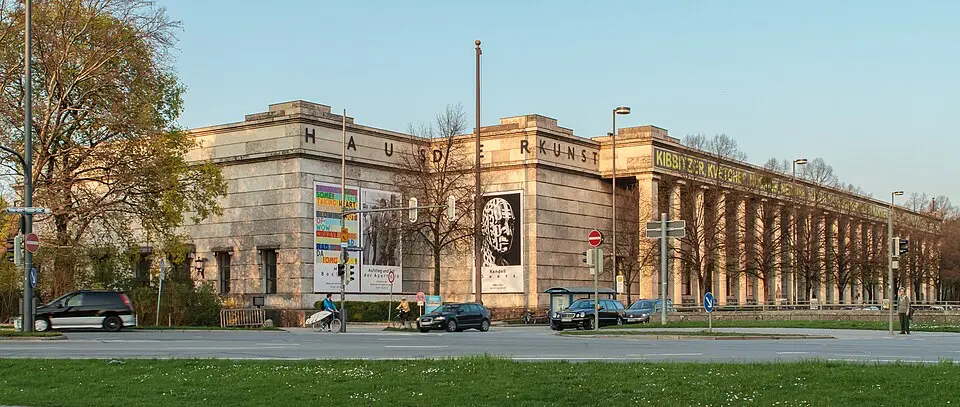
The Haus der Kunst in Munich is a major exhibition building located at the southern end of the English Garden on Prinzregentenstrasse. It is owned by the Free State of Bavaria and run by the Haus der Kunst Foundation, in which the state is joined by the association of Munich artists' groups and a patrons' association. The building houses no permanent collection of its own; instead, it organizes and presents changing exhibitions of contemporary and modern art. Since February 2020, Andrea Lissoni has served as artistic director. Thanks to its history and monumental architecture, the site is a central meeting place for art lovers and visitors from around the world.
The building's origins date back to 1933, when Adolf Hitler commissioned a new design. Following the fire at the Glaspalast in 1931, Munich's artists' associations had originally commissioned a new building, but Hitler scrapped that project shortly before construction was to begin. Instead, he tasked Paul Ludwig Troost, who had already remodeled the Nazi Party headquarters, with designing a new House of German Art. The site was moved from the old Botanical Garden to the southern entrance of the English Garden to meet the regime's monumental ambitions.
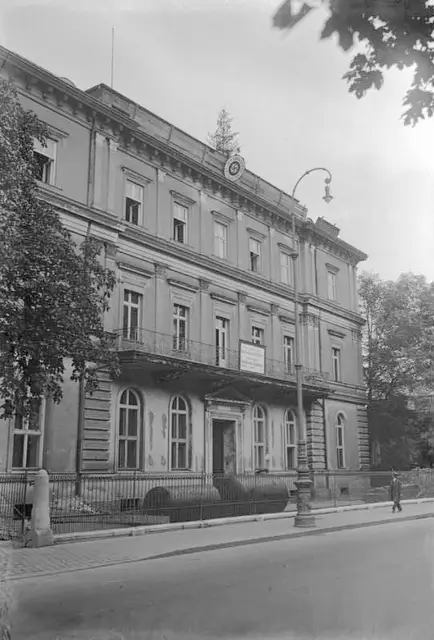
The building's architecture is an example of stripped-down neoclassicism and is considered one of the first major construction projects of National Socialism. Troost simplified the formal language of the neoclassicism of his prewar period by reducing detail and enlarging the proportions to a monumental scale. The building, which is symmetrical along two axes, is 175 meters long and 50 meters wide in the central section. Its construction is based on a continuous grid of steel beams clad with stone slabs, creating the impression of a solid stone structure. The facade is clad in limestone from the Danube Valley, while the base section shows conglomerate (Nagelfluh).
On each of the long sides of the building stands a 21-bay portico with colossal, unfluted columns that span the full height of the building. The main entrance is in the middle of the south facade, where a broad flight of steps originally led up to it; it was greatly reduced in 1971 as part of street redesign work. At the back, the lower level is accessible at ground level because of the lay of the land. Including the entrance halls and staircases, the building has a total depth of 75 meters. In front of the building stands a row of linden trees, a traditional avenue tree in Munich.
The interior is likewise symmetrical. The central hall, originally called the Hall of Honor, runs from the entrance all the way to the North Gallery. To its left and right are large, elongated exhibition halls that reach the building's full height and are paved with Solnhofen limestone slabs. These halls can be flexibly partitioned so that several exhibitions can take place at the same time. The administrative offices are on the south side, while the former restaurant space in the north is now used as the North Gallery. Only these parts of the building have two stories, with additional exhibition rooms on the upper floor.
The interior is lavishly appointed, using high-quality materials such as Jura marble for door frames and baseboards, as well as Saalburg and Tegernsee marble in the central hall. The original lighting came from skylights, which made the high-ceilinged rooms feel bright and open. At the eastern end of the north gallery is the Goldene Bar, located in the former artists' banquet room; its murals by Karl Heinz Dallinger were uncovered again by 2004. Set against a gold-leaf background, they depict maps and exotic motifs relating to the origins of luxury foods and stimulants. In the basement of the west wing, the club P1 occupies the former Bierstüberl.
The building was financed through an initiative of Bavarian and German industrialists who wanted to present it to Hitler as a gift. Eighteen cornerstone donors from major corporations such as I.G. Farben, Krupp, Siemens, and Bosch raised a combined three of the originally planned five million Reichsmarks. The City of Munich contributed further funds, and the construction industry and the Reichsbahn provided in-kind contributions. Despite this support, donations were not enough to cover the final construction costs of twelve million marks, so an interest-free loan had to be taken out. Hitler himself laid the cornerstone on October 15, 1933.
After the architect Paul Ludwig Troost died in 1934, construction was continued by his associate Leonhard Gall with the involvement of Troost's widow, Gerdy Troost. The building opened on July 18, 1937, with the first Great German Art Exhibition. This exhibition was part of National Socialist cultural policy and served the regime's propaganda. In parallel, the Degenerate Art exhibition took place the same year, denouncing the modern art the regime rejected. The Haus der Kunst was thus a site of the political instrumentalization of art from the very beginning.
The building survived World War II almost undamaged. During the American occupation it served as an officers' club before reopening for cultural purposes in 1946. The first postwar exhibition showed works from the Alte Pinakothek, followed by a show of French painting that presented international modern art on German soil for the first time. In the following years the building was used by various institutions, including the Bavarian State Painting Collections, which displayed selected works from its holdings in the west wing until they moved to other museums.
In the 1950s and 1960s, the Haus der Kunst established itself as an important venue for presenting classic modernism and contemporary art. Under the direction of Peter Ade, it organized major crowd-pleasers such as the 1955 Picasso exhibition, which showed Guernica in Europe, as well as shows on Egyptian art, including the famous Tutankhamun exhibition in 1980. The building was also used for other events, such as the German Art and Antiques Fair and the cultural programs of the 1972 Olympic Games, for which a temporary annex was built.
Since the 1990s, the Haus der Kunst has continued to evolve and increasingly addresses its own history. Under Chris Dercon, the fixtures installed in the 1950s and 1960s were critically removed, so that the architecture can once again be experienced in its original state. Since 2014, a permanent exhibition in the Archive Gallery has shed light on the building's history through film documents, plans, and objects. Today the Haus shows a broad range of contemporary art, architecture, film, and photography, and collaborates with international institutions.
The building's current phase is marked by a search for new ways of financing and developing its program. After the withdrawal of its longtime sponsor, the Schörghuber family, the Alexander Tutsek Foundation was secured as the new principal sponsor. The Haus also plans a complete renovation that is meant to restore the building to its original state while making it more transparent. Despite its historical burden, the Haus der Kunst remains a central place for art education in Munich, inviting visitors to experience the tension between monumental architecture and contemporary art.
At a glance
- Category
- Museum › Art museums
- Rating
- no reviews yet · write a review
- Address
- Prinzregentenstraße 1
80538 Munich, Germany - District
- Altstadt-Lehel
- Phone
- +498921127113
- Website
- www.hausderkunst.de
- mail@hausderkunst.de
- Coordinates
- 48.14414° N · 11.58593° E
- Data quality
- confidence 0.99
- Identifier
- ID f84529c6-006…
Location & surroundings
Toggle layersRatings & comments
none yetNear Haus der Kunst
closest 5 per category · 2 kmSights
Restaurants
Museums
Hotels
More:Art museums in Munich (21)Museums in Altstadt-Lehel (34)All museums in Munich (164)
300 places within 2 km loaded.
You need a free account to leave reviews and photos – that keeps comments genuine and lets you edit them later.
Grand exhibition hall completed in 1937 in Nazi - Art Deco style. It doesn't have a permanent collection but mounts ever-changing graphic arts exhibitions.
Source: Wikivoyage, „Munich/Altstadt“ · authors per page history · CC BY-SA 4.0 · as of 10/18/2022