About Deutsches Museum
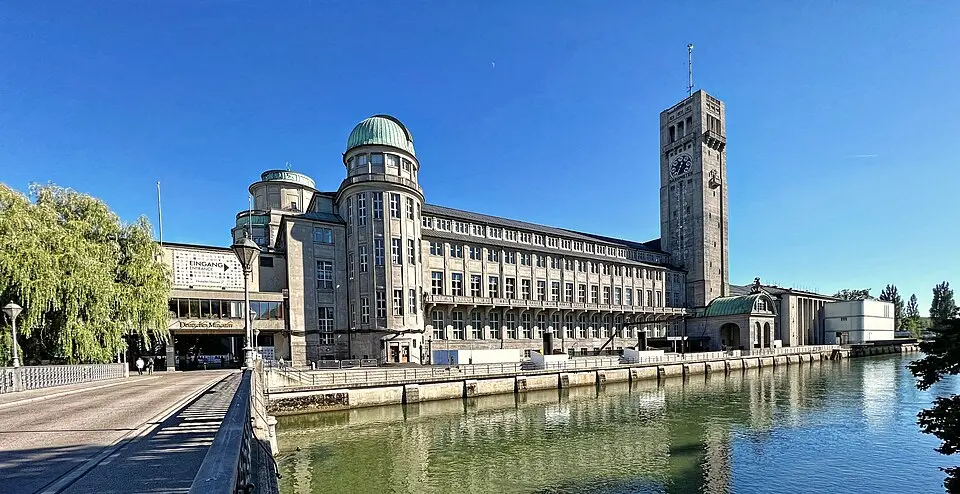
With its enormous exhibition space, the Deutsche Museum in Munich ranks among the world's most important museums of science and technology. A public-law institution and a member of the Leibniz Association, it aims to make scientific and technical knowledge understandable and engaging for a broad audience. The focus is not simply on displaying objects but on showing how technology developed over time and how deeply it has shaped society. Besides the historic main building on Munich's Museumsinsel (Museum Island), the museum operates four other branches that broaden the range of exhibitions and explore their themes in greater depth.
The heart of the institution is the main building on Museum Island, a former gravel bank in the Isar River that served as a timber raft landing and storage yard in the Middle Ages and was therefore also known as Coal Island (Kohleninsel). Because of the constant threat of flooding, the site stayed undeveloped for a long time, until the Isar Barracks were built in 1772. After the devastating flood of 1899, the island was reinforced and made flood-proof, which paved the way for the new museum building. The Munich city council made the site available in 1903, and in 1906 Kaiser Wilhelm II laid the foundation stone for the building, which was designed by the architect Gabriel von Seidl.
Constructing the main exhibition building was a complex undertaking, badly delayed by the difficult subsoil of alluvial sand and by World War I. Despite the political and economic upheavals of the postwar years and the inflation that wiped out the foundation's cash assets, the museum opened with a ceremony on May 7, 1925. The architecture of the exhibition building is remarkable: it was one of the first larger buildings constructed of reinforced concrete. This then-modern building material was chosen deliberately, to demonstrate technical progress and to make the building itself part of the exhibition.
Besides the main exhibition building, there are other historic buildings on the grounds. The library building, completed in 1932, now houses the administration, the archive, and the museum's own workshops. To the east is the congress hall, which opened in 1935; its large auditorium was Munich's biggest concert hall until the Gasteig opened in 1985. After being sold and bought back, the building stood empty for years before being used as an event venue with dining from 2017. In July 2022, the restaurant Frau im Mond also opened on the roof terrace of the adjoining Aeronautics and Astronautics Hall, and you can visit it even without a museum ticket.
The museum's history is inseparably linked to its founder, Oskar von Miller, a civil engineer who had made a name for himself as a pioneer of electrical engineering. Miller initiated the founding of the museum association in 1903 and used his organizational talent to win over influential figures from science and industry as supporters. His vision was an education-focused museum that stands out for its hands-on approach. Exhibits invite you to try small physics experiments or show automated miniature models that present complex processes in simplified form. Miller's creative drive shaped the museum until his resignation in 1933, when he resisted political pressure from the Nazis, who wanted to exploit the museum for their own purposes.
The Nazi era and World War II were a period of severe hardship for the museum. Jewish employees were excluded from its governing bodies and deported, while the museum was under pressure to conform to Nazi ideology. Despite these circumstances, the museum's management tried to preserve its autonomy. The destruction caused by Allied air raids from 1940 onward was devastating; by the end of the war, about 80 percent of the building fabric had been destroyed, and many valuable exhibits were lost. Reconstruction began even during the war, and the museum officially reopened in 1948. In the following decades, the presentation of the collections was fundamentally redesigned, while the buildings were restored to their original form.
Since the 1970s, the Deutsche Museum has continued to evolve by professionalizing its administration and expanding its range of locations. Establishing branch museums was a response to the limited space on Museum Island. In 1992, the Flugwerft Schleißheim opened, using historic buildings of the former airfield to show the development of aviation. In 1995 came the Deutsche Museum Bonn, which focuses on the history of science and technology after 1945. In Munich itself, the Verkehrszentrum (Transport Museum) opened in 2003 on the Theresienhöhe, documenting the history of land transport in the historic halls of the old trade fair grounds.
Another important branch is the Deutsche Museum Nuremberg, which opened in 2021 in the Augustinerhof building complex in the Old Town. This so-called Museum of the Future is devoted to current technological challenges and futures research. In addition, the museum operates the Lokwelt railway museum in cooperation with the city of Freilassing. This decentralized structure makes it possible to appeal to different audiences and to separate thematic focuses by location, which enriches the visitor experience and makes the content more accessible.
The Deutsche Museum's collections cover a broad range, from physics and chemistry to biology, engineering, and the history of technology. The exhibits are systematically organized into departments and groups that trace the historical development of each discipline. You can marvel at original machines, models, and documents that trace the path from idea to industrial application. The museum places great emphasis on conveying the connection between scientific discovery and technical implementation, supported by interactive stations and educationally designed information.
In recent years, the focus has been on the comprehensive renovation of the main exhibition building, in order to modernize the exhibitions and improve the condition of the structure. This extensive overhaul, which has been under way since 2015, includes renovating the buildings and redesigning the exhibition areas. The aim is to prepare the museum for the decades ahead and to bring the presentation of the exhibits in line with current scientific knowledge and educational standards. The renovation is a major project that requires financial support from the federal government and the Free State of Bavaria, underscoring the museum's importance as a cultural and scientific institution.
The Deutsche Museum is more than a place for sharing knowledge; it is a place of encounter and inspiration. It links the history of technology with the future and invites visitors of all ages to explore the world of the natural sciences. Through its international outlook, its extensive collections, and its active research, the museum makes a valuable contribution to understanding technological civilization. It remains a central attraction in Munich and a symbol of Germany's tradition in science and technology, which rests on the ideas and dedication of Oskar von Miller and many other pioneers.
At a glance
- Category
- Museum › Science museums
- Rating
- no reviews yet · write a review
- Address
- Museumsinsel 1
80538 Munich, Germany - District
- Ludwigsvorstadt-Isarvorstadt
- Phone
- +49892179333
- Website
- www.deutsches-museum.de
- information@deutsches-museum.de
- Coordinates
- 48.12996° N · 11.58345° E
- Data quality
- confidence 1.00
- Identifier
- ID 30c6af15-6e1…
Location & surroundings
Toggle layersRatings & comments
none yetNear Deutsches Museum
closest 5 per category · 2 kmSights
Restaurants
Museums
Hotels
More:Museums in Ludwigsvorstadt-Isarvorstadt (24)All museums in Munich (164)
300 places within 2 km loaded.
You need a free account to leave reviews and photos – that keeps comments genuine and lets you edit them later.
Enormous museum of science and technology, needing a full day, and even then you need to prioritise which galleries to explore - though half the fun is discovering the secrets of technology you'd never considered. Themes include natural sciences (from atom physics to music), materials and energy (including robotics), transport including aerospace, environment, health, agriculture and food, IT, communications and photography. At any time, some galleries are closed for refurb (these are indicated by the ticket booths), some are fresh and exciting, and some are getting tired. The museum is very popular, buy online to avoid queuing in the rain. Verkehrszentrum is the branch museum for transport west edge of this district, Flugwerft Schliessheim exhibits aviation north of the city, and there are branch museums in Bonn and Nuremberg.
Source: Wikivoyage, „Munich/Ludwigsvorstadt-Isarvorstadt“ · authors per page history · CC BY-SA 4.0 · as of 10/5/2022