About Porte Saint-Antoine
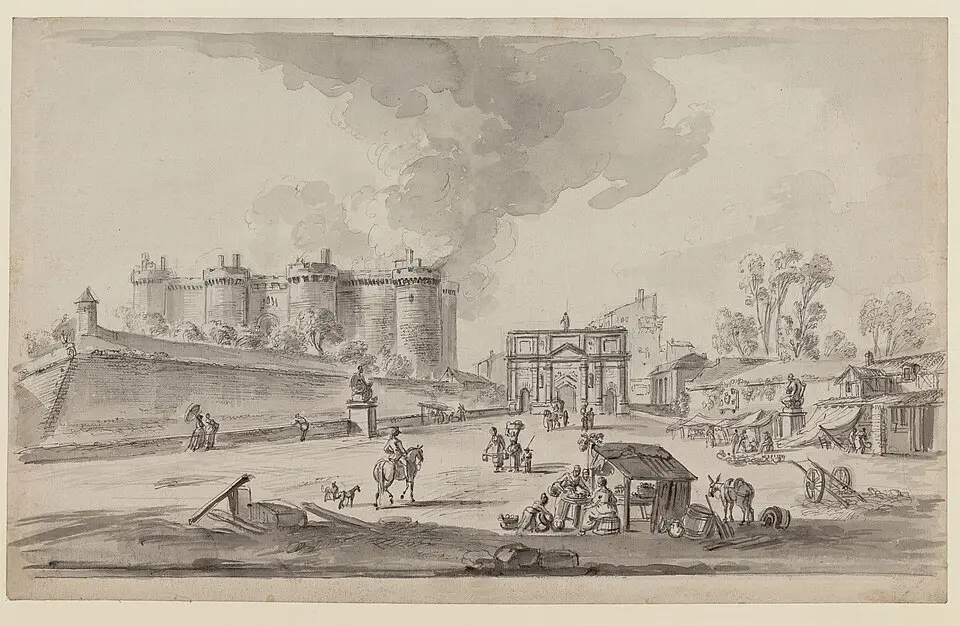
The Porte Saint-Antoine was one of the historic city gates of Paris and no longer exists today. Its best-known site was in the 4th arrondissement, where the Rue de la Bastille now begins. The gate stood on one of the city's oldest routes, which as far back as Roman times led from the center of town toward Meaux and Melun. In the Middle Ages, the road beyond the city wall served the Abbey of Saint-Antoine-des-Champs. When King Philip II Augustus had a new city wall built, a first gate was erected here, which was later replaced by the Bastille fortress. This complex, built under Charles V in the 14th century, protected the royal residence in the Marais and controlled access to the city.
Over the centuries, the gate was the setting for numerous historic events. During the civil wars between the Armagnacs and the Burgundians, as well as during various uprisings by the Parisian population, it served as a strategic point for attacks and escape routes. Ceremonial entrances by rulers also took place here, including the arrival of Holy Roman Emperor Charles V and the coronation celebrations of Louis XIII. Under Henry II, the gate was adorned with a triumphal arch featuring sculptures by Jean Goujon. Later, under Louis XIV, the monument received two additional arcades commemorating the king's entry at the time of his wedding, flanked by sculptures by Gérard Van Opstal.
Because the gate lost its military significance in the 18th century and obstructed street traffic, it was demolished in 1778. Today, you can locate the gate's former position by following the street layout in the 4th arrondissement. The history of the Porte Saint-Antoine reflects the eventful development of the Parisian city walls and the political history of France, from medieval fortification to baroque splendor.
At a glance
- Category
- Sight › Historic sites
- Rating
- no reviews yet · write a review
- Address
- —
Paris, France - District
- Quartier de l'Arsenal
- Phone
- —
- Website
- —
- —
- Coordinates
- 48.85379° N · 2.36856° E
- Data quality
- confidence 0.80
- Identifier
- ID 56fe27ce-faa…
Location & surroundings
Toggle layersFAQ about Porte Saint-Antoine
quick answersWhat is the Porte Saint-Antoine in Paris?
The Porte Saint-Antoine was one of the historic city gates of Paris and no longer exists today. It stood on one of the oldest routes in the city, which led from the center toward Meaux and Melun as far back as Roman times. A first gate was built as part of the city wall of King Philip II Augustus; later, the Bastille fortress, built under Charles V in the 14th century, took over protecting the approach and the royal residence in the Marais.
Can you still see the Porte Saint-Antoine today?
No, the Porte Saint-Antoine in Paris was demolished in 1778 because it had lost its military importance and was obstructing traffic. Its best-known location was in the 4th arrondissement in the Quartier de l’Arsenal, where the Rue de la Bastille begins today. You can still trace the gate's former position by following the layout of the streets in the 4th arrondissement.
What historical events took place at the Porte Saint-Antoine?
For centuries, the Porte Saint-Antoine in Paris was the scene of battles, uprisings, and ceremonial entries. During the civil wars between the Armagnacs and the Burgundians and during uprisings of the Parisian population, it served as a strategic point for attacks and escape routes. Ceremonial entries included the arrival of Holy Roman Emperor Charles V and the coronation celebrations of Louis XIII.
What did the Porte Saint-Antoine look like?
Over time, the Porte Saint-Antoine in Paris was transformed into a magnificent triumphal arch. Under Henry II, the gate received a triumphal arch with sculptures by Jean Goujon. Under Louis XIV, two additional arcades were added, commemorating the king's entry on the occasion of his wedding and flanked by sculptures by Gérard Van Opstal.
What can you see around the Porte Saint-Antoine?
Around the former site of the Porte Saint-Antoine in Paris you'll find several monuments and historic sites. The Colonne de Juillet is only about 77 meters away, and the Maison de Victor Hugo about 250 meters. Nearby you'll also find the Hôtel de Mayenne (about 204 meters), the Hôtel Mansart de Sagonne (about 187 meters), as well as the Passage du Cheval Blanc and the Rue de Lesdiguières. For a break, travelguide195 lists around 367 restaurants within 500 meters.
Ratings & comments
none yetNear Porte Saint-Antoine
closest 5 per category · 2 kmSights
Restaurants
Museums
Hotels
More:Historic sites in Paris (1,524)Sights in Quartier de l'Arsenal (24)All sights in Paris (1,859)
300 places within 2 km loaded.
You need a free account to leave reviews and photos – that keeps comments genuine and lets you edit them later.