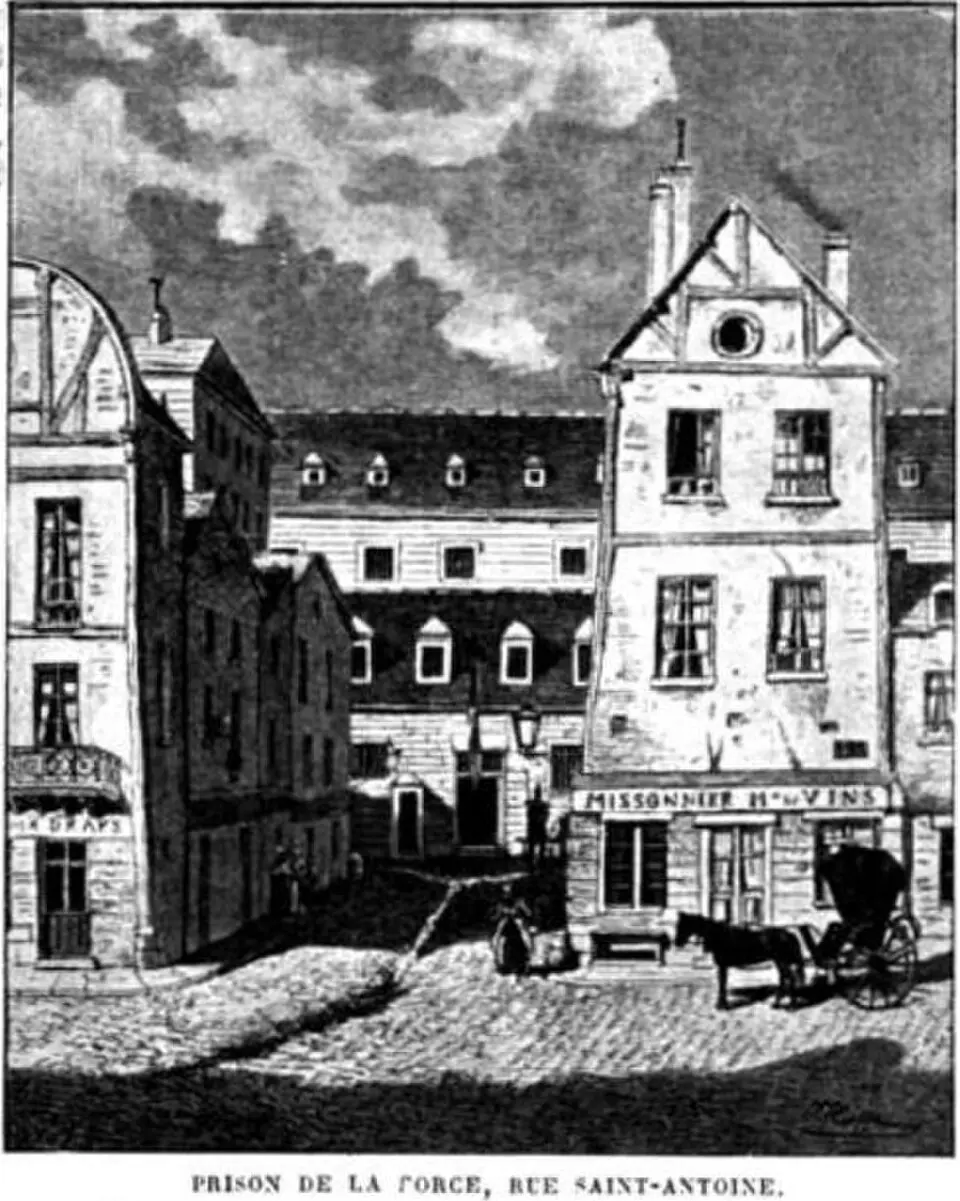
About La force prison
The former La Force prison in Paris's 4th arrondissement began as a city mansion built in the 16th century by René de Birague. Over the centuries it changed hands several times before taking its final name under the Duke of La Force. After the building was divided in 1698 and altered in various ways, the property passed to Louis XVI in 1780, who converted it into a prison for men and women. The complex served as a place of detention until it closed in 1845 and was the scene of dramatic historical events at various times. During the French Revolution, on the day the Bastille was stormed, Parisians first freed the debtors imprisoned there. Later, especially during the Reign of Terror, La Force became a site of political imprisonment and was part of the September Massacres, in which numerous prisoners were murdered. The prison remained in operation under the Consulate and the Empire as well, and contemporary accounts describe a spacious courtyard with trees and a mixed prison population.
The list of inmates includes a remarkable mix of political figures, artists, and scientists. Well-known prisoners included the astronomer and first mayor of Paris Jean-Sylvain Bailly, the mathematician Évariste Galois, the revolutionary Auguste Blanqui, and the writer Pierre-Ambroise-François Choderlos de Laclos. The Princess of Savoy, Madame de Lamballe, and the architect Claude-Nicolas Ledoux also spent time within the walls of La Force. The prison also found its way into world literature. Authors such as Alexandre Dumas, Honoré de Balzac, Charles Dickens, and Victor Hugo drew on the atmosphere and conditions of the prison in their novels, with Hugo describing the dilapidated state of the so-called Bâtiment-Neuf in particularly vivid detail.
After its closure in 1845, the building was demolished because of its dilapidated and unsanitary condition. Today only a section of wall on the Rue Malher, adjoining the Historical Library of the City of Paris and protected as a historic monument, recalls the former complex. A commemorative plaque tells visitors about the history of the site. In addition, a walled-up window with a grille has survived in the courtyard of the fire station on the Rue Madame de Sévigné; these are considered the last physical remnants of this historic prison.
At a glance
- Category
- Sight › Historic sites
- Rating
- no reviews yet · write a review
- Address
- 2 Rue du Roi de Sicile
75004 Paris, France - District
- Quartier Saint-Gervais
- Phone
- —
- Website
- —
- —
- Coordinates
- 48.85555° N · 2.36109° E
- Data quality
- confidence 0.81
- Identifier
- ID e31136b5-9ae…
Location & surroundings
Toggle layersFAQ about La force prison
quick answersWhat is La Force Prison in Paris?
La Force Prison was a historic detention facility in the Saint-Gervais quarter of Paris's 4th arrondissement, in operation from 1780 to 1845. René de Birague originally had the building constructed in the 16th century as a city mansion, and it later took its name from the Duke of La Force. After the property was divided in 1698 and underwent several renovations, it passed to Louis XVI in 1780, who had it converted into a prison for men and women.
What can still be seen of La Force Prison in Paris today?
Only a few remains of La Force Prison in Paris survive today, because the building was demolished after its closure in 1845 due to its dilapidated and unsanitary condition. A protected section of wall on Rue Malher, next to the Historical Library of the City of Paris, recalls the complex, and a commemorative plaque there tells the history of the site. In addition, a walled-up window and a grille survive in the courtyard of the fire station on Rue Madame de Sévigné, considered the last physical traces of the prison.
What role did La Force Prison play during the French Revolution?
During the French Revolution, La Force Prison in Paris was first the site of a liberation and later a place of political imprisonment and violence. On the day the Bastille was stormed, Parisians first freed the debtors held there. During the Reign of Terror in particular, political prisoners were held in La Force, and the prison was the scene of the September Massacres, in which numerous inmates were murdered.
Which famous prisoners were held in La Force Prison in Paris?
Numerous well-known politicians, artists, and scientists were held in La Force Prison in Paris. They included the astronomer and first mayor of Paris Jean-Sylvain Bailly, the mathematician Évariste Galois, the revolutionary Auguste Blanqui, and the writer Choderlos de Laclos. Madame de Lamballe, Princess of Savoy, and the architect Claude-Nicolas Ledoux were also imprisoned there. Alexandre Dumas, Honoré de Balzac, Charles Dickens, and Victor Hugo all wove the prison into their novels, with Hugo describing the dilapidated Bâtiment-Neuf in particular detail.
What can you see around the former La Force Prison in Paris?
Around the former La Force Prison at 2 Rue du Roi de Sicile in Paris, you'll find several historic sites and museums within a short distance. travelguide195 lists the Passage Charlemagne about 100 meters away, the Maison Européenne de la Photographie about 150 meters away, and the Hôtel d'Angoulême Lamoignon with its garden about 170 meters away, among others. The Jewish Quarter is about 180 meters away, and travelguide195 lists around 293 restaurants within 500 meters.
Ratings & comments
none yetNear La force prison
closest 5 per category · 2 kmSights
Museums
Hotels
More:Historic sites in Paris (1,524)Sights in Quartier Saint-Gervais (28)All sights in Paris (1,859)
300 places within 2 km loaded.
You need a free account to leave reviews and photos – that keeps comments genuine and lets you edit them later.