About Chapelle expiatoire
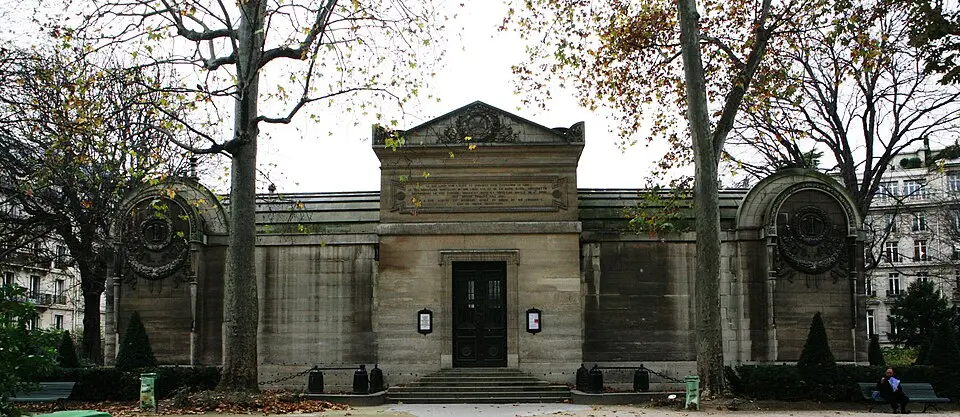
The Chapelle expiatoire in Paris's 8th arrondissement is a historic memorial built on the grounds of the former Madeleine Cemetery. King Louis XVIII had the chapel commissioned in the 19th century to commemorate the victims of the French Revolution who were buried there, in particular Louis XVI and Marie Antoinette, whose remains were later transferred to the Basilica of Saint-Denis. The chapel's architecture, designed by Pierre-François-Léonard Fontaine and Louis-Hippolyte Lebas, includes an entrance pavilion, side galleries, and a raised inner garden. This courtyard symbolically marks the former burial site, while gravestones along the walls honor the Swiss Guards who were killed. Inside, you can admire white marble statues of the royal couple, created by François Joseph Bosio and Jean-Pierre Cortot. These sculptures depict the monarchs in a kneeling pose and are adorned with historic documents such as the king's will. Since 1865, the complex has been surrounded by the park-like Square Louis XVI, which gives the site a dignified and peaceful atmosphere.
At a glance
- Category
- Sight › Monuments
- Rating
- no reviews yet · write a review
- Address
- 29 Rue Pasquier
75008 Paris, France - District
- Quartier de la Madeleine
- Phone
- +33142653580
- Website
- chapelle-expiatoire.monuments-nationaux.fr
- chapelle.expiatoire@monuments-nationaux.fr
- Coordinates
- 48.87374° N · 2.32342° E
- Data quality
- confidence 0.99
- Identifier
- ID 66b5d6ce-9e2…
Part of the tour
Paris and Its History: From the Sun King to the Present →Location & surroundings
Toggle layersFAQ about Chapelle expiatoire
quick answersWhat is the Chapelle expiatoire in Paris?
The Chapelle expiatoire is a historic memorial in Paris's 8th arrondissement that commemorates the victims of the French Revolution. King Louis XVIII had it built in the 19th century on the site of the former Madeleine Cemetery. The chapel was designed by the architects Pierre-François-Léonard Fontaine and Louis-Hippolyte Lebas.
Whom does the Chapelle expiatoire in Paris commemorate?
The Chapelle expiatoire in Paris commemorates above all King Louis XVI and Marie-Antoinette, who were buried in the former Madeleine Cemetery. Their remains were later transferred to the Basilica of Saint-Denis. Gravestones along the walls of the complex also honor the Swiss Guards who were killed.
What can you see at the Chapelle expiatoire?
At the Chapelle expiatoire in Paris, you'll see an entrance pavilion, side galleries, and a raised inner garden that symbolically marks the former burial site. Inside stand white marble statues of Louis XVI and Marie-Antoinette in kneeling poses, created by François Joseph Bosio and Jean-Pierre Cortot. The sculptures are inscribed with historical documents such as the king's will.
Where is the Chapelle expiatoire in Paris located?
The Chapelle expiatoire is located at 29 Rue Pasquier in the Quartier de la Madeleine in Paris's 8th arrondissement. Since 1865, the complex has been surrounded by the park-like Square Louis XVI, which gives it a tranquil atmosphere. The Passage Puteaux is about 89 meters away, and travelguide195 lists around 503 restaurants within 500 meters.
Are there tours that include the Chapelle expiatoire in Paris?
Yes, travelguide195 lists the Chapelle expiatoire in Paris as a stop on the tour "Paris and Its History: From the Sun King to the Present." The memorial fits the theme well, since it is directly tied to the French Revolution and the fate of Louis XVI and Marie-Antoinette.
Ratings & comments
none yetNear Chapelle expiatoire
closest 5 per category · 2 kmSights
Restaurants
Museums
Hotels
More:Monuments in Paris (322)Sights in Quartier de la Madeleine (34)All sights in Paris (1,859)
300 places within 2 km loaded.
You need a free account to leave reviews and photos – that keeps comments genuine and lets you edit them later.
A solemn neoclassical chapel built between 1815 and 1826 on the former burial site of Louis XVI and Marie Antoinette, commemorating their execution during the French Revolution. Set within a quiet, enclosed garden, it feels more like a memorial than a traditional church.
Source: Wikivoyage, „Paris/8th arrondissement“ · authors per page history · CC BY-SA 4.0 · as of 5/1/2026