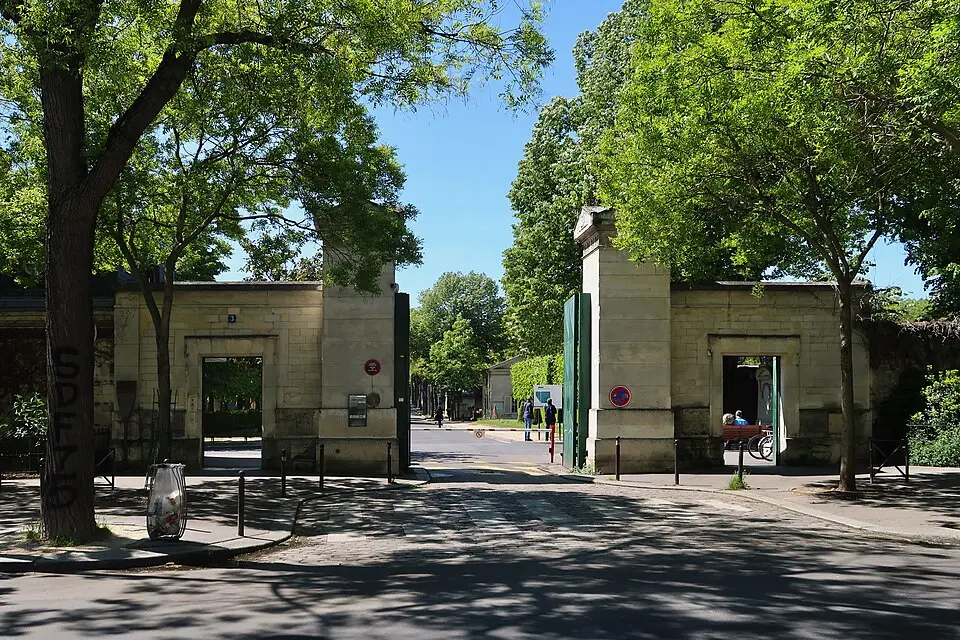
About Cementerio de Montparnasse
Montparnasse Cemetery (Cimetière du Montparnasse), historically also known as the South Cemetery, is one of the four great Paris burial grounds laid out in the early 19th century according to the plans of Napoleon Bonaparte. The move was part of the effort to relocate cemeteries from the city center to the outskirts in order to improve hygiene in the growing metropolis. Alongside Montparnasse, the cemeteries of Montmartre, Père-Lachaise, and Passy were created at the time. The present-day grounds occupy land that was previously dominated by three old farms and a windmill dating from the 14th or 15th century. In the 17th century, the site was a popular excursion spot for students of the Jesuit college Louis-le-Grand, which earned the mill the mocking nickname "Moulin Moliniste." When the Brothers of Charity acquired the land in 1654 to use as a burial ground, the mill's sail-less tower was preserved and from then on was known as the "Moulin de la Charité." From 1784, the dead of the nearby Hôpital de la Charité were also buried here.
The formal conversion into a municipal cemetery took place at the beginning of the 19th century, when the Paris prefect Nicolas Frochot purchased the property in order to comply with the requirements of the Edict of Saint-Cloud. The first public burial, however, did not take place until 1824. Since 1890, the Rue Émile-Richard has divided the grounds into a large section and a small one. Today the cemetery is far more than a place of rest; it has become a cultural landmark that draws thousands of visitors from around the world. The reason lies in the extraordinary concentration of graves of figures who profoundly shaped French culture, politics, and science, as well as world history in the 19th and 20th centuries.
Here you will find the resting places of poets such as Charles Baudelaire, Guy de Maupassant, and Théodore de Banville, who deeply influenced French literature. The world of music is also strongly represented, with the graves of composers such as César Franck, Camille Saint-Saëns, and Emmanuel Chabrier. In philosophy and the humanities, names such as Jean-Paul Sartre, Simone de Beauvoir, and Pierre-Joseph Proudhon rest here. The cemetery also holds the final resting places of numerous artists, including the sculptors Auguste Rodin, Constantin Brâncuși, and Henri Laurens, as well as painters such as William-Adolphe Bouguereau and Man Ray. Significant names from the worlds of film and theater, such as Jean-Paul Belmondo, Agnès Varda, Jacques Chirac, and Serge Gainsbourg, are also buried here.
A special feature of Montparnasse Cemetery is the close connection between the graves and the visual arts. Many of the graves are works of art in their own right or bear sculptures by famous artists. On the grave of the art collector Pierre Loeb, for example, you will find a granite sculpture by Jean Arp, while the grave of the composer César Franck is adorned with a bronze medallion by Auguste Rodin. Constantin Brâncuși also created a stone work, "Le Baiser" (The Kiss), which can be seen in the cemetery. These artworks turn the grounds into an open-air gallery where you can experience the artists' works in an intimate, contemplative setting. The inscriptions and the architectural design of the tombs tell the stories of the deceased and invite you to pause.
A walk along the avenues of Montparnasse is a journey through the history of modern culture. The atmosphere is marked by a mix of mourning and admiration for the legacy of the figures buried here. Whether you seek out the graves of scientists such as Henri Poincaré and Gabriel Lippmann or visit the sites of political figures such as Paul Reynaud and Jacques Chirac, the cemetery offers a comprehensive look at the diversity of human achievement. The upkeep of the grounds and their historical significance make Montparnasse Cemetery an essential destination for anyone who wants to explore the cultural soul of Paris. It is a place where the past remains alive and invites you to honor the legacy of France's great minds and artists.
At a glance
- Category
- Sight › Historic sites
- Rating
- no reviews yet · write a review
- Address
- —
Paris, France - District
- Quartier du Montparnasse
- Phone
- —
- Website
- —
- —
- Coordinates
- 48.83806° N · 2.32694° E
- Data quality
- confidence 0.71
- Identifier
- ID 065347ea-b49…
Location & surroundings
Toggle layersRatings & comments
none yetNear Cementerio de Montparnasse
closest 5 per category · 2 kmSights
Museums
Hotels
More:Historic sites in Paris (1,524)Sights in Quartier du Montparnasse (16)All sights in Paris (1,859)
300 places within 2 km loaded.
You need a free account to leave reviews and photos – that keeps comments genuine and lets you edit them later.