About Barrière d'Enfer
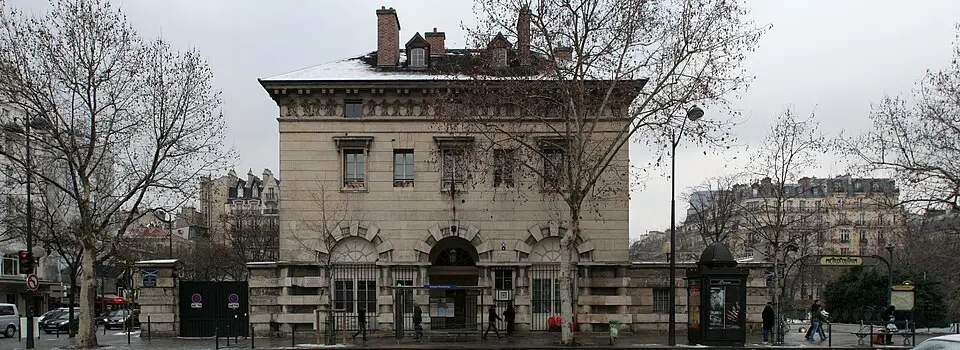
The Barrière d'Enfer, literally the "Gate of Hell," consists of two neoclassical pavilions built in 1787 by the architect Claude Nicolas Ledoux. These buildings originally served as toll houses along the Wall of the Farmers-General, where taxes were collected on goods entering the city. Today the two identical structures flank the Avenue du Colonel-Henri-Rol-Tanguy near the Place Denfert-Rochereau and are decorated with frieze reliefs of dancing figures by the sculptor Jean Guillaume Moitte. The name comes from the former Rue d'Enfer, whose name is traced to various historical origins, including its reputation as a place of mischief and a Latinized derivation. The site is known in culture through Puccini's opera La Bohème and Victor Hugo's novel Les Misérables. Today the eastern building houses the Quarry Inspection Office, while the western building is home to the road department. During the Liberation of Paris in 1944, the command post of the Resistance fighter Colonel Henri Rol-Tanguy was located beneath this building; the stretch of the square between the pavilions was renamed in his honor.
At a glance
- Category
- Sight › Historic sites
- Rating
- no reviews yet · write a review
- Address
- —
Paris, France - District
- Quartier du Montparnasse
- Phone
- —
- Website
- —
- —
- Coordinates
- 48.83389° N · 2.33194° E
- Data quality
- confidence 0.78
- Identifier
- ID 1600f129-e51…
Location & surroundings
Toggle layersRatings & comments
none yetNear Barrière d'Enfer
closest 5 per category · 2 kmSights
Museums
Hotels
More:Historic sites in Paris (1,524)Sights in Quartier du Montparnasse (16)All sights in Paris (1,859)
276 places within 2 km loaded.
You need a free account to leave reviews and photos – that keeps comments genuine and lets you edit them later.
The two pavilions were built in 1784 to 1787 by the French architect Claude-Nicolas Ledoux, who erected many similar toll houses at the entrances to the city.
Source: Wikivoyage, „Paris/14th arrondissement“ · authors per page history · CC BY-SA 4.0