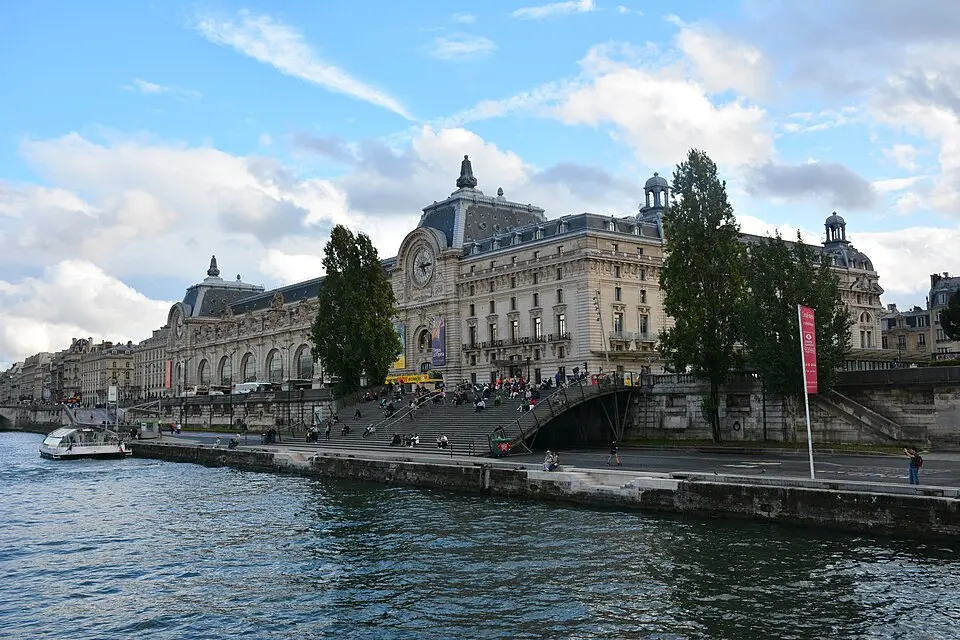
About Museé D'orsay
The Musée d’Orsay is located in the 7th arrondissement of Paris, right on the Left Bank of the Seine and across from the Tuileries Garden. The striking building was originally the Gare d’Orsay, a long-distance train station built by Victor Laloux in 1900 for the World's Fair. Until 1939 it served rail traffic to the southwest of France before it was shut down. After a period of inactivity and various interim uses, including as a backdrop for film productions and as a meeting place for cultural circles, the decision was made in 1977 to convert the historic building into an art museum. The initiative came from the French president at the time, Valéry Giscard d’Estaing. The conversion, led by the architecture firm ACT Architecture and completed in 1986, preserved the station's original structure and turned it into one of the most visited cultural sites in the city.
The museum's architecture impresses with its careful integration of modern exhibition spaces into the historic fabric of the building. The great main hall of the former station was largely opened up, and the glass roof creates a bright, airy atmosphere. Covered terraces and galleries were built along both sides of the hall, while old iron and stucco ornaments were uncovered and restored. Particularly delicate artworks are housed in the darker side galleries on the lower and mezzanine levels, while the brighter rooms are devoted to the remaining exhibits. The restored rooms of the former Hôtel Palais d’Orsay, which was once part of the station complex, also serve as exhibition space today. This architectural blend of historic elegance and functional museum design creates a unique setting for the works on display.
The Musée d’Orsay's collection focuses on the period from 1848 to 1914, from the Second Republic to the outbreak of World War I. Across 16,000 square meters (about 172,000 square feet), more than 4,000 exhibits are on view, including paintings, sculptures, prints, photographs, and works of decorative art and design. The comprehensive collection of French Impressionists, presented here in all its diversity, is unrivaled anywhere in the world. The holdings also include works of outstanding quality in nearly every style of the era. The collection originally came from various Parisian museums, in particular the Musée du Jeu de Paume, the Louvre, and the Centre Georges Pompidou. Bringing these works together offers a dense and varied overview of the development of art in the late 19th and early 20th centuries.
At the Musée d’Orsay, visitors experience not only a chronological journey through art history but also an impressive architectural landmark. The museum has become a fixture of cultural life in Paris and draws millions of visitors every year. The combination of the imposing setting of the former train station and the high-caliber collection makes it an unforgettable experience for art lovers and tourists alike. The careful curation of the works and the special atmosphere of the building invite you to take your time with the art and explore the history of the place.
At a glance
- Category
- Museum › Art museums
- Rating
- no reviews yet · write a review
- Address
- 1 Rue de la Légion d'Honneur
75007 Paris, France - District
- Quartier Saint-Thomas-d'Aquin
- Phone
- +33140494814
- Website
- www.musee-orsay.fr
- —
- Coordinates
- 48.85993° N · 2.32654° E
- Data quality
- confidence 0.94
- Identifier
- ID 43a58f71-21f…
Part of the tour
From Orsay to Picasso: Art Along the Seine →Location & surroundings
Toggle layersRatings & comments
none yetNear Museé D'orsay
closest 5 per category · 2 kmSights
Restaurants
Museums
Hotels
More:Art museums in Paris (119)All museums in Paris (525)
300 places within 2 km loaded.
You need a free account to leave reviews and photos – that keeps comments genuine and lets you edit them later.
Housed in a former Beaux-Arts railway station (completed in 1900 for the Exposition Universelle , later saved from demolition and converted to its present use), the rambling, open-plan museum is home to the works of the great artists of the 19th century (1848-1914) - Impressionists, post-Impressionists, and the rest - that were formerly displayed in the l'Orangerie. This is perhaps the most spectacular collection of European impressionism in the world—breath-taking rooms full of Manet, Renoir, Monet, Van Gogh, and many others. Impressionist represent the biggest draw, but there is much more to explore.
Source: Wikivoyage, „Axe historique“ · authors per page history · CC BY-SA 4.0