About Musée d'art et d'histoire du Judaïsme
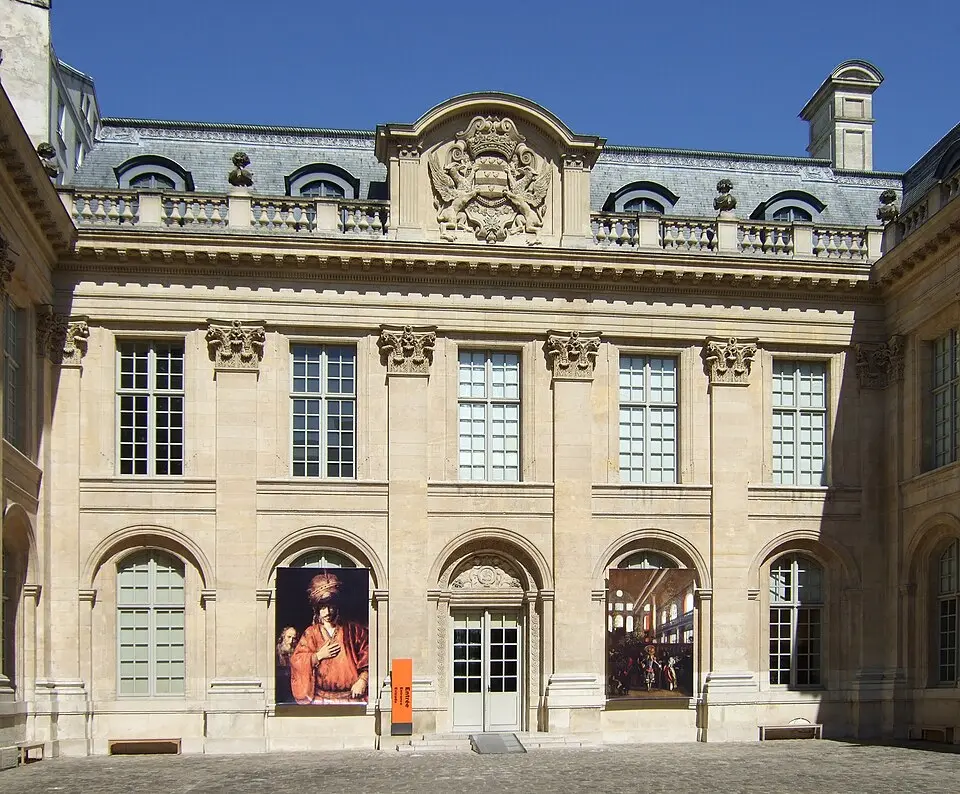
The Musée d'art et d'histoire du Judaïsme, or mahJ for short, is France's most important museum devoted to Jewish art and history. It opened on November 30, 1998, in the historic Hôtel de Saint-Aignan in the Marais district of Paris. The choice of location is rooted in history: since the late 18th century, the Marais has been an important home to Paris's Jewish community, and today it forms a cultural center with additional museums and memorial sites. The museum sheds light on the culture and history of Jews in Europe, the Levant, and North Africa from the Middle Ages to the 20th century. Its holdings include religious objects, archives, manuscripts, and works of art that highlight the contribution of Jewish communities to art and culture. In addition to the permanent collection, the museum has a bookstore, a media library with a public online catalog, and an auditorium. During the peak tourist season from April to July, guided tours in English are also offered.
The idea for a museum like this arose in 1985 through the efforts of Claude-Gérard Marcus, Victor Klagsbald, and Alain Erlande-Brandenburg, supported by the City of Paris and the Ministry of Culture. The goal was to make the national collections stored in the reserves of the National Museum of the Middle Ages accessible to the public. From 1988, Laurence Sigal led the project, and then-mayor Jacques Chirac made the Hôtel de Saint-Aignan available as a suitable venue. The architects Catherine Bizouard and François Pin were responsible for redesigning the building's interior, combining the historic setting with modern exhibition concepts.
The museum's collection has its roots in three main sources. One is the former Jewish Art Museum of Paris, whose holdings consist of European religious objects, graphic works by Russian and German Jewish artists, and architectural models of destroyed synagogues. Another important source is the collection of Isaac Strauss, a pioneer of Jewish collecting in the 19th century. On his travels through Europe, Strauss had assembled 149 religious objects, including furniture, ceremonial items, and Hebrew manuscripts. After his death, the collection passed via Nathaniel de Rothschild to the state and eventually to the Musée national du Moyen Âge. To this are added long-term loans from major institutions such as the Louvre, the Centre Pompidou, and the Musée d'Orsay, as well as donations from Jewish institutions and families.
The permanent exhibition is arranged chronologically and presents the works in their historical context, without treating the Holocaust as a central theme, since remembering it is the task of the neighboring memorial. In the gallery on the Middle Ages, the focus is on the remains of a 13th-century Jewish cemetery in Paris, discovered in 1849 and the largest archaeological find of its kind on French soil. Alongside these are valuable manuscripts and ritual objects from the period before the expulsion of the Jews from France. The room devoted to the Italian Renaissance shows the cultural splendor of cities such as Modena and Venice, including a rare 15th-century Torah ark resembling a fortified tower, as well as liturgical embroideries and paintings depicting life in the ghetto.
A special focus is placed on the differences and similarities between Ashkenazi and Sephardic traditions. In the Ashkenazi section, the harsh living conditions in Poland and Russia are illustrated by works by Samuel Hirszenberg and Marc Chagall, which also reflect life in the shtetls. The Sephardic collection presents textiles, synagogue utensils, and folk art that shed light on the religious customs of these communities. One highlight is a 19th-century wooden sukkah decorated with motifs from Jerusalem and the Decalogue, which can be completely taken apart. The exhibition also addresses the emancipation of French Jews in the 19th century, in particular the founding of the consistories under Napoleon and the social rise of Jewish figures.
The exhibition continues into the era of intellectual and political movements around the turn of the century, with an emphasis on Zionism, the revival of the Hebrew language, and Yiddish culture. A separate room is devoted to the contribution of Jewish artists to world art in the early 20th century, including works by Amedeo Modigliani, Chaim Soutine, and other artists of the School of Paris. In the museum's courtyard is an installation by the contemporary artist Christian Boltanski that lists the names of the residents of the Hôtel de Saint-Aignan on the eve of World War II, making the building's personal history before the war visible. The museum is organized as a nonprofit association and receives funding from the City of Paris and the Ministry of Culture. A foundation of its own supports the financing of exhibitions and publications and regularly awards a prize for contemporary art.
At a glance
- Category
- Museum › History museums
- Rating
- no reviews yet · write a review
- Address
75003 Paris, France- District
- Quartier Sainte-Avoye
- Phone
- +33153018653
- Website
- www.mahj.org
- info@mahj.org
- Coordinates
- 48.86095° N · 2.35563° E
- Data quality
- confidence 1.00
- Identifier
- ID 3eb86698-5e2…
Location & surroundings
Toggle layersRatings & comments
none yetNear Musée d'art et d'histoire du Judaïsme
closest 5 per category · 2 kmSights
Museums
More:History museums in Paris (70)All museums in Paris (525)
300 places within 2 km loaded.

You need a free account to leave reviews and photos – that keeps comments genuine and lets you edit them later.