About Centre Pompidou
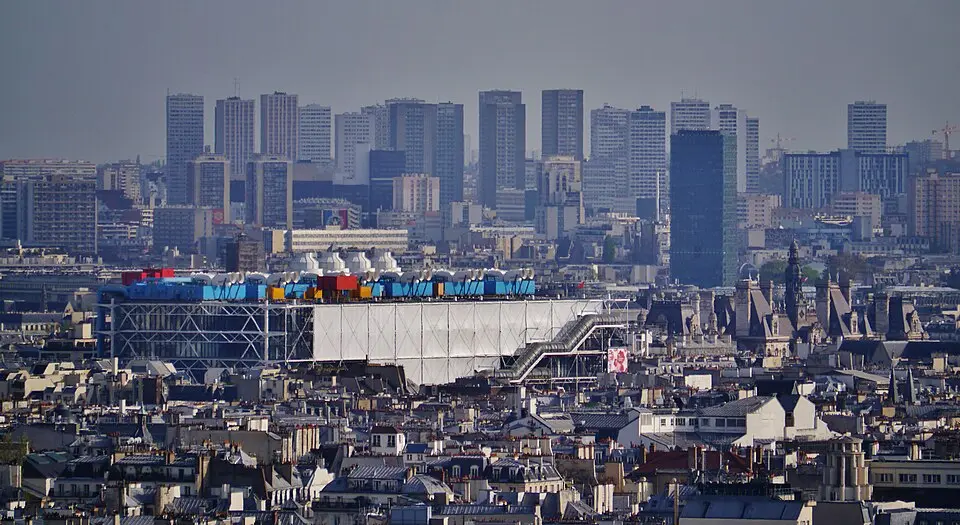
The Centre Pompidou, officially the Centre national d'art et de culture Georges-Pompidou, is a national arts and cultural center in Paris's 4th arrondissement. Designed by the architects Renzo Piano, Richard Rogers, and Gianfranco Franchini, the building opened in 1977 after five years of construction. The site on the Beaubourg plateau had previously been an urban wasteland, after the historic Saint-Merri quarter was demolished and the central wholesale market was relocated. The initiative for the project came from then-President Georges Pompidou, who wanted to strengthen Paris's position as an international art capital while also relieving the overcrowded national library. Under one roof, the center brings together the Museum of Modern Art with an industrial design center, a large public library, a music research institute, and spaces for theater, film, and lectures.
The building's architecture is defined by its unusual facade, in which the structural framework, ventilation ducts, and circulation routes have been moved to the outside, where they are fully visible. These so-called exoskeleton elements are color-coded: structure and ventilation in white, stairs and escalators in red, electrical systems in yellow, water in green, and air conditioning in blue. This design made it possible to create largely column-free, flexibly usable interior spaces with high ceilings. When it opened, the design was highly controversial because it resembled an industrial plant; today it is regarded as a groundbreaking break from pure modernism. Because of the exterior construction, the first renovations were already needed in the 1980s. The Centre Pompidou is currently closed until around 2030 for extensive renovation and asbestos removal work, and its permanent exhibition already ended in spring 2025.
Around the building, the plazas to the west and south provide a lively setting for visitors. Street performers appear here regularly, and to the south you'll find the Stravinsky Fountain, designed by Niki de Saint Phalle and Jean Tinguely. The Forum des Halles and Paris City Hall are also nearby. The Centre Pompidou has made an impact beyond Paris as well, for example by opening branches in Metz and Málaga, where works from the Paris collection are on display. In the 1970s, the building also served as a backdrop for a James Bond film, and at one point it hosted a large countdown clock that counted down to the year 2000.
At a glance
- Category
- Museum › Modern art
- Rating
- no reviews yet · write a review
- Address
- Place Georges Pompidou, 120 Rue Saint-Martin
75004 Paris, France - District
- Quartier Saint-Merri
- Phone
- +33144781233
- Website
- www.centrepompidou.fr
- contact@contact-centrepompidou.fr
- Coordinates
- 48.86058° N · 2.35249° E
- Data quality
- confidence 1.00
- Identifier
- ID 55461d58-886…
Part of the tour
From the Marais to the Latin Quarter via the Islands →Location & surroundings
Toggle layersRatings & comments
none yetNear Centre Pompidou
closest 5 per category · 2 kmSights
Restaurants
Museums
Hotels
More:All museums in Paris (525)
300 places within 2 km loaded.
You need a free account to leave reviews and photos – that keeps comments genuine and lets you edit them later.
Centre Georges Pompidou closed its doors in 2025, for a major renovation project, which is expected to be completed in 2030. The vast collection of the museum will be exhibited in various venues across France, as part of the Constellation Program. Please see the website for more information. Another site, Centre Pompidou Francilien – fabrique de l’art in Massy, is expected to open in 2027. Those who are unfamiliar with conceptual art sometimes don't know quite what to expect, or how to approach it. They should rest assured that the curators at the Pompidou Centre have assembled a marvellous introduction consisting of mostly approachable works which delight, amuse, and entertain. The art is far from the only reason for a visit, as the building also contains a vast public library and a fine restaurant (run by the Costes brothers) on the roof. In fact the place is literally surrounded by some of the nicest pavement cafés in the city, in its superb location between the car-free above ground part of Forum Les Halles and the Marais art district.
Source: Wikivoyage, „Paris/4th arrondissement“ · authors per page history · CC BY-SA 4.0 · as of 8/30/2026