About St. Stephen's Cathedral South Tower
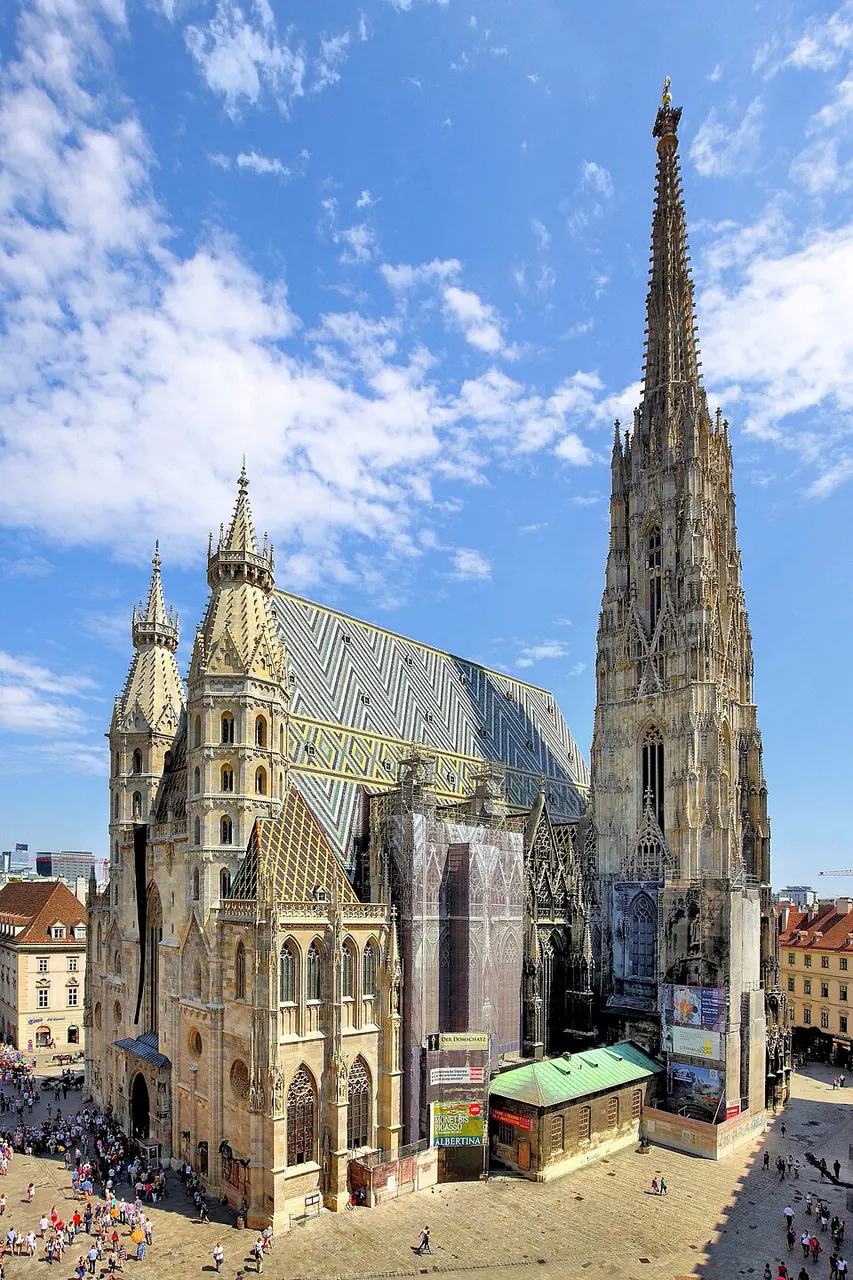
St. Stephen's Cathedral in Vienna is far more than just a church; it is the architectural and spiritual heart of the city. Regarded as Vienna's landmark and often called Austria's national sanctuary, it shapes the skyline of the Inner City like no other building. It is named after Saint Stephen, the first Christian martyr, with All Saints as its second patron. The building has been a collegiate church and the seat of a community of priests since the 14th century, a cathedral since the 15th century, and the metropolitan church of the Archbishop of Vienna since the 18th century. For visitors, the cathedral is not only a place of worship but also a fascinating testament to European architecture, shaped over the centuries by different styles and historical events.
The building itself is impressive in scale, measuring 109 meters long and 72 meters wide. It is considered one of the most important Gothic structures in Austria, though parts of the Late Romanesque predecessor from the 13th century still survive. These older elements form the west facade, which is flanked by the two so-called Heathens' Towers. The origin of the name is disputed; it may refer to ancient Roman stones used in the construction, or to non-Christian fertility symbols depicted on the blind columns. The towers are about 65 meters tall and are joined by a Late Gothic flying arch that braces the towers against each other and prevents settling.
The best-known part of the cathedral is the South Tower, affectionately called the "Steffl" by Viennese. At 136.4 meters, it is the tallest of the four towers, and when it was completed in 1433 it was the tallest structure in continental Europe. Despite this enormous height, the tower's foundation is surprisingly shallow, less than four meters deep. The tower is an architectural masterpiece, its square base gradually transitioning into an octagon through a clever arrangement of gables. Below the spire, twelve pinnacles rise up, giving the tower a delicate yet monumental grace.
Visitors can climb the South Tower to a height of 72 meters. There you will find the so-called watchman's room (Türmerstube), which offers breathtaking views over the rooftops of Vienna and the surrounding Alps. For safety reasons, climbing further to the top of the spire is reserved exclusively for staff of the cathedral's building office. Historically, the tower also served as a fire watchtower, where watchmen kept lookout. Today it is also a site of scientific research: sensors installed on the lightning rods record and analyze lightning strikes.
Inside the South Tower there are a total of 13 bells, 11 of which make up the main peal. The most famous of them is the Pummerin, the third-largest free-swinging church bell in Europe. It has hung in the North Tower under a Renaissance cap since 1957. The history of the bells is closely tied to the destruction of World War II, when the original Pummerin shattered in the burning bell frame. The present bell was recast with donations from the public and symbolizes the city's reconstruction and resilience.
The North Tower forms an interesting contrast to the completed South Tower. It was never finished and stands only 68 meters tall. Construction began in the 15th century but was halted because of economic difficulties, religious turmoil, and the looming Turkish threat. Instead, in the 16th century the stump of the tower received a simple belfry with a Renaissance cap named after the master builder Hans Saphoy. The double-headed eagle of the House of Austria sits at the top, which is why the tower is also known as the Eagle Tower. Numerous legends surround the tower's unfinished state, including the story of a master builder who made a pact with the devil to complete the tower quickly.
The roof of St. Stephen's Cathedral is another highlight that captivates visitors. It rises 37.5 meters above the nave and is covered with around 250,000 colorful tiles arranged in a characteristic zigzag pattern. The tiles come from a brickworks in Slovakia and were newly supplied after the fire of 1945. Various coats of arms and symbols can be seen on the roof, including the coat of arms of the Austrian Empire and the Vienna city coat of arms. The roof truss itself is a modern steel structure that replaced the original timber truss, which burned down completely in World War II.
The west facade of the cathedral shows the oldest visible elements of the building, dating from the 13th and 14th centuries. The main portal, the Giant's Gate (Riesentor), is a masterpiece of Romanesque architecture and was richly articulated on the occasion of an imperial visit. It is made of limestone sandstone and decorated with sculptures of apostles, saints, and mythological figures. Above the gate is a tympanum depicting Christ as ruler of the world. Next to the Giant's Gate is the Singers' Gate (Singertor), considered the cathedral's most significant Gothic work of art and originally used as an entrance for the choir singers.
The history of St. Stephen's Cathedral is inseparable from the history of Vienna and Austria. Construction began in the 12th century and stretched over several centuries, with various dukes and emperors supporting the work. Duke Rudolf IV laid the foundation stone for the South Tower in 1359 and contributed significantly to raising the church's status. Over the centuries, the cathedral was damaged by fires, wars, and natural events, but was always rebuilt. World War II in particular left deep scars, when the roof truss and belfry went up in flames. The reconstruction, funded by numerous donations, was completed in 1952 with a ceremonial reopening.
Today, St. Stephen's Cathedral is a living place used both for religious services and for cultural installations. Artworks are regularly exhibited here that cast the cathedral in a new light and draw public attention. The cathedral remains a central meeting point for locals and tourists alike and a symbol of Vienna's cultural and historical importance. The combination of Gothic splendor, Romanesque roots, and modern restoration makes St. Stephen's Cathedral a distinctive and fascinating destination that draws visitors from around the world.
At a glance
- Category
- Sight › Historic sites
- Rating
- no reviews yet · write a review
- Address
- Stephansplatz 1
1010 Vienna, Austria - District
- Innere Stadt
- Phone
- +431515523767
- Website
- de.wikipedia.org
- —
- Coordinates
- 48.20821° N · 16.37311° E
- Data quality
- confidence 0.78
- Identifier
- ID eade8e8a-02c…
Part of the tour
Vienna in a Day: Cathedral, Hofburg and Ringstrasse →Location & surroundings
Toggle layersRatings & comments
none yetNear St. Stephen's Cathedral South Tower
closest 5 per category · 2 kmSights
Restaurants
Museums
Hotels
More:Historic sites in Vienna (518)Sights in Innere Stadt (216)All sights in Vienna (661)
300 places within 2 km loaded.
You need a free account to leave reviews and photos – that keeps comments genuine and lets you edit them later.