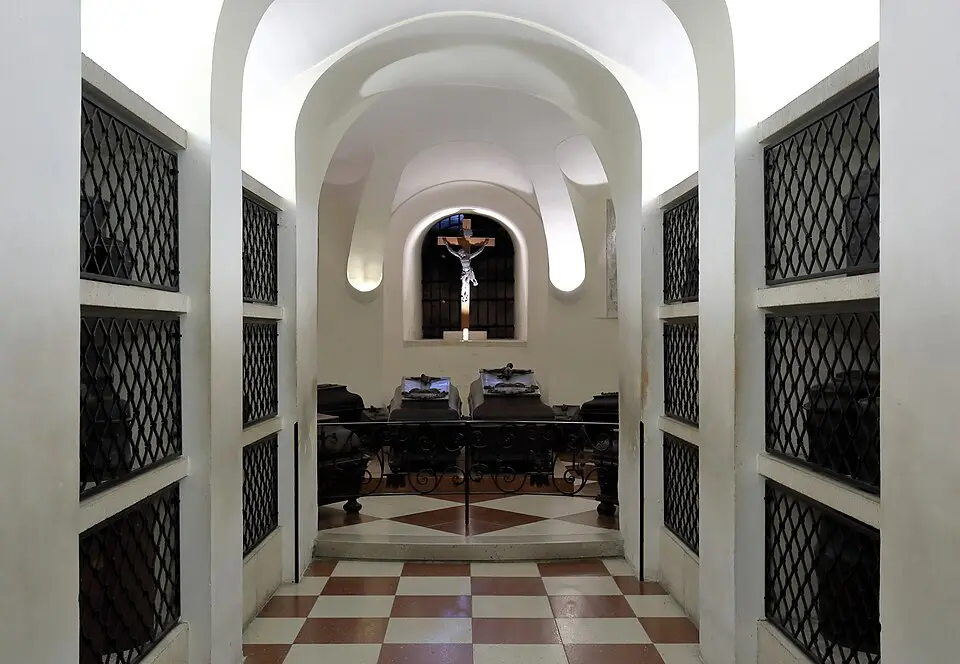
About Ducal Crypt, Vienna
The Ducal Crypt (Herzogsgruft) lies beneath the central choir of St. Stephen's Cathedral in Vienna and forms the oldest part of the catacombs there. Duke Rudolf IV had it built around 1363, and it went on to become one of the most important Habsburg family burial sites. The space originally consisted of a rectangular, vaulted chamber reached by a steep stairway. After the burial of an archduke in 1566, the crypt fell into oblivion until it was rediscovered by chance in 1645. Afterward, King Ferdinand IV introduced the so-called separate burial, in which the entrails or hearts of the deceased were interred here, while their bodies rested in other crypts. This practice meant that between 1654 and 1878, the remains of 56 Habsburgs were placed in urns in the crypt.
The architectural form of the crypt changed over the centuries. In the 1750s, Maria Theresa had an oval chamber added and the remains of her ancestors transferred to new metal sarcophagi. Today the complex presents itself as an ensemble of rectangular and oval sections that were renovated and remodeled in 1956 and 1967. Here you can admire the metal sarcophagi of important rulers such as Emperor Matthias, Leopold I, and Maria Theresa. In addition, copper urns containing the entrails or hearts of the Habsburgs, once wrapped in silk cloths and preserved in spirits, stand in niches behind iron grilles.
Alongside the Imperial Crypt (Kapuzinergruft), the Ducal Crypt is regarded as one of the most significant monuments of European history. In a very confined space, it holds a unique collection of the remains of Austrian rulers and their families, spanning the 17th to the 19th century. The site documents not only the burial traditions of the House of Habsburg but also the historical development of corpse preservation and court protocol. For visitors, it offers an impressive glimpse into Vienna's dynastic history and the religious and political customs of past centuries.
At a glance
- Category
- Sight › Historic sites
- Rating
- no reviews yet · write a review
- Address
- —
Vienna, Austria - District
- Innere Stadt
- Phone
- —
- Website
- —
- —
- Coordinates
- 48.20833° N · 16.37278° E
- Data quality
- confidence 0.80
- Identifier
- ID a2832fec-993…
Location & surroundings
Toggle layersRatings & comments
none yetNear Ducal Crypt, Vienna
closest 5 per category · 2 kmSights
Restaurants
Museums
Hotels
More:Historic sites in Vienna (518)Sights in Innere Stadt (216)All sights in Vienna (661)
300 places within 2 km loaded.
You need a free account to leave reviews and photos – that keeps comments genuine and lets you edit them later.