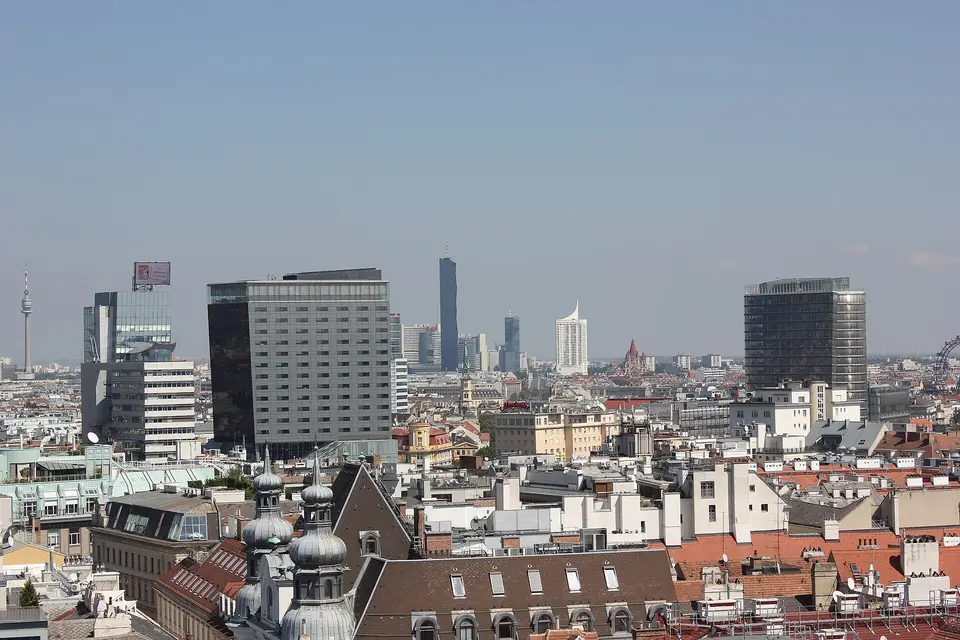
About Downtown Vienna
Vienna, the federal capital of the Republic of Austria, is not only the most populous of the country's federal states but also one of the most important metropolises in Europe. With more than two million residents in the city proper and around three million in the greater metropolitan area, the city on the Danube is an economic and cultural center of international standing. The second-largest city in the German-speaking world and the fifth-largest in the European Union, Vienna attracts more than eight million tourists every year, who come for its high quality of life and rich cultural offerings. The city lies on the eastern edge of the Alps, where the Alpine foothills give way to the Pannonian Plain, a geographic position that shaped its historical development as a crossroads between West and East.
The city's roots reach back to pre-Roman times, when Celtic settlements such as Vedunia sprang up on the banks of the Wien River. In the first century A.D., the Romans built the military camp of Vindobona on this site, which served as a border defense for the province of Pannonia. Even today, the streets of the Inner City follow the original course of the walls and the layout of the Roman camp. After the Romans withdrew in the fifth century, the settlement experienced a new upswing in the Middle Ages, coinciding with the victory over the Magyars in 955. In the 11th century, Vienna became an important trading center, and in 1155 Duke Henry II Jasomirgott declared the city his capital.
Habsburg rule, which began in 1278, changed the face of Vienna for good. Under Duke Rudolf IV, the University of Vienna was founded in 1365, and the construction of the Gothic nave of St. Stephen's Cathedral set architectural accents that still define the city today. In the 15th century, Vienna became the residence city of the Holy Roman Empire, cementing its status as a political center. The Counter-Reformation brought the Jesuits to the city, where they took over the university and censored books, wielding great influence over cultural and religious life. This era established Vienna as the starting point of Catholic renewal in the empire.
Two severe Ottoman sieges in the 16th and 17th centuries profoundly shaped the city's history. The first siege in 1529 failed but led to the construction of modern fortifications. The second siege in 1683 ended with the victory of the Polish relief army under Jan Sobieski, which set in motion the Ottoman Empire's final retreat from Central Europe. In the aftermath, Vienna enjoyed a golden age of Baroque, known as Vienna gloriosa. Architects such as Johann Bernhard Fischer von Erlach and Johann Lukas von Hildebrandt adorned the city with magnificent noble palaces and churches that reflected the reconstruction and the monarchy's new wealth.
In the 19th century, Vienna transformed from a fortress city into a modern metropolis. After the March Revolution of 1848 and the October Revolution that followed, the old city walls were torn down and the famous Ringstrasse was laid out in their place. This wide boulevard, lined with monumental Historicist buildings, symbolizes the transition into the Gründerzeit, the era of rapid industrial expansion. The regulation of the Danube between 1868 and 1875 created a straight main channel and the Danube Canal, which eased urban development and trade. Industrialization led to rapid population growth, and around 1910 the city passed the mark of two million inhabitants.
The turn of the century around 1900 is regarded as one of the most culturally fertile periods in Vienna's history. Viennese Modernism, driven by the Secession art movement, made the city a center of Art Nouveau. In music, the Second Viennese School emerged around Arnold Schoenberg, while in literature the coffeehouse became a place of intellectual exchange. Sigmund Freud founded psychoanalysis here, and the city became a melting pot for artists, thinkers, and scientists from every corner of the Austro-Hungarian monarchy. This cultural dynamism shaped Vienna's self-image right up to the present day.
After the end of World War I and the collapse of the Habsburg monarchy, Vienna became the capital of the new state of German-Austria in 1918, before becoming a federal state in its own right in 1920. The period of the First Republic, often called "Red Vienna," was marked by Social Democratic reforms. The city government invested heavily in building municipal housing complexes to provide workers with decent homes, and created a dense network of social services. These pioneering achievements in social housing remain visible today and are part of the city's heritage.
The Nazi era was a dark chapter for Vienna. After the Anschluss in 1938, the Jewish population was systematically persecuted, dispossessed, and murdered. Of the nearly 200,000 Jewish residents, only a few survived the Shoah, and the city lost a large part of its cultural diversity. In World War II, Vienna was heavily damaged by air raids, with about a third of the city center destroyed. St. Stephen's Cathedral survived the bombing but was damaged by a fire that broke out during looting. After the war, the arduous reconstruction of the city began.
Today, Vienna is a cosmopolitan metropolis with a high quality of life and a strong focus on international cooperation. The city is home to more than 40 international organizations, including OPEC, the IAEA, and the OSCE. The Vienna International Centre (VIC) houses one of the four headquarters of the United Nations and is a symbol of Vienna's diplomatic role, which dates back to the Congress of Vienna in 1814/15. This international outlook makes Vienna an important hub for politics, business, and culture.
Architecturally, the city impresses with a harmonious mix of styles. The Ringstrasse buildings of the Gründerzeit, the grand Baroque edifices, and the Art Nouveau facades of Viennese Modernism define the cityscape. The historic center of Vienna and Schönbrunn Palace are UNESCO World Heritage Sites and draw visitors from around the world. The city offers a wide range of cultural experiences, from classical concerts at the State Opera to modern exhibitions at museums such as the Albertina.
Nature is closely woven into urban life in Vienna. A green belt surrounds the city center, made up of forests such as the Lainzer Tiergarten, as well as parks and vineyards. The Danube-Auen National Park in the southeast of the city offers a refuge for wildlife and is a popular destination for day trips. The Danube itself, with its floodplains and islands, shapes the city's climate and landscape. With its combination of historical depth, cultural diversity, and natural beauty, Vienna remains a fascinating destination that unites tradition and modernity in a unique way.
At a glance
- Category
- Sight › Historic sites
- Rating
- no reviews yet · write a review
- Address
- Stephansplatz 1
1010 Vienna, Austria - District
- Innere Stadt
- Phone
- +436643852383
- Website
- downtownvienna.com
- info@dtvie.com
- Coordinates
- 48.20871° N · 16.37265° E
- Data quality
- confidence 0.93
- Identifier
- ID 497bd1c3-369…
Part of the tour
Vienna in a Day: Cathedral, Hofburg and Ringstrasse →Location & surroundings
Toggle layersRatings & comments
none yetNear Downtown Vienna
closest 5 per category · 2 kmSights
Restaurants
Museums
Hotels
More:Historic sites in Vienna (518)Sights in Innere Stadt (216)All sights in Vienna (661)
300 places within 2 km loaded.
You need a free account to leave reviews and photos – that keeps comments genuine and lets you edit them later.
has the Heeresgeschichtliche Museum that has several high profile exhibits from the war, including the bloodstained order of Wallenstein to Pappenheim to intervene in the battle of Lützen where the latter would die (leading to the bloodstains)
Source: Wikivoyage, „Thirty Years' War“ · authors per page history · CC BY-SA 4.0