About Wien Museum Prater Museum
Vienna's Prater is a sprawling area in the city's second district, covering roughly six square kilometers (about 2.3 square miles). Although the name is often associated with the famous Wurstelprater amusement park, the entire area encompasses far more than this one attraction. The Prater lies in the southeastern part of the river island that was created by the regulation of the Danube in the 19th century. The landscape is shaped by the historic Danube floodplains, which still exist today in various forms. While the northern part is heavily urbanized and home to the amusement park, the south and east still contain relatively untouched areas of wet floodplain landscape, which are protected as a landscape conservation area.
The history of the site goes back to the 12th century, when Emperor Frederick I Barbarossa gave away land in the region that was known as Pratum, meaning meadow. Over the centuries, the name Prater, which originally referred only to a small island in the Danube, came to describe the adjacent floodplains. Until the mid-18th century, the Prater was a closed hunting ground of the emperor and his court, off-limits to the general public. Not until 1766 did Emperor Joseph II open the area to the people, marking the beginning of a new era as a public recreation area.
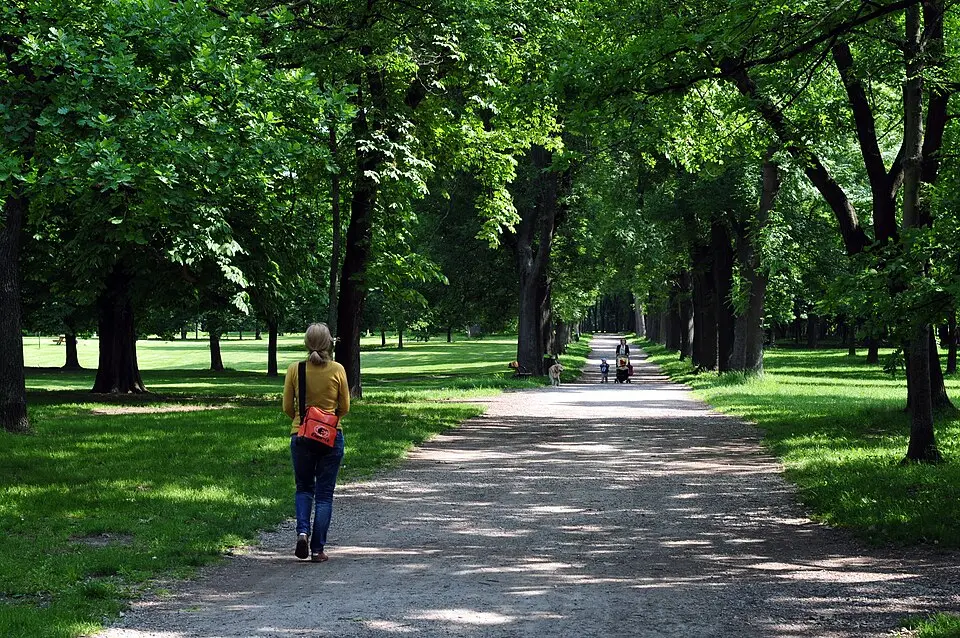
Since it opened, the Prater has become one of the most popular excursion destinations for Viennese. Especially on holidays and at the start of the season in May, large crowds poured into its avenues and meadows. The writer Adalbert Stifter once described the place as a unique blend of park, meadow, garden, and forest that cannot be fitted into a single category. This variety is what makes the place so appealing, suited to both athletic activities and quiet strolls. The Hauptallee, laid out in 1538 as a perfectly straight path through the floodplain forest, remains the backbone of the Prater to this day, connecting the Praterstern in the north with the Lusthaus in the south.
A central point of the Prater is the Praterstern, a star-shaped square created in 1782 from which seven avenues once radiated. Today this hub is an important traffic junction with connections to subway lines U1 and U2 as well as various streetcar and bus lines. The Praterstern is the entrance to the Wurstelprater, the best-known part of the area. Here you'll find the Giant Ferris Wheel, the planetarium, and numerous other rides that have shaped the character of the amusement park since the 18th century. The Wurstelprater itself is only a small part of the total area, but it concentrates the tourist highlights.
In the southern part of the Prater stands the Lusthaus, a Baroque pavilion built between 1781 and 1783. The building originally served as a hunting lodge and later became a meeting place for elegant Viennese society. Today it is a popular restaurant and an architectural landmark of the area. Near the Lusthaus you can still see remnants of the original arms of the Danube, such as the Lusthauswasser and the Mauthnerwasser, which are protected as natural monuments. These waters recall the time before the Danube Canal was regulated and the terrain took on its present dry form.
The Danube regulation, completed in 1875, fundamentally changed the Prater's landscape. The creation of a new, deeper riverbed lowered the water table, and much of the original floodplain vegetation disappeared. Only in the southeastern section did wet floodplain landscapes survive. These changes turned many of the former Danube arms into stagnant oxbow lakes. Despite these interventions, the Prater remains an important refuge for nature and for the recreation of city residents, and its green section has been a protected landscape area since 1978.
A special historical event was the 1873 World's Fair, held on the Prater grounds. For this event the Rotunda was built, which at the time had the largest dome in the world. Although the Rotunda fell victim to a fire in 1937, street names and two surviving pavilions still recall that era. The pavilions, which lie between the Krieau trotting track and the stadium, now serve as studios for sculptors. The World's Fair was a cultural highlight that made the Prater internationally known and laid the foundation for today's exhibition grounds.
In the 20th century, the Prater saw further developments and destruction. During World War II, large parts of the area, especially the Wurstelprater and the exhibition grounds, were badly damaged by fighting and bombing. After the war, reconstruction began and continued into the 1950s. During this time new infrastructure was also created, such as the subway connection and the commuter rail line, which improved access to the Prater. The Liliputbahn, a narrow-gauge railway opened in 1928, is a popular attraction that takes visitors through the Prater's meadows and wooded areas.
Today the Prater is a diverse recreation area with a large number of sports facilities. Here you can play soccer, tennis, and golf, go horseback riding, and enjoy many other activities. In winter, cross-country ski trails and sledding runs are popular. The core of the Prater is car-free, which adds to the peace and safety of pedestrians and cyclists. Connections to the public transportation network are excellent, making the Prater an easy destination for locals and tourists alike. The combination of historical significance, natural landscape, and modern leisure offerings makes the Vienna Prater an indispensable part of city life.
The Prater Museum, housed in an annex of the planetarium, offers insight into the history of the area. The collection was donated by a local historian and includes exhibits documenting the Prater's development over the centuries. Here you can learn more about the history of the hunt, the World's Fair, and the cultural events that have shaped the Prater. The museum is a good starting point for exploring the Prater's many facets and understanding the close connection between past and present.
In short, the Vienna Prater is far more than just an amusement park. It is a living piece of Viennese history that stretches from the imperial hunt to modern leisure society. The mix of nature, culture, and entertainment makes it a unique place with something to offer every visitor. Whether you stroll along the historic Hauptallee, enjoy nature in the southern part, or try the rides in the Wurstelprater, the Prater offers a varied package of experiences that reflects the appeal of Vienna in a special way.
At a glance
- Category
- Museum › History museums
- Rating
- no reviews yet · write a review
- Address
- Prater 92
1020 Vienna, Austria - District
- Leopoldstadt
- Phone
- +431505874785173
- Website
- www.wienmuseum.at
- service@wienmuseum.at
- Coordinates
- 48.21697° N · 16.39696° E
- Data quality
- confidence 1.00
- Identifier
- ID dea5f2bf-84d…
Location & surroundings
Toggle layersRatings & comments
none yetNear Wien Museum Prater Museum
closest 5 per category · 2 kmSights
Restaurants
Museums
Hotels
More:History museums in Vienna (57)Museums in Leopoldstadt (16)All museums in Vienna (308)
259 places within 2 km loaded.
You need a free account to leave reviews and photos – that keeps comments genuine and lets you edit them later.
This large park began life as a carriage-riding area for the nobility, and is still a popular place to spend a weekend afternoon with family.
Source: Wikivoyage, „Vienna/Inner East“ · authors per page history · CC BY-SA 4.0 · as of 2/3/2017