Vienna: Imperial City, Coffeehouses, and Culture
Travel guide · editorialVienna is both the capital and a federal state of Austria in its own right, and one of the most livable big cities in the world. A vacation in Vienna combines Habsburg palaces and world-class museums with coffeehouses, wine taverns known as Heurigen in the vineyards on the city's edge, and a musical tradition stretching from Mozart to the present day.
A City on the Danube and the Vienna Woods
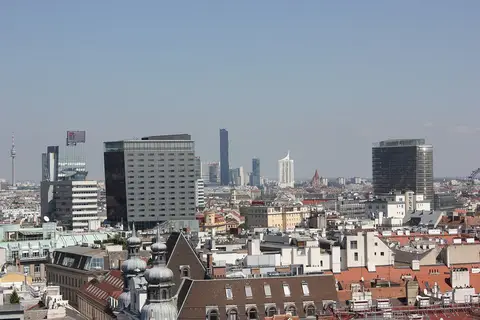
Vienna lies where the foothills of the Alps, the Vienna Woods, meet the Vienna Basin. To the west and north, wooded hills such as the Kahlenberg and the Leopoldsberg stretch all the way to the city limits, with vines growing on their slopes – Vienna is one of the few major cities with significant wine production within its borders. The Danube flows in a regulated channel to the east, alongside the Danube Island with its swimming spots and the Danube-Auen National Park, which reaches into the city. The Prater, with its Ferris wheel and broad floodplain forests, serves as a green lung.
Districts and Neighborhoods
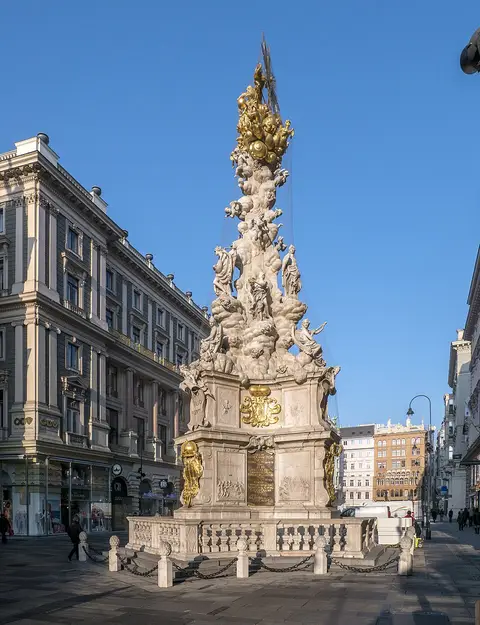
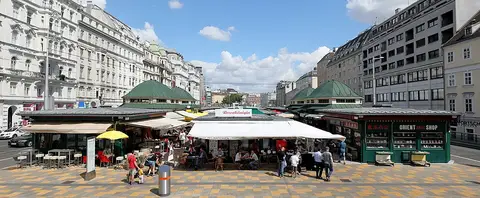
The Inner City, the 1st district, is encircled by the Ringstrasse, where the State Opera, Parliament, City Hall, Burgtheater, and museums were built in the 19th century. Inside the ring you'll find St. Stephen's Cathedral, the Graben, the Kohlmarkt, and the Hofburg. Beyond the Ring, distinct neighborhoods begin: the Freihausviertel and the Naschmarkt in Wieden and Mariahilf, the MuseumsQuartier by the Spittelberg, the 2nd district of Leopoldstadt with its Jewish heritage, the late-19th-century districts to the west, and the Heuriger villages of Grinzing, Sievering, and Stammersdorf on the outskirts. Municipal housing complexes such as the Karl-Marx-Hof bear witness to "Red Vienna" of the interwar period, when the city built social housing on a grand scale.
Away from the major sights, it's worth strolling through the Naschmarkt with its stalls and eateries, visiting the Augarten with its porcelain manufactory, or taking streetcar line D to the Heurigen in Nussdorf. The Central Cemetery, with the graves of Beethoven, Schubert, and Brahms, is a place of quiet all its own, and in summer young Viennese gather at beach bars along the Danube Canal.
Sights in Vienna
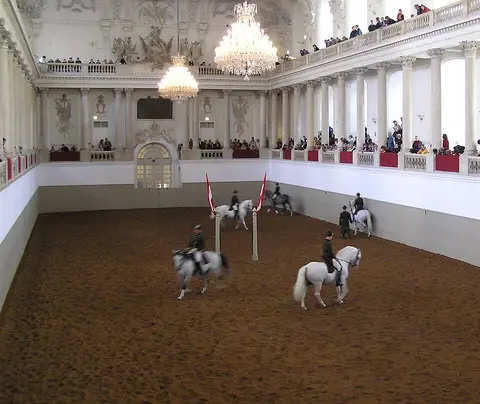
Schönbrunn Palace, the Habsburgs' summer residence with its park, the Gloriette, and the oldest zoo in the world still in operation, is the most visited site. Other well-known sights in Vienna include St. Stephen's Cathedral with its colorful tiled roof, the Hofburg with the Sisi Museum and the Spanish Riding School, the Belvedere with Klimt's "The Kiss," and the Museum of Fine Arts with paintings by Bruegel. The Hundertwasserhaus, the Secession building with the Beethoven Frieze, Otto Wagner's buildings such as the Church at Steinhof, and the Ferris wheel in the Prater showcase other eras. The Inner City and Schönbrunn are UNESCO World Heritage Sites.
Music and Culture
Mozart, Haydn, Beethoven, Schubert, Brahms, and the Strauss family all lived and composed in Vienna. The State Opera, the Musikverein with the Vienna Philharmonic's New Year's Concert, and the Konzerthaus offer performances almost every day. During the ball season between New Year's Eve and Carnival, hundreds of balls take place, including the Opera Ball. Viennese coffeehouse culture is recognized as UNESCO cultural heritage: at Café Central, Café Hawelka, or Café Sperl, people read the newspaper for hours over a Melange. Sigmund Freud developed psychoanalysis here, and his former home on Berggasse is now a museum.
Modern art is on show at the Leopold Museum, home to the world's largest Schiele collection, and at the mumok in the MuseumsQuartier, while architecture fans visit Otto Wagner's Postal Savings Bank and the Looshaus on Michaelerplatz.
Food and Drink
Wiener schnitzel made from veal, Tafelspitz with apple horseradish, goulash, and Backhendl (fried chicken) are the classics of Viennese cuisine. Among the pastries and sweet dishes are Sachertorte, apple strudel, Kaiserschmarrn, and Topfenknödel (quark dumplings). At a sausage stand you can get a Käsekrainer, and at a Heuriger you drink the Wiener Gemischter Satz, a white wine made from several grape varieties grown in the same vineyard, alongside a cold platter called a Jause. In summer, the Danube Island Festival and open-air cinema on the Rathausplatz are big draws.
Getting There and Best Time to Visit
Vienna-Schwechat Airport is connected to the city by the City Airport Train in 16 minutes. From Munich, the Railjet takes around four hours, and night trains link Vienna with many German cities. The subway, streetcars, and buses serve all districts frequently and affordably. The best times to visit are spring and fall; during Advent, the Christmas markets in front of City Hall, at Schönbrunn, and on the Spittelberg are a major draw.