Hanoi: A Thousand Years as Capital on the Red River
Travel guide · editorialHanoi wears its age with composure: for more than a thousand years, kings, colonial officials and party secretaries have ruled here, and yet the city, spread around its lakes, still feels almost like a village. A vacation in Hanoi combines narrow merchant lanes, French boulevards and pagodas with a surrounding region of rice paddies, craft villages and karst mountains.
Location on the Red River
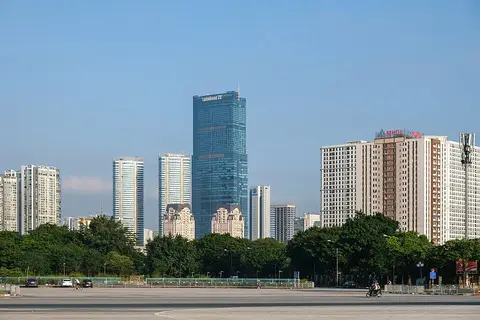
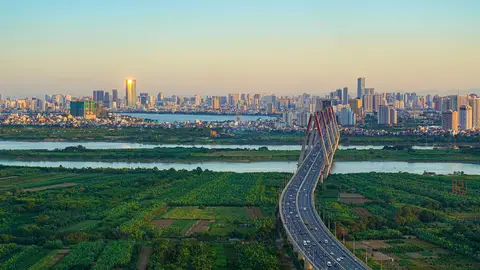
Vietnam's capital lies in the Red River Delta, about 100 kilometers (62 miles) from the coast of the Gulf of Tonkin. Its name means "city within the rivers," and waterways and about two dozen lakes do indeed shape the cityscape. Since 2008, the former province of Hà Tây has also been part of the city province, which is why the territory extends west to the foothills of the Ba Vì mountains. There you'll find the old garrison town of Sơn Tây, the university district of Hòa Lạc and Xuân Mai, and to the north Sóc Sơn with the airport. In total, almost nine million people live on roughly 3,360 square kilometers (1,300 square miles).
The Old Quarter and Its Lakes
Between Hoàn Kiếm Lake and the Red River lies the Quarter of the 36 Streets, where each guild once claimed its own street: Hàng Bạc for silver, Hàng Mã for paper offerings, Hàng Thiếc for tin. The narrow tube houses are often only three meters (10 feet) wide and dozens of meters deep. On weekends, the city closes the streets around the lake to cars, and the shoreline belongs to street performers, families and badminton players. On an island in the lake stands Ngọc Sơn Temple, reached via the red-lacquered Thê Húc Bridge. Farther north lies West Lake, the city's largest, with Trấn Quốc Pagoda, considered the oldest pagoda in Hanoi.
Hanoi Attractions
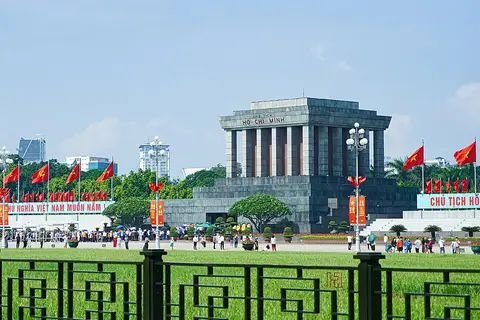
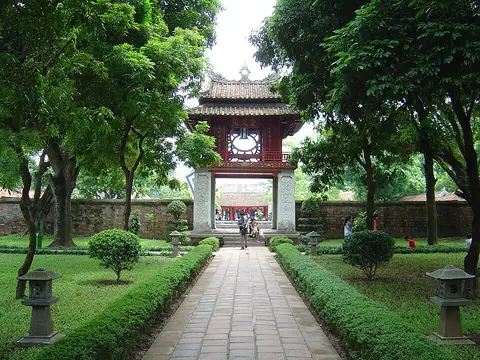
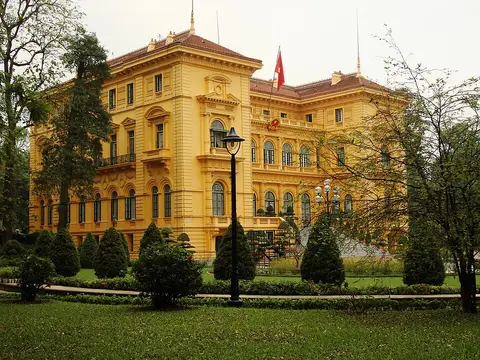
The Temple of Literature, founded in 1070, was Vietnam's first university; the names of the doctoral graduates who passed their exams here are inscribed on stone steles resting on stone turtles. Just a few minutes' walk away, Hồ Chí Minh lies embalmed in his mausoleum on Ba Đình Square, near which you'll also find the One Pillar Pagoda and his simple stilt house. The Imperial Citadel of Thăng Long is a UNESCO World Heritage Site, and its excavations offer a glimpse into several dynasties. The French legacy shows in the 1911 Opera House, the Hotel Metropole and the villas of the district south of Hoàn Kiếm Lake. The Museum of Ethnology offers the best overview of the country's 54 ethnic groups, while the Hỏa Lò Prison, once nicknamed the "Hanoi Hilton" by American pilots, tells the story of the colonial era and the war. And on the famous Train Street, the train rolls past house walls just inches away, though the authorities have at times restricted access.
Day Trips from Hanoi
Hanoi's destinations beyond the city are varied. The Perfume Pagoda lies in a karst landscape to the south and is visited in spring by hundreds of thousands of pilgrims who arrive by rowboat along the Yến River. In the pottery village of Bát Tràng, artisans have been throwing ceramics for centuries, and in Vạn Phúc families weave silk. The old village of Đường Lâm near Sơn Tây has preserved its laterite houses and ancestral halls, while Ba Vì National Park offers cooler forest air and views over the delta. Hanoi is the usual starting point for day trips to Ninh Bình or multi-day trips to Halong Bay.
Food and Drink
Hanoi is considered the birthplace of phở, the noodle soup with beef or chicken, which is served here with a clear broth and few herbs. Bún chả, grilled pork in a sweet-and-sour broth with rice noodles, became world-famous when Barack Obama ate it at a simple street kitchen in 2016. Chả cá Lã Vọng, fish fried with turmeric and dill, even has a street named after it. To finish, you'll want an egg coffee, cà phê trứng, made with whipped egg yolk, at an Old Quarter café. In the evening, locals sit on plastic stools at the corner of Tạ Hiện over freshly tapped bia hơi.
Getting There and Best Time to Visit
Nội Bài Airport (HAN) lies about 30 kilometers (19 miles) north of the center; Vietnam Airlines flies direct from Frankfurt. Within the city, taxis and Grab motorbikes are practical, and two metro lines supplement the bus network. Trains run south as far as Saigon and north toward Lào Cai. The best time to visit is fall, from October to December, with mild temperatures and clear skies. In winter it turns gray and cool, often below 59°F, while summer from May to September is hot, humid and rainy.