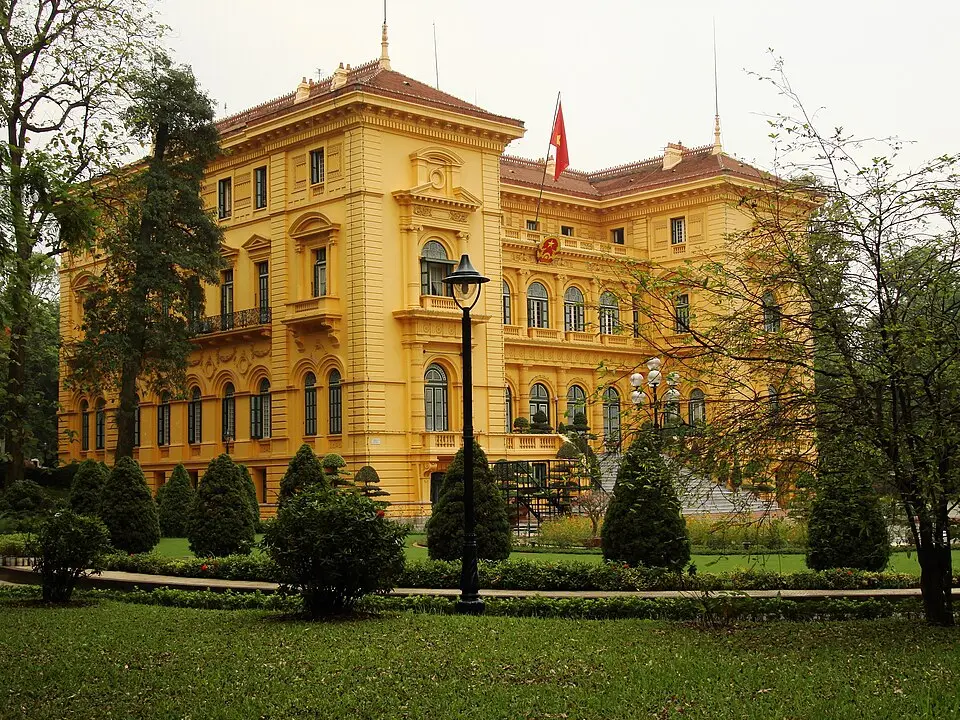
About Phủ Chủ Tịch
The Presidential Palace in Hanoi serves as the official residence of the Vietnamese president. It was built between 1900 and 1906 as the home of the French governor-general. The yellow building, with its wrought-iron gates and sentry boxes, is a strongly European example of colonial architecture, its only local touch being the mango trees growing on the grounds. After independence in 1954, Ho Chi Minh refused to live here, but he had a traditional stilt house and a carp pond built on the property. Government meetings are still held in the palace today. Although the building itself is not open to visitors, you can tour the surrounding grounds for a fee.
At a glance
- Category
- Sight › Palaces
- Rating
- no reviews yet · write a review
- Address
- Hùng Vương
Hanoi, Vietnam - District
- Ba Dinh Ward
- Phone
- +841659835735
- Website
- —
- —
- Coordinates
- 21.03797° N · 105.83413° E
- Data quality
- confidence 0.95
- Identifier
- ID 00e93127-1db…
Location & surroundings
Toggle layersFAQ about Phủ Chủ Tịch
quick answersWhat is the Phủ Chủ Tịch in Hanoi?
The Phủ Chủ Tịch is the Presidential Palace in Hanoi and serves as the official residence of the Vietnamese president. The building was constructed between 1900 and 1906 as a residence for the French governor-general. The yellow building, with its wrought-iron gates and guard booths, is a strongly European-influenced example of colonial architecture; only the mango trees on the grounds offer a local touch. Government meetings are still held in the palace today.
Can you visit the Presidential Palace (Phủ Chủ Tịch) in Hanoi?
The palace building of the Phủ Chủ Tịch in Hanoi is not open to visitors, but you can tour the surrounding grounds for a fee. The reason for the closure: government meetings continue to take place in the palace. On the grounds, you can see the colonial facade, the wrought-iron gates, and the mango trees, among other things.
What is Ho Chi Minh's connection to the Presidential Palace in Hanoi?
After independence in 1954, Ho Chi Minh refused to live in the Presidential Palace (Phủ Chủ Tịch) in Hanoi. Instead, he had a traditional stilt house and a carp pond built on the grounds. The stilt house is known as Nhà Sàn Bác Hồ and, according to travelguide195, is about 99 meters from the palace.
What can you see around the Phủ Chủ Tịch in Hanoi?
Around the Presidential Palace (Phủ Chủ Tịch) in Hanoi's Ba Đình district, several well-known historic sites lie close together. According to travelguide195, the Ho Chi Minh Mausoleum is only about 132 meters away. You can reach the One Pillar Pagoda after about 248 meters.
Where is the Phủ Chủ Tịch located, and are there restaurants nearby?
The Phủ Chủ Tịch is located on Hùng Vương Street in the Ba Đình district of Hanoi, a city of about 8.7 million people. For a break after your visit, travelguide195 lists about 29 restaurants within 500 meters of the Presidential Palace.
Ratings & comments
none yetNear Phủ Chủ Tịch
closest 5 per category · 2 kmSights
Restaurants
Museums
Hotels
More:Sights in Ba Dinh Ward (74)All sights in Hanoi (3,480)
279 places within 2 km loaded.
Don't miss in Hanoi
All sights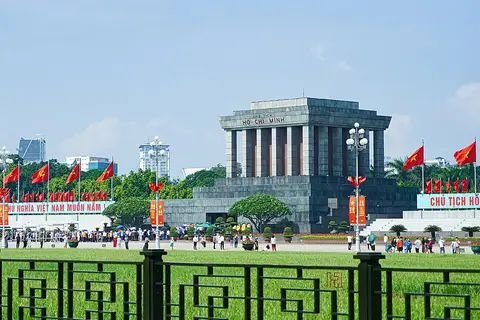 Historic sites01
Ho Chi Minh's Mausoleum
1 Hùng Vương · Hanoi● Website● Phone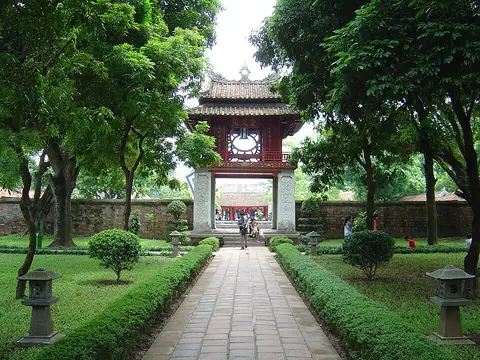 Historic sites02
Văn Miếu Quốc Tử Giám
2 P. Văn Miếu · Hanoi● Website● Phone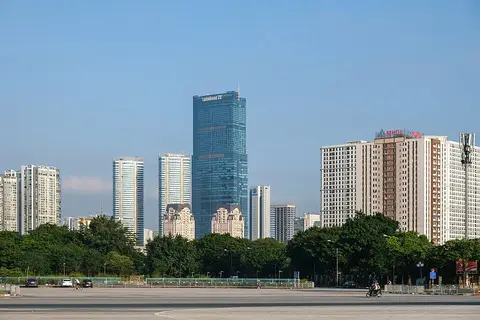 Historic sites03
Keangnam Hanoi Landmark Tower
Phạm Hùng, Nam Từ Liêm · Hanoi● Website● Phone Historic sites04
You need a free account to leave reviews and photos – that keeps comments genuine and lets you edit them later.
The official residence of the President of Vietnam, it is a beautiful French colonial mansion that was built as the residence of the French Governor-General of Indochina. The building is not open to the public, though visitors may walk around part of the grounds. According to the official government narrative, Ho Chi Minh refused to live in the palace for symbolic reasons, and commissioned a simple traditional Vietnamese stilt house on the grounds of the palace to serve as his residence; this stilt house has now been converted into a museum that tourists may visit.
Source: Wikivoyage, „Official residences“ · authors per page history · CC BY-SA 4.0 · as of 4/3/2022