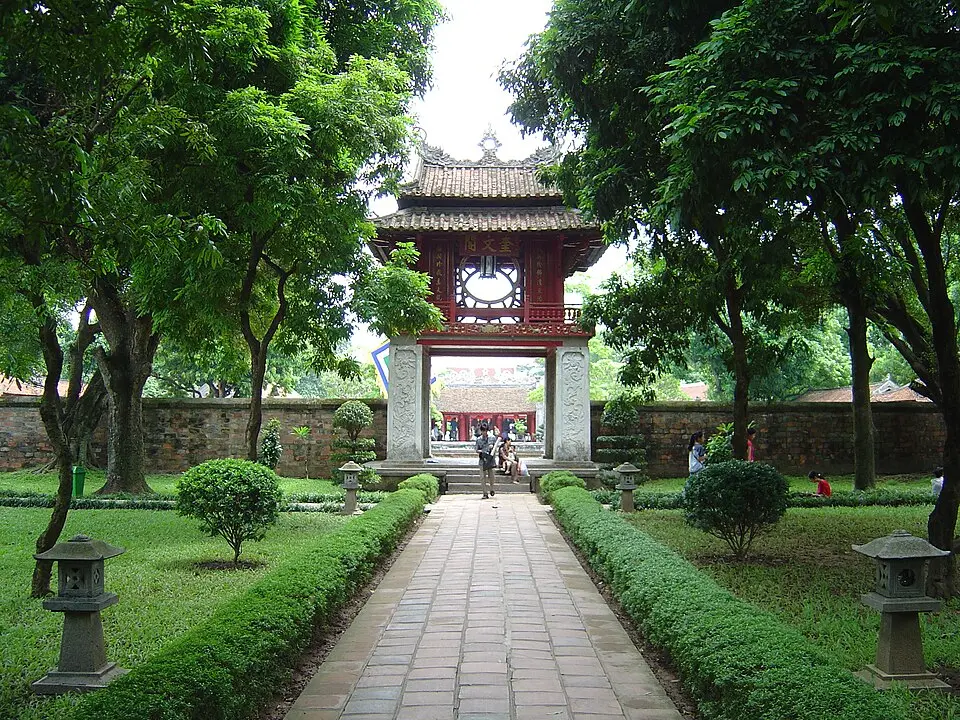
About Văn Miếu Quốc Tử Giám
The Văn Miếu Quốc Tử Giám, on the west side of Hanoi's Old Quarter, is Vietnam's most important Temple of Literature and a historic complex that originally served as the country's first academy. Founded in 1070 under the Lý dynasty, the complex was modeled on the Temple of Confucius in Qufu, China. For more than eight centuries, until 1915, the sons of mandarins and gifted aristocrats were educated here. Although the name suggests a temple, the complex was never used for religious purposes but was the main shrine of Confucian scholarship. The history of the complex is marked by destruction and rebuilding, including severe damage during the First Indochina War. After extensive renovations, most recently in 2000, the complex is now regarded as one of the city's central cultural legacies. A view of the famous Well of Heavenly Clarity is also depicted on the back of the 100,000-đồng banknote.
The complex stretches along a north-south axis across five walled courtyards laid out according to the classical Chinese scheme. You first pass through the main gate, guarded by stone dragons, and continue to the second courtyard. Here stands the two-story Pavilion of the Constellation of Literature, the emblem of Hanoi, which once served as a gathering place for debates and readings. The third courtyard holds the square Thiên Quang Tỉnh pond, surrounded by 82 surviving stone stelae resting on the backs of turtles. These stelae bear the names and exam results of more than 1,300 graduates of the imperial examinations from the Lê and Mạc dynasties and were inscribed on UNESCO's Memory of the World Register in 2010.
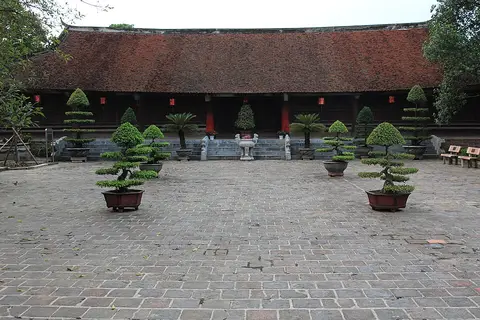
The fourth courtyard forms the temple area proper, with the ceremonial hall and the sanctuary, where a statue of Confucius is flanked by his most important disciples. The space is decorated with elaborate carvings and bronze cranes, while small museums and souvenir shops can be found here today. In the fifth courtyard, the former site of the National University, were the classrooms and later also dormitories for the students. The entire grounds cover about 54,000 square meters and lie south of the Thang Long Citadel, near Hoan Kiem Lake.
At a glance
- Category
- Sight › Historic sites
- Rating
- no reviews yet · write a review
- Address
- 2 P. Văn Miếu
Hanoi, Vietnam - District
- Van Mieu - Quoc Tu Giam Ward
- Phone
- +84437472499
- Website
- www.36phophuong.vn
- longvietarch@gmail.com
- Coordinates
- 21.02767° N · 105.83519° E
- Data quality
- confidence 0.96
- Identifier
- ID 2b16a853-d87…
Part of the tour
Hanoi in One Day: From Ba Đình to Hoàn Kiếm Lake →Location & surroundings
Toggle layersFAQ about Văn Miếu Quốc Tử Giám
quick answersWhat is the Văn Miếu Quốc Tử Giám in Hanoi?
The Văn Miếu Quốc Tử Giám is Vietnam's most important Temple of Literature and originally served as the country's first academy. The complex in Hanoi was founded in 1070 under the Lý dynasty and modeled on the Temple of Confucius in Qufu, China. For more than eight centuries, until 1915, the sons of mandarins and gifted aristocrats were educated here. Despite its name, the complex never served religious purposes but was the main sanctuary of Confucian scholarship.
What can you see at the Văn Miếu Quốc Tử Giám in Hanoi?
At the Văn Miếu Quốc Tử Giám in Hanoi, you walk along a north-south axis through five walled courtyards covering about 54,000 square meters. After the main gate with its stone dragons, you reach the two-story Pavilion of the Constellation of Literature in the second courtyard, a landmark of Hanoi. The fourth courtyard holds the ceremonial hall and the inner sanctuary with a statue of Confucius, flanked by his most important disciples, as well as small museums and souvenir shops. The fifth courtyard is the former site of the National University, with former classrooms and dormitories.
What is the story behind the stone stelae at the Văn Miếu Quốc Tử Giám?
The stone stelae in the third courtyard of the Văn Miếu Quốc Tử Giám in Hanoi have been part of UNESCO's Memory of the World Register since 2010. The 82 remaining stelae rest on the backs of turtles and stand around the square pond Thiên Quang Tỉnh, the Well of Heavenly Clarity. They bear the names and exam results of more than 1,300 graduates of the imperial examinations from the Lê and Mạc dynasties. A depiction of this pond appears on the back of the 100,000 đồng banknote.
Where is the Văn Miếu Quốc Tử Giám in Hanoi?
The Văn Miếu Quốc Tử Giám is located at 2 P. Văn Miếu in the neighborhood of the same name, Văn Miếu - Quốc Tử Giám, in Hanoi. The complex lies in the west of the Old Quarter, south of the Thang Long Citadel and near Hoan Kiem Lake. The Temple of Literature is part of the tour "Hanoi in One Day: From Ba Đình to Hoàn Kiếm Lake."
What is there to see around the Văn Miếu Quốc Tử Giám in Hanoi?
Around the Văn Miếu Quốc Tử Giám in Hanoi, you'll find more historic sites within walking distance. Hồ Văn lake is about 96 meters away, and the historic site Bích Câu Đạo Quán Đống Đa is about 214 meters away. For a break, travelguide195 lists around 223 restaurants within 500 meters of the Temple of Literature.
Ratings & comments
none yetNear Văn Miếu Quốc Tử Giám
closest 5 per category · 2 kmSights
Restaurants
Museums
Hotels
More:Historic sites in Hanoi (3,419)Sights in Van Mieu - Quoc Tu Giam Ward (50)All sights in Hanoi (3,480)
286 places within 2 km loaded.
You need a free account to leave reviews and photos – that keeps comments genuine and lets you edit them later.
The Temple was founded in 1070 and became the country's first university six years later. The overall design is somewhat similar to the "original" Confucian Temple in Qufu, with 5 courtyards. Most of the architecture is named with titles indicating reverence to literature and language. The showpiece of the complex is the third courtyard with eighty-odd stone tablets, each mounted on the back of a tortoise (known as bixi in Chinese), inscribed with the names of graduates. Another courtyard is full of gift shops, which also sell stamps, coins, and books. A reduced-size replica of the famous giant softshell turtle (the original being at the Ngoc Son Temple at the Lake of the Returned Sword) can be seen in one of the pavilions as well; it was made by Vietnamese artisans out of ceramic, and gold-plated. The fourth courtyard contains a temple and statues devoted to Confucius and his four disciples. Chinese history buffs should look out for the 萬世師表 plaque, which was presented to the temple by Emperor Kangxi of China in 1693. The fifth and last courtyard, which was destroyed by the French in 1946 and rebuilt in 2000, contains a mini-museum showcasing information on Emperor Lý Thánh Tông and his successors who built and renovated the temple. You may find a Vietnamese band playing local instrumental music in front of this museum. There are explanatory wall-hangings in English and French all along the way, and you don't need a guide.
Source: Wikivoyage, „Hanoi“ · authors per page history · CC BY-SA 4.0 · as of 4/7/2020