About Literaturtempel
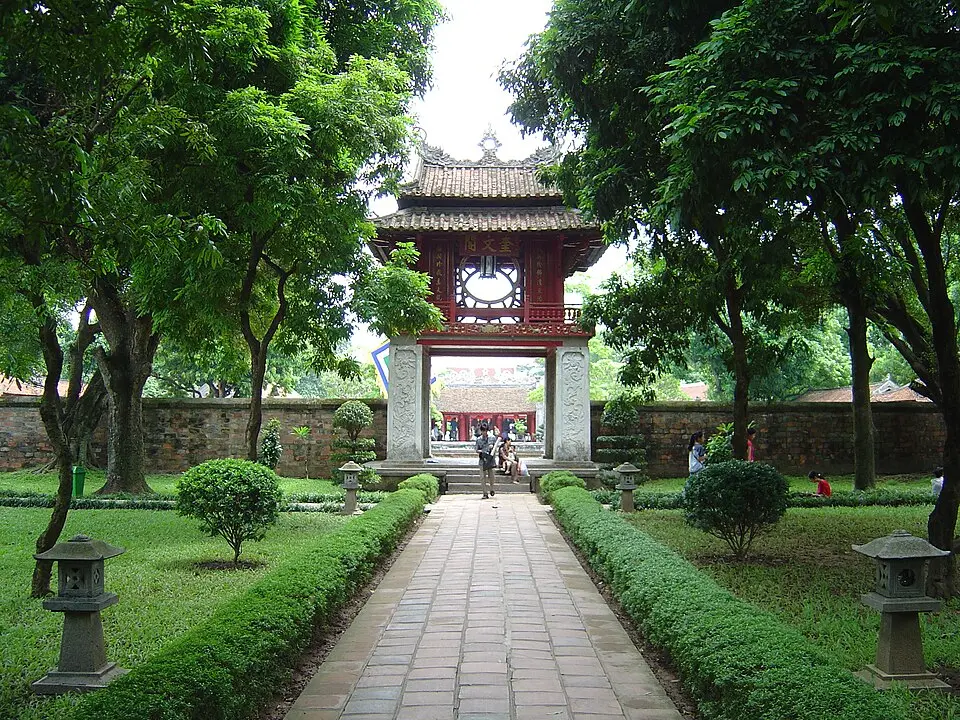
The Temple of Literature in Hanoi is far more than a religious shrine, since it never served primarily as a place of worship. Rather, it is Vietnam's most important Confucian complex, founded in 1070 under the Lý Dynasty as the country's first national academy. For more than eight centuries, until 1915, this was where the sons of mandarins and gifted commoners were trained for the imperial examinations. The architectural concept is based on the Confucian temple in Qufu, China, but it has been reworked and renovated several times over the centuries. Despite destruction over the years, including heavy damage during the First Indochina War, the complex is considered one of the city's most important historical and cultural legacies today.
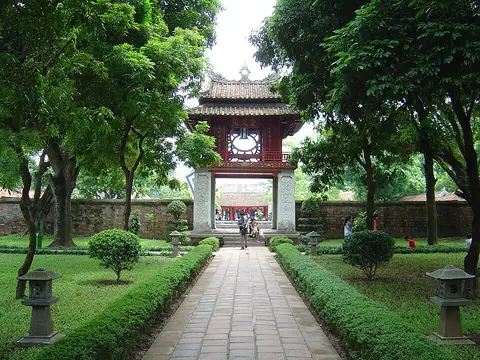
Your visit takes you through five walled courtyards stretching along a central north-south axis. In the second courtyard, the two-story Constellation of Literature Pavilion, a symbol of Hanoi, once served as a gathering place for debates and is the highlight. The third courtyard is dominated by the Well of Heavenly Clarity, surrounded by 82 stone stelae resting on the backs of turtles. These stelae bear the names and examination results of more than 1,300 graduates of the Lê and Mạc dynasties and are recognized as a UNESCO Memory of the World document. The fourth courtyard houses the temple area proper, with the ceremonial hall, where a statue of Confucius is flanked by his most important disciples. The fifth courtyard marks the area of the former National University, where you can still see the academy's classrooms and living quarters today.
At a glance
- Category
- Museum › Museums (general)
- Rating
- no reviews yet · write a review
- Address
- —
Hanoi, Vietnam - District
- Van Mieu - Quoc Tu Giam Ward
- Phone
- —
- Website
- da.wikipedia.org
- —
- Coordinates
- 21.02861° N · 105.83556° E
- Data quality
- confidence 0.48
- Identifier
- ID 6bd6b62c-d05…
Location & surroundings
Toggle layersRatings & comments
none yetNear Literaturtempel
closest 5 per category · 2 kmSights
Restaurants
Museums
Hotels
More:All museums in Hanoi (139)
286 places within 2 km loaded.
You need a free account to leave reviews and photos – that keeps comments genuine and lets you edit them later.
The Temple was founded in 1070 and became the country's first university six years later. The overall design is somewhat similar to the "original" Confucian Temple in Qufu, with 5 courtyards. Most of the architecture is named with titles indicating reverence to literature and language. The showpiece of the complex is the third courtyard with eighty-odd stone tablets, each mounted on the back of a tortoise (known as bixi in Chinese), inscribed with the names of graduates. Another courtyard is full of gift shops, which also sell stamps, coins, and books. A reduced-size replica of the famous giant softshell turtle (the original being at the Ngoc Son Temple at the Lake of the Returned Sword) can be seen in one of the pavilions as well; it was made by Vietnamese artisans out of ceramic, and gold-plated. The fourth courtyard contains a temple and statues devoted to Confucius and his four disciples. Chinese history buffs should look out for the 萬世師表 plaque, which was presented to the temple by Emperor Kangxi of China in 1693. The fifth and last courtyard, which was destroyed by the French in 1946 and rebuilt in 2000, contains a mini-museum showcasing information on Emperor Lý Thánh Tông and his successors who built and renovated the temple. You may find a Vietnamese band playing local instrumental music in front of this museum. There are explanatory wall-hangings in English and French all along the way, and you don't need a guide.
Source: Wikivoyage, „Hanoi“ · authors per page history · CC BY-SA 4.0 · as of 4/7/2020