About Việt Phục Hoàng Thành
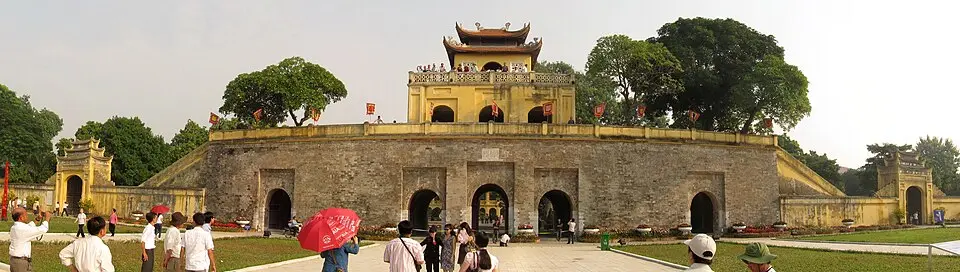
The Imperial Citadel of Thăng Long, whose name literally means "Residence of the Ascending Dragon," is one of the most significant historic sites in Vietnam. It stood on the west bank of the Red River in Hanoi and served for centuries as the imperial court and seat of government for several dynasties. Between 1010 and 1802, the site was the capital of the country under various names. The historic area covers a total of 140 hectares, and its central 20-hectare zone was declared a UNESCO World Heritage Site in 2010. The region is regarded as the cradle of Vietnamese culture, since political and social centers have emerged here since antiquity that decisively shaped the country's development.
The history of the site reaches back to the time before the Christian era. According to legendary sources, the early kingdom of Văn Lang was ruled by a series of kings before it was conquered by Thục Phán and united with his own land. The capital of this new kingdom, Âu Lạc, was the fortress of Cổ Loa, whose name refers to the spiral arrangement of its ramparts. After conquest by Chinese dynasties and a long period of foreign rule known as Bắc thuộc, General Ngô Quyền managed in 938 to end Chinese rule over northern Vietnam. He founded the independent state of Đại Cồ Việt and at first made the old fortress of Cổ Loa his capital, before the residence was later moved to Hoa Lư.
The site's real rise began in 1010, when King Lý Thái Tổ built his royal city on the ruins of the old Chinese fortress and renamed it Thăng Long. According to legend, he had seen a vision of a yellow dragon rising from the waters on the banks of the Tô Lịch River. The architecture of the new imperial residence followed Chinese models. The inner royal city was laid out as a square, with the most important buildings along a north-south axis. To the north lay the Forbidden City, where the royal family lived, while the outer city housed the residential quarters of ordinary people, merchants, and craftsmen. This urban structure left a lasting mark on the face of Hanoi.
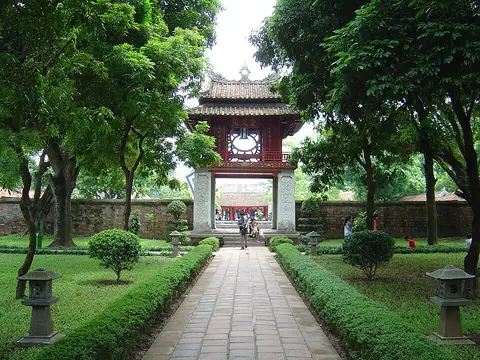
During the Lý dynasty, the country experienced a cultural and political golden age, which was also reflected in architectural expansion. In 1049, King Lý Thái Tông had the famous One Pillar Pagoda built, while his son founded the Confucian Temple of Literature in 1070 as a national academy. For a long time, this institution was the country's most important center of learning, where the sons of mandarins were educated. A collection of stone stelae documenting the names of those who passed imperial examinations is now part of the UNESCO Memory of the World Register. The city also had to endure repeated wars and destruction, including Mongol attacks in the 13th century and conquests by the Champa.
After independence was restored by the Later Lê dynasty in the 15th century, the citadel experienced another heyday, often described as the golden age of Vietnamese culture. Emperor Lê Thánh Tông had the Kính Thiên Palace built, whose main hall formed the center of the citadel. The country's official national chronicle was also compiled during this period. Political stability did not last forever, however, as the country later split into two parts, with the north under the rule of the Trịnh family and the south governed by the Nguyễn. This division led to a long civil war that was ended only by the Tây Sơn Rebellion and later by unification under the Nguyễn dynasty.
Under the Nguyễn dynasty, founded in 1802, the citadel lost its status as the main residence, as the emperors established their principal seat in Huế in the south of the country. Even so, the northern site remained important as a second royal seat and regained the name Thăng Long, though the meaning of the characters was slightly altered. Between 1802 and 1812, the citadel was rebuilt in the Vauban style according to plans by French fortress engineers. In 1831, the city's name was officially changed to Hà Nội, roughly meaning "city within the rivers," in order to reserve the name Thăng Long for the imperial capital of Huế.
The colonial era brought profound changes. From the late 19th century, French troops sought to consolidate their influence in northern Vietnam, leading to several conflicts. In 1873, French forces under Francis Garnier occupied the citadel and destroyed large parts of the complex. Although they later withdrew, the colonial rulers used the opportunity to strengthen their administration. In 1883, France declared Hà Nội the capital of Tonkin and built a modern administrative city south of the Old Quarter. In the process, parts of the old citadel and palaces were demolished to make room for the new colonial infrastructure.
During World War II, the citadel served the Japanese army as an internment camp for thousands of French military personnel. After the fall of the French colonial administration in 1945, American soldiers freed the prisoners. During the Vietnam War, the North Vietnamese general staff under General Võ Nguyên Giáp used the site as its command center. Especially well known is House D67, a network of bunkers built in 1967 beneath the remains of the Kính Thiên Palace. This system with its thick walls and evacuation tunnels also served as a refuge for the Politburo and has been open to visitors since 2004.
Since 2001, significant archaeological finds have been made during construction projects, particularly for the new National Assembly building. Systematic excavations have been carried out since 2002, rediscovering parts of the historic grounds. This work has shown that the relics of different eras reflect a distinct regional culture that developed along the lower Red River under influences from China and Champa. The excavation site on Hoàng Diệu Street is currently closed to the public because of ongoing work, but it provides valuable insights into the history of the site.
Today, visitors can see several sights within the former citadel. The Central Gate, Đoan Môn, and the North Gate are important architectural remnants, with the North Gate decorated with Chinese characters in relief. The 33.4-meter-high Flag Tower, which was not destroyed during the French occupation, remains a landmark of the city to this day and is used as a military post. The Kính Thiên Palace, of which only the throne hall survives, recalls the splendor of the Lê dynasty. The Princess's Pavilion, built according to the principles of feng shui, is also a complex worth seeing.
Nearby historic sites such as the One Pillar Pagoda and the Temple of Literature complete the picture of Hanoi's cultural history. The One Pillar Pagoda, destroyed by the French and later reconstructed, is a symbolic structure from the Lý era. The Temple of Literature, the country's first academy, houses the historic collection of stone stelae. Together with the remains of the citadel in Ba Đình District, these sites testify to Vietnam's long and eventful history, shaped by imperial rule, wars, and cultural flowering. The site remains a central point for understanding Vietnamese identity and history.
At a glance
- Category
- Sight › Historic sites
- Rating
- no reviews yet · write a review
- Address
- Hoàng Thành
100000 Hanoi, Vietnam - District
- Ba Dinh Ward
- Phone
- +84985006671
- Website
- vietphuchoangthanh.com
- vietphuchoangthanh@gmail.com
- Coordinates
- 21.03326° N · 105.84020° E
- Data quality
- confidence 0.31
- Identifier
- ID f7b9355b-472…
Location & surroundings
Toggle layersRatings & comments
none yetNear Việt Phục Hoàng Thành
closest 5 per category · 2 kmSights
Restaurants
Museums
Hotels
More:Historic sites in Hanoi (3,419)Sights in Ba Dinh Ward (74)All sights in Hanoi (3,480)
292 places within 2 km loaded.
You need a free account to leave reviews and photos – that keeps comments genuine and lets you edit them later.