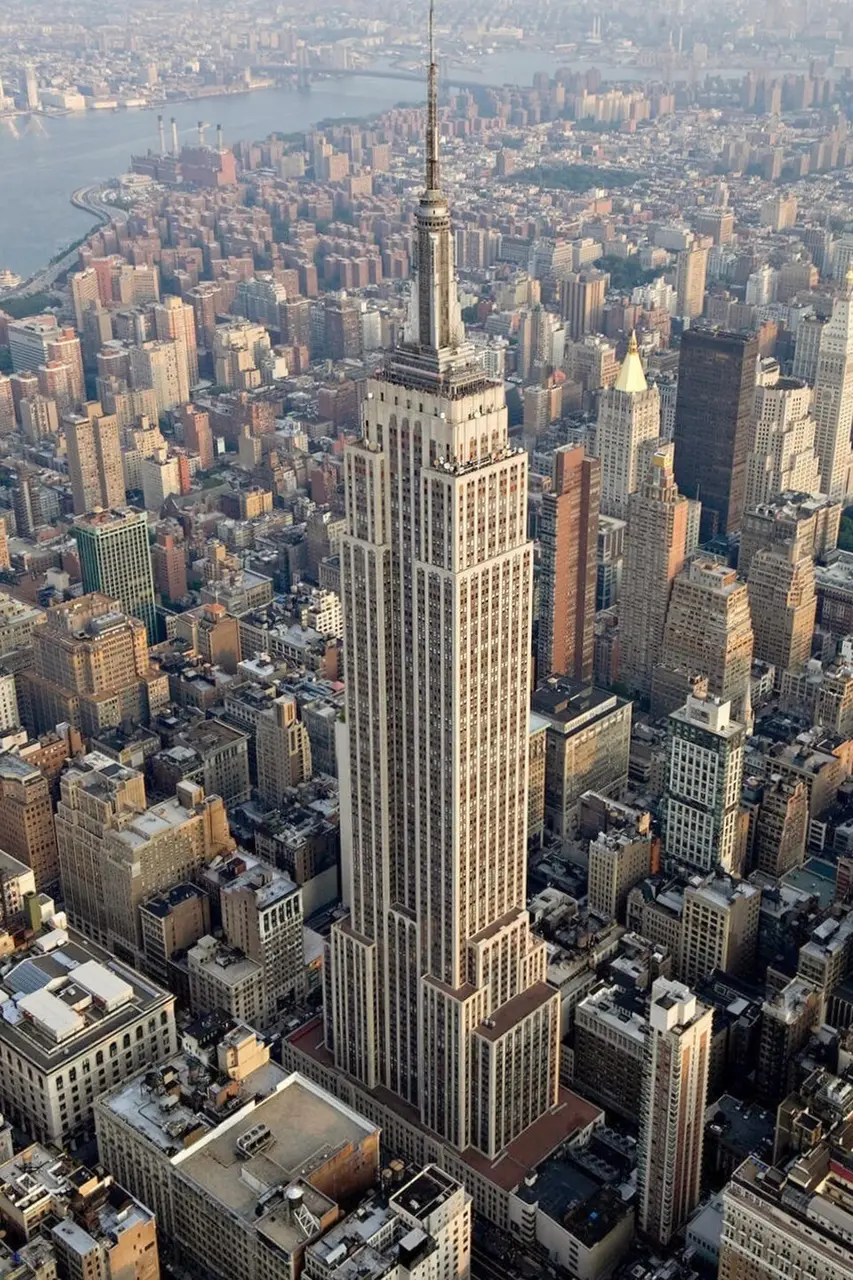
About Empire State Building
The Empire State Building is one of the most famous skyscrapers in the world, standing in the heart of Midtown Manhattan in New York City. The building is located on Fifth Avenue between West 33rd and West 34th Streets, and with a structural height of 381 meters (1,250 feet), it remains a dominant element of the city skyline to this day. Including the tip of its antenna, the tower measures around 443 meters (1,454 feet). From its completion in 1931 until the construction of the World Trade Center in 1972, it was the tallest building in the world. After the destruction of the World Trade Center on September 11, 2001, it once again took on that role in the city, until it was surpassed by One World Trade Center in 2013. The name derives from the nickname of New York State, which is known as the Empire State.
The building's architecture belongs to the Art Deco style, as seen in its elegant, geometric form. The design was strongly influenced by the 1916 zoning resolution, which required skyscrapers in New York to taper as they rose so they would not cast too much shadow on neighboring buildings. This gave rise to the tower's characteristic shape, which narrows upward through gentle setbacks from street level to the 86th floor. The main block rises to 320 meters (1,050 feet), topped by a slender tower that mainly houses broadcasting equipment. The facade is made of limestone and granite and was set into the steel frame that supports the building.
The construction of the Empire State Building was a masterpiece of the engineering of its day. The steel frame, held together by riveted construction, weighs around 370,000 tons. Roughly 60,000 tons of steel were used in the build, sourced from Pennsylvania and assembled on site with great precision. The 6,379 window units were installed in the facade one by one. Inside the building, especially in the lobby, you'll find elaborate marble floors and walls. A special feature of the lobby is the inlay work depicting the Empire State Building as the eighth wonder of the world alongside the classic seven. In the background of this depiction is a map of the North American continent, pointing to the building's location in New York.
Construction began in January 1930 and was remarkably fast for its time. The shell was completed in just 18 months, thanks to outstanding logistics and planning. More than 3,400 workers were on the job site, putting up an average of about 4.5 floors per week. The steel beams were hoisted up by cranes and riveted with a tolerance of less than three millimeters. The photographs of workers on the steel framework taken by Lewis Hine became especially famous and turned the structure into an iconic symbol of modernity. The grand opening took place on May 1, 1931, led by U.S. President Herbert Hoover.
Although the building was originally conceived as an office complex, it stood largely empty in the first years after opening, earning it the nickname the Empty State Building. During this period, the observation decks brought in more revenue than the rent from the offices. Today the Empire State Building is used mostly for commercial purposes, with offices of insurance companies, advertising agencies, and financial institutions on the lower floors. The building has 73 elevators, which run in shafts with a combined length of 11 kilometers (about 7 miles). The technical systems have been modernized in recent years to improve energy efficiency and reduce environmental impact.
A central aspect of the Empire State Building is its function as a broadcasting mast. Since 1931, the top of the building has served as an antenna for radio and television stations. The Radio Corporation of America began broadcasting television programs from here, and over time additional transmitters were installed. The antenna has been replaced and upgraded several times to meet the growing needs of the media industry. Today, numerous television and radio programs are still broadcast from the Empire State Building, underscoring its importance for communications in the region.
The building's lighting is another feature that makes it a landmark. Since 1964, the tower has been illuminated in various colors at nightfall. Without a special occasion it glows in white light, but on holidays and special occasions it is lit in specific colors. For example, it glows red, white, and blue on U.S. holidays, red and green during the Christmas season, and in the colors of the German flag on the day of the German-American Steuben Parade. The lighting is also used for current events, such as presidential elections or sporting events. Since 2012, an LED lighting system has been in use that allows rapid color changes and moving light effects.
Visitors can experience the Empire State Building from two observation decks. The first is on the 86th floor, on an open-air terrace 320 meters (1,050 feet) up, and offers sweeping views over New York City and the surrounding region. On clear days, you can see more than 80 kilometers (50 miles). The second observation deck is on the 102nd floor, the top level of the building, and is located inside the tower. This deck is smaller and was closed from 1999 to 2005, but it underwent extensive renovation in 2019. Access to the decks is by high-speed elevators, and because of security measures, waits of more than half an hour are common.
Besides the observation decks, the Empire State Building offers other tourist attractions. On the second floor is a Skyride theater, which gives visitors a virtual 3-D flight over New York City. The building is also the site of the Empire State Building Run-Up, an annual stair race in which participants run from the lobby to the 86th floor. This event draws many runners and climbers every year and is a popular sporting event in the city.
The Empire State Building has great cultural significance and appears in many films and literary works. Its role in the film King Kong, in which the ape climbs to the roof of the building, is especially well known. This portrayal contributed significantly to the tower's popularity. The building also plays an important role in other films such as Independence Day and The Day After Tomorrow. The Empire State Building is considered the epitome of the skyscraper and has been a U.S. National Historic Landmark since 1986. It is not only an architectural masterpiece but also a symbol of the history and culture of New York.
In summary, the Empire State Building is far more than just an office building. It is a historic landmark, a marvel of engineering, and a cultural symbol that shapes New York City. Its architecture, its history, and its place in pop culture make it one of the most visited and most admired buildings in the world.
At a glance
- Category
- Sight › Historic sites
- Rating
- no reviews yet · write a review
- Address
- 20 W 34th St
10118-0114 New York, USA - District
- Manhattan
- Phone
- —
- Website
- esbnyc.com
- —
- Coordinates
- 40.74914° N · -73.98662° E
- Data quality
- confidence 0.95
- Identifier
- ID 91b41dc1-59c…
Part of the tour
New York in One Day: Midtown and Lower Manhattan →Location & surroundings
Toggle layersFAQ about Empire State Building
quick answersWhat is the Empire State Building?
The Empire State Building is one of the best-known skyscrapers in the world and stands in the heart of Midtown Manhattan in New York City. You'll find it at 20 W 34th St, on Fifth Avenue between West 33rd and West 34th Streets. The Art Deco tower has a structural height of 381 meters (1,250 ft) and measures roughly 443 meters (1,454 ft) to the tip of its antenna. Its name comes from the nickname of New York State, known as the "Empire State."
Was the Empire State Building ever the tallest building in the world?
Yes, the Empire State Building in New York was the tallest building on Earth from its completion in 1931 until the World Trade Center was built in 1972. After the destruction of the World Trade Center on September 11, 2001, it once again became the tallest building in New York City. It held that title until it was surpassed by One World Trade Center in 2013.
How long did it take to build the Empire State Building?
The structural shell of the Empire State Building in New York was completed in just 18 months after construction began in January 1930. More than 3,400 workers were on the construction site, putting up an average of about 4.5 floors per week. The official opening took place on May 1, 1931. Lewis Hine's photographs of workers on the steel framework became famous.
What makes the architecture and lobby of the Empire State Building special?
The Empire State Building in New York is built in the Art Deco style, and its distinctive shape goes back to New York's 1916 zoning law, which required skyscrapers to taper as they rose. That's why the tower narrows through slight setbacks from street level up to the 86th floor. The facade is made of limestone and granite with 6,379 individually set window units. In the lobby you'll see elaborate marble floors and walls as well as inlay work depicting the building as the eighth wonder of the world, alongside the classic seven.
What can you see around the Empire State Building?
In the immediate vicinity of the Empire State Building in Midtown Manhattan are other historic buildings such as the Herald Towers (about 71 meters away) and the Marbridge Building (about 126 meters away). travelguide195 also lists around 728 restaurants within 500 meters. The Empire State Building is also part of the travelguide195 tour "New York in One Day: Midtown and Lower Manhattan."
Ratings & comments
none yetNear Empire State Building
closest 5 per category · 2 kmSights
Restaurants
Museums
Hotels
300 places within 2 km loaded.
You need a free account to leave reviews and photos – that keeps comments genuine and lets you edit them later.
A legend from the moment it was finished in 1931, the Empire State Building was easily the tallest building not just in New York, but the entire world for many years before being overtaken by another New York landmark - the twin towers of the World Trade Center. With the destruction of those two buildings, the Empire State Building was once again the tallest building in the city, but that lasted less than eleven years. But even though it's no longer the tallest, it remains iconic and one of the city's biggest tourist attractions. Expect long lines, and a lot of them - you'll have to wait in line to pass through a security checkpoint, wait in line to get tickets, wait in line for the elevators, and then make your way through the crowd on the outdoor observation deck on the 86th floor. One way to deal with the lines is to buy an express line ticket, which will bring you to the front of any line, but it will more than double the cost of your ticket. Another option is to visit very early in the day or late in the evening, when the lines will be considerably shorter. Despite the long lines and inevitable tourist kitsch, the views are excellent and the experience of being outdoors on top of New York City is a great one. Hawkers outside the building may try to tell you there is a very long line inside and that they can get you tickets to cut the line for some exorbitant price; before believing them, go inside and check the actual wait time which is clearly written on the electronic boards.
Source: Wikivoyage, „Manhattan/Midtown East“ · authors per page history · CC BY-SA 4.0