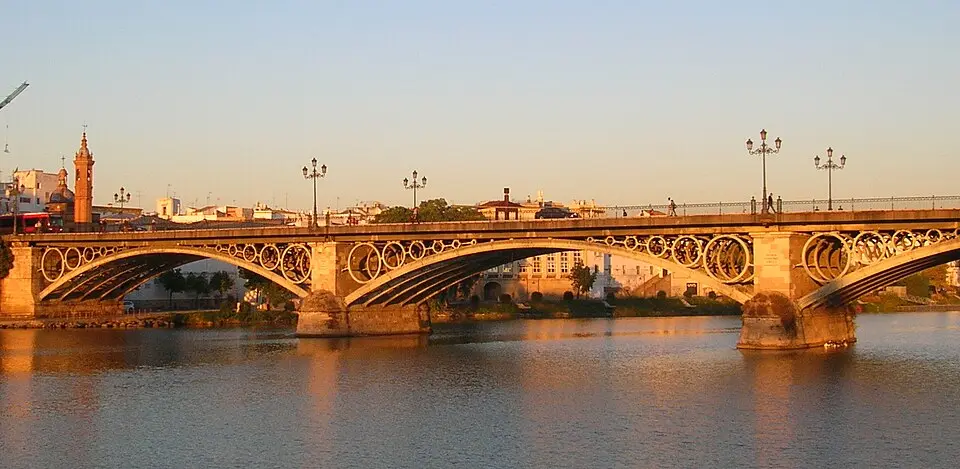
About Puente de Isabel II
The Puente de Isabel II, commonly known in everyday life as the Puente de Triana, is the oldest surviving iron bridge in Spain and was the first permanent crossing over the Guadalquivir in Seville. It spans the old arm of the river and connects the old town with the Triana district. Construction began in 1848 under the reign of Isabella II and was completed in 1852. The design is based on a plan by the French engineers Ferdinand Bernardet and Gustave Steinacher, which was heavily modeled on the Pont du Carrousel in Paris. The three shallow arches, each with a span of more than 43 meters (141 feet), were made of cast-iron tubes with an oval cross-section, joined by bolts and filled with bitumen. Stone piers carry the structure up to the bridge deck.
Over time, the bridge has had to withstand several challenges. As early as 1918, the deck was replaced and widened to make room for a streetcar line. In the 1950s and 1970s, concerns about stability under growing traffic, along with a panic during a procession in 1974, led to its closure. Instead of complete demolition, which the local population opposed, the bridge deck was replaced in 1977 with a self-supporting steel girder structure. The historic iron arches were preserved, but they no longer bear the weight of the deck. Since 1976, the structure has been protected as a national historic monument.
For visitors, the bridge offers an impressive view of the city and the river. On the Triana side, it ends next to the Capilla del Carmen and the Museo del Castillo de San Jorge, which stands on the ruins of a medieval fortress. The building of the former Bar Faro de Triana, once the station building of a steamship line, is also in the immediate vicinity. Today the bridge serves as an important thoroughfare with one traffic lane, one bike lane, and one sidewalk in each direction. Despite the modernization of its inner workings, its appearance has barely changed, which makes it a popular photo spot and one of Seville's central landmarks.
At a glance
- Category
- Sight › Monuments
- Rating
- no reviews yet · write a review
- Address
41010 Seville, Spain- Phone
- +34954592915
- Website
- sevillapedia.wikanda.es
- —
- Coordinates
- 37.38636° N · -6.00236° E
- Data quality
- confidence 0.99
- Identifier
- ID 280cb61d-c0d…
Location & surroundings
Toggle layersFAQ about Puente de Isabel II
quick answersWhat is the Puente de Isabel II in Seville?
The Puente de Isabel II, usually called the Puente de Triana, is the oldest surviving iron bridge in Spain and a central landmark of Seville. It was the first permanent crossing over the Guadalquivir and links the old town with the Triana district across the river's old channel. Since 1976 it has been protected as a national historic monument.
When was the Puente de Triana built, and who designed it?
The Puente de Isabel II in Seville was built between 1848 and 1852 during the reign of Isabella II. It was designed by the French engineers Ferdinand Bernardet and Gustave Steinacher and is closely modeled on the Pont du Carrousel in Paris. The three shallow arches, each spanning more than 43 meters (about 141 feet), are made of bolted cast-iron tubes with an oval cross-section, filled with bitumen and supported by stone piers.
Do the historic iron arches of the Puente de Isabel II still support the bridge?
No. The iron arches of the Puente de Isabel II in Seville have been preserved, but they no longer carry the bridge deck. After concerns about stability due to growing traffic and a panic during a religious procession in 1974, the bridge was closed. Because locals opposed demolition, the deck was replaced in 1977 with a self-supporting steel structure, so the bridge's appearance has barely changed. The deck had already been renewed and widened in 1918 to accommodate a streetcar.
Can you cross the Puente de Triana on foot or by bike?
Yes, the Puente de Isabel II in Seville has a sidewalk, a bike lane, and a traffic lane in each direction. As you cross, you get an impressive view of the city and the Guadalquivir, which makes the bridge a popular photo spot. travelguide195 also lists it in tours such as "Palaces, Patios, and Arenal: A Walk Through Seville's Old Town."
What can you see around the Puente de Isabel II in Seville?
Right at the Triana end of the Puente de Isabel II are the Capillita del Carmen (about 90 meters / 295 feet away) and the Museo del Castillo de San Jorge (about 110 meters / 360 feet away), built on the ruins of a medieval fortress. Nearby you will also find the Muelle de la Sal, the Monumento a la Tolerancia, the Callejón de la Inquisición, and the Museo de Cerámica de Triana (about 230 meters / 755 feet away). travelguide195 also lists around 156 restaurants within 500 meters (about 1,640 feet).
Ratings & comments
none yetNear Puente de Isabel II
closest 5 per category · 2 kmSights
Restaurants
Museums
Hotels
More:Monuments in Seville (55)All sights in Seville (269)
281 places within 2 km loaded.
Don't miss in Seville
All sights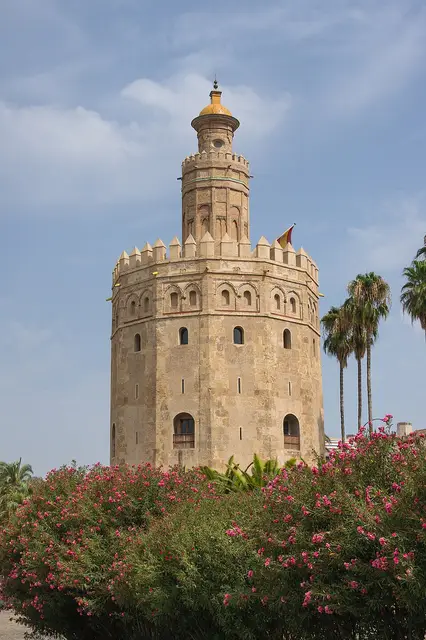 Historic sites01
Torre del Oro
The Golden Tower, P.º de Cristóbal Colón, s/n · Seville● Website● Phone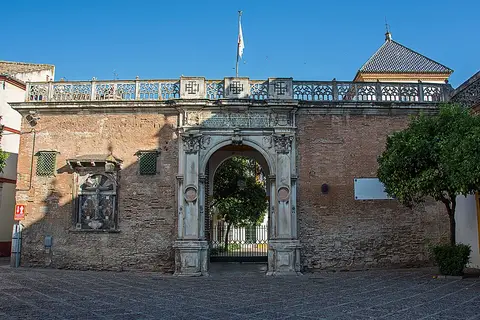 Palaces02
Casa de Pilatos
Pl. de Pilatos, 1 · Seville● Website● Phone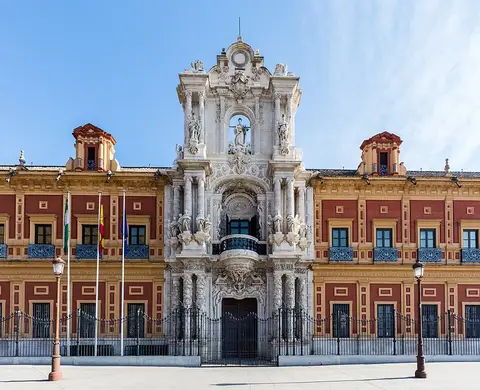 Palaces03
Palacio de San Telmo
P.º de Roma · Seville● Website● Phone Monuments04
You need a free account to leave reviews and photos – that keeps comments genuine and lets you edit them later.