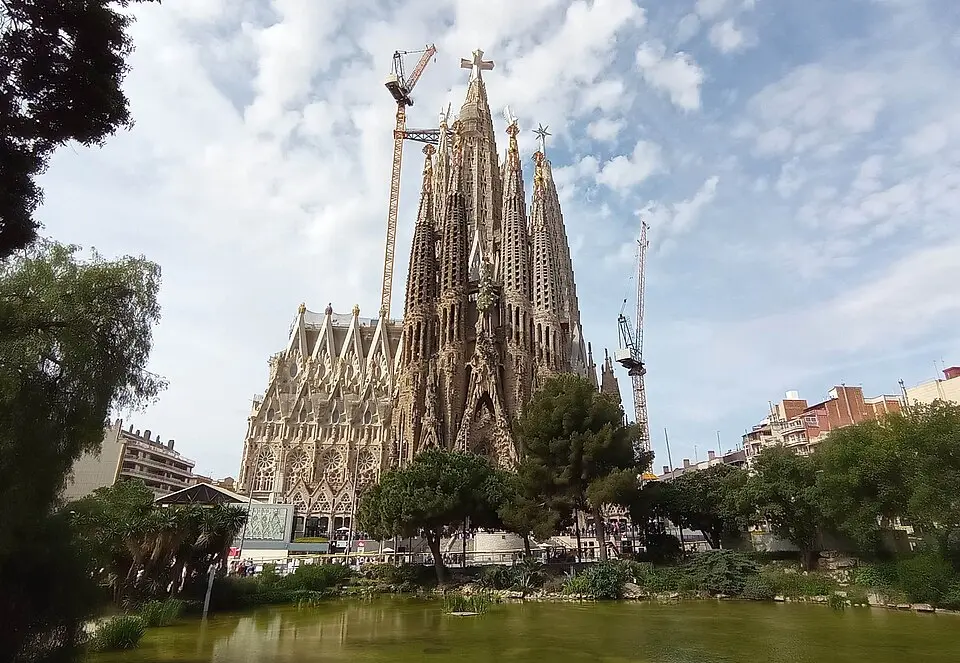
About Sagrada Familia
The Sagrada Família in Barcelona is a Roman Catholic basilica widely regarded as the most important work of the Catalan architect Antoni Gaudí. The building stands in the Eixample district, north of the Old Town, where it and its construction site take up an entire city block. It is a church in the Modernisme style, construction of which began in 1882 with the building of the crypt and continues to this day. The project managers cite 2035 as a possible completion date, though without committing to it. With the completion of the cross at the top in February 2026, the central Tower of Christ, at a height of 172.5 meters (566 feet), rises above every other church tower in the world. On June 10, 2026, the 100th anniversary of Gaudí's death, Pope Leo XIV solemnly consecrated this tower. As early as 2005, UNESCO added the Nativity Façade and the crypt to its list as an extension of the World Heritage site Works of Antoni Gaudí, and in 2010 Pope Benedict XVI elevated the church to the rank of minor basilica.
The idea for a church honoring the Holy Family goes back to Josep Maria Bocabella, a bookseller and author of Christian writings. He founded a spiritual association in 1866 and decided in 1874 to build a large expiatory church financed by donations. In 1881, the association acquired the site, which covers an area of 12,800 square meters (about 138,000 square feet). The original architect, Francisco de Paula del Villar y Lozano, initially designed a simple church in the Neo-Romanesque and Neo-Gothic style. After a falling-out with the building committee, Gaudí took over the planning in 1883. He largely completed the crypt according to his predecessor's plans but reworked the vaulting. From the mid-1880s, Gaudí began to fundamentally redesign the plans, and in 1885 he presented a new concept with a Gothic formal vocabulary.
A large anonymous donation allowed Gaudí to expand the project, and he developed the basic concept of a five-aisled basilica with 18 towers. Work on this new project began in 1894 with the foundations for the four-towered façade. Over time, the building's architectural language went through various stages, from an idiosyncratically interpreted historicism through Catalan Modernisme to an abstract, expressionist late style. Gaudí worked on the church for 43 years, the last 15 exclusively. When he died in 1926 after a streetcar accident, only one tower of the northeast-facing Nativity Façade had been completed. Construction was interrupted repeatedly afterward, especially during the Spanish Civil War, when parts of the crypt and the façade were destroyed. Many original plans and models were lost or damaged but could later be reconstructed from debris and photographs.
Construction continues to be financed by donations and admission fees, just as Bocabella originally intended. Most donations come from Catholic circles and from Japanese donors. The COVID-19 pandemic and the drop in tourist numbers caused revenue to fall sharply, leading to delays. In 2024, admission fees from nearly five million visitors brought in revenue of €130 million. The cost of completion was estimated at around €400 million in 2023. A building permit, granted only in 2019, was crucial for the continuation of construction, and funds were also agreed upon for renovating the surrounding area and expanding the public transit network.
The architecture of the Sagrada Família is characterized by intricate ornamentation and a distinctive formal language strongly influenced by nature. Gaudí considered nature his principal teacher and used mathematical ruled surfaces in his designs. The vaults consist of hyperboloids of revolution and hyperbolic paraboloids, while the columns are generated from the intersection of helicoids. These forms recall tree trunks branching into limbs and suggest a leafy canopy. Gaudí determined the building's structural stability using graphic methods and models based on the principle of the catenary curve. As a result, the building needs no external buttresses of the kind common in Gothic architecture.
The church's façades are divided into distinct sections. The northeast-facing Nativity Façade was largely completed during Gaudí's lifetime and shows scenes from the life of Christ, such as the Nativity and the Adoration of the Magi. It consists of three portals symbolizing the Christian virtues of faith, hope, and charity. The southwest-facing Passion Façade was completed in 2018 and is distinguished by clean, geometric lines and very little ornamentation. It depicts Christ's Passion, with figures by the artist Josep Maria Subirachs. The third façade, the Glory Façade, is still under construction and is meant to adorn the apse side. It will have 21 columns and two chapels.
The basilica's interior has been completed and glazed since 2010. The side aisles are 30 meters (98 feet) high, the nave 45 meters (148 feet), and the crossing 60 meters (197 feet). The vault above the apse reaches a height of 75 meters (246 feet). The stone columns support the vaults and are designed to resemble trees. The stained-glass windows were designed by the glass artist Joan Vila i Grau and let colored light fall into the space. The chancel holds a choir organ, built in 2010 and played for the first time at the consecration by Pope Benedict XVI. Antoni Gaudí is buried in the crypt, which lies beneath the apse. The crypt is in the Neo-Gothic style and houses several chapels, including the Chapel of Our Lady of Mount Carmel.
The towers of the Sagrada Família are a central feature of the building. When complete, the church is meant to have 18 towers. Twelve of them are dedicated to the apostles, with Judas Iscariot replaced by his successor Matthias. Four more towers are dedicated to the Evangelists, along with one tower for Mary and the central tower for Jesus Christ. The towers have shapes reminiscent of bishops' crosiers and are decorated with animals, sacred symbols, and Bible quotations. The Tower of Christ, which stands above the crossing, is the tallest tower and will be crowned with a walk-in cross made of stainless steel, glass, and high-performance concrete. The tower's height was chosen so that it stands half a meter lower than Montjuïc, the city's local hill, so that the work of man would not appear taller than the work of God.
The Sagrada Família is one of Barcelona's most visited attractions. In 2024, nearly five million people visited the basilica, with a considerable share coming from the United States, Spain, China, and France. Visitors can see part of the interior as well as the completed towers, which are reached by elevator. The Museu Gaudí, located beneath the transept, offers insights into the architect's life and work. Symphony concerts are occasionally held in the church as well. Because of its popularity, tickets often have to be purchased online weeks in advance.
The construction of the Sagrada Família was and is the subject of various debates and protests. In the 1960s and 2000s, some architects and artists called for construction to be halted, criticized its commercialization for tourism, or rejected its style. More recently, local residents have protested the upcoming construction work, especially the building of the Glory Façade, fearing that many people could lose their homes. Despite these controversies, the basilica remains a symbol of Barcelona's cultural and religious significance and an impressive testament to Gaudí's architectural vision.
At a glance
- Category
- Museum › Museums (general)
- Rating
- no reviews yet · write a review
- Address
- Carrer Mallorca, 401
08013 Barcelona, Spain - District
- l'Eixample
- Phone
- 932080414
- Website
- sagradafamilia.org
- —
- Coordinates
- 41.40322° N · 2.17487° E
- Data quality
- confidence 0.99
- Identifier
- ID a3abf2c0-cbc…
Part of the tour
Barcelona in a Day: Gaudí, the Gothic Quarter and El Born →Location & surroundings
Toggle layersRatings & comments
none yetNear Sagrada Familia
closest 5 per category · 2 kmSights
Restaurants
Museums
Hotels
More:Museums in l'Eixample (37)All museums in Barcelona (236)
296 places within 2 km loaded.
Don't miss in Barcelona
All sights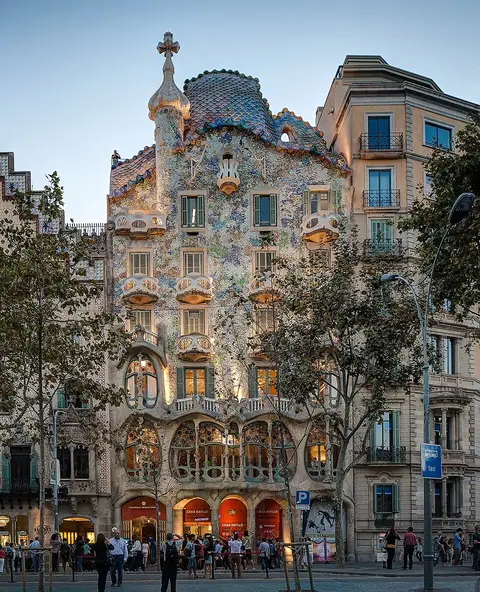 Historic sites01
Casa Batlló
Pg. de Gràcia, 43 · Barcelona● Website● Phone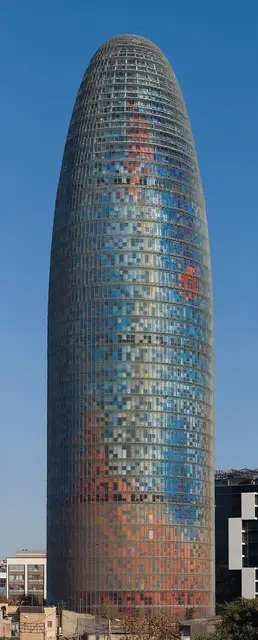 Historic sites02
Torre Glòries
Av. Diagonal, 211 · Barcelona● Website● Phone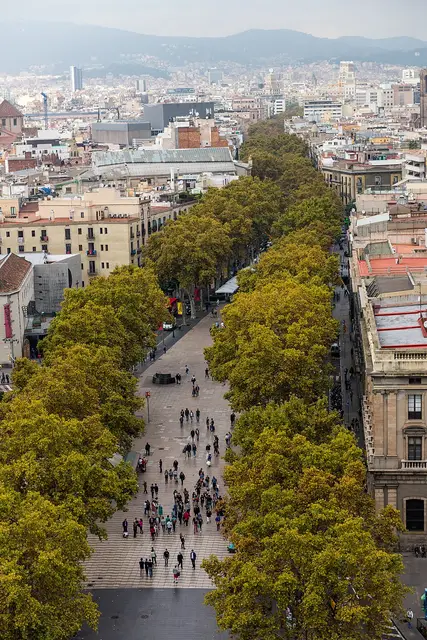 Historic sites03
Las ramblas
Barcelona (Sants · Barcelona● Website○ Phone Historic sites04
You need a free account to leave reviews and photos – that keeps comments genuine and lets you edit them later.
Barcelona's most popular and famous attraction, the Sagrada Família is a testament to Antonio Gaudi's modernist style and unlike any other church in the world. The texture and detail on the façades are intricate and incorporate forms seen in nature as much of Gaudi's work does. The inside is huge — it's estimated that it can hold 13,000 people — with vaulted ceilings and columns designed to be reminiscent of trees. The church is still under construction, but the central nave, apse and crypt are open. Seeing the Sagrada Família at night with lights on is impressive — this is the time when you understand why people say that it is built of bones.
Source: Wikivoyage, „Barcelona/Eixample“ · authors per page history · CC BY-SA 4.0 · as of 3/1/2025