About Traditional Serbia
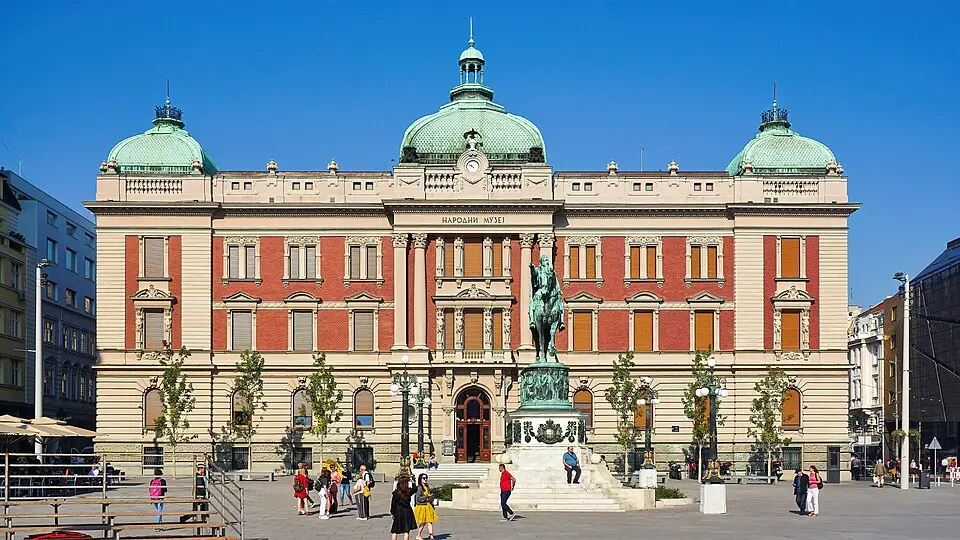
The National Museum of Serbia in Belgrade is the most important cultural institution in both the city and the country. Founded in 1844, it now houses an immense collection of more than 400,000 archaeological and art-historical objects, including numerous outstanding masterpieces. The museum stands on Trg republike (Republic Square), on the historic site of the former Stambol Gate. After being closed for fifteen years and undergoing a comprehensive renovation, it reopened to the public on June 28, 2018. The reopening drew international media attention, including a presentation featuring the well-known ballet dancer Sergei Polunin.
The stately building is an architectural gem in its own right. It was originally constructed between 1902 and 1903 as the home of the Mortgage Bank. Designed by the architects Andra Stevanović and Nikola Nestorović, who won a competition for the commission, the two-story structure embodies the Neo-Renaissance style with elements of Neo-Baroque. Especially striking are the monumental staircase, the paired columns at the entrance, and the magnificent domes above the central and side projections. The facades are distinguished by polychrome design with decorative sculpture. Inside, you'll find rich ornamentation created by renowned artists of the era such as Andrea Domenico, Franja Valdman, and Bora Kovačević. The building was damaged in World War II, when the central dome section was destroyed, and served various purposes after the war before it was finally given to the museum permanently.
The museum's collections span a broad sweep of human history. The archaeological department displays significant finds from the Neolithic Starčevo, Vinča, and Lepenski Vir cultures, with the sculptures from Lepenski Vir drawing particular attention. The museum also presents the mummy of an Egyptian priest from the Ptolemaic period, along with weapons and metalwork of the Celts. The Greek collection includes ceramics and gold masks, while the Roman department mainly shows finds from cities such as Sirmium, Singidunum, and Viminacium. Of particular historical importance are the Late Antique exhibits, including the famous Belgrade Cameo and a bronze head of Constantine the Great. Because of its architectural and historical-cultural value, the building is recognized as a cultural monument of great importance to the Republic of Serbia.
At a glance
- Category
- Museum › History museums
- Rating
- no reviews yet · write a review
- Address
- Улица Лазе Пачуа 2
11000 Belgrade, Serbia - Phone
- —
- Website
- traditionalserbia.com
- traditionalserbia@gmail.com
- Coordinates
- 44.81707° N · 20.45913° E
- Data quality
- confidence 0.40
- Identifier
- ID 933bf660-f73…
Location & surroundings
Toggle layersRatings & comments
none yetNear Traditional Serbia
closest 5 per category · 2 kmSights
Restaurants
Museums
Hotels
More:All museums in Belgrade (87)
277 places within 2 km loaded.
You need a free account to leave reviews and photos – that keeps comments genuine and lets you edit them later.