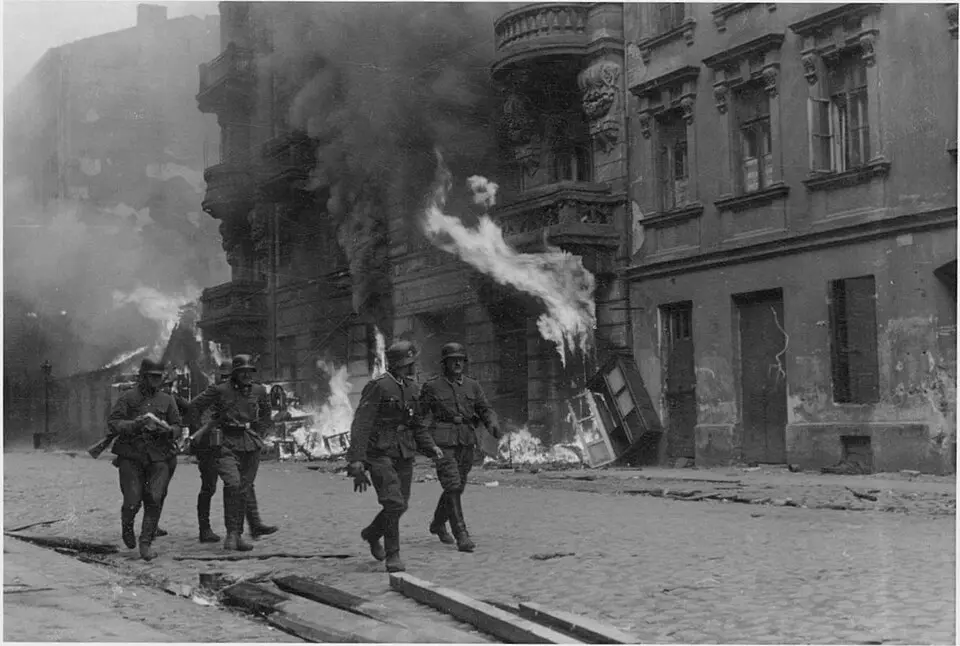
About Ghetto Warsaw
The Warsaw Ghetto was a collection camp set up by the German occupation authorities during World War II and officially disguised under the name "Jewish Residential District." It served as a central site for the planned genocide of Poland's Jews. The ghetto was established on October 15, 1940, in an area that made up only 2.4 percent of the Polish capital's territory but was meant to hold around 30 percent of Warsaw's population at the time. This extreme overcrowding led to catastrophic sanitary conditions, hunger, and the spread of deadly diseases such as typhus and spotted fever. Despite the devastating conditions, aid organizations and the Judenrat appointed by the Germans tried to ease the situation with soup kitchens and medical care, but only a small share of the residents could be adequately fed.
The history of the ghetto is inseparable from the resistance of the people confined there. After Warsaw's surrender in September 1939, many Jewish politicians went into exile or fled to the Soviet Union, leaving a shortage of leadership. The remaining political parties and organizations, including the Bund, various Zionist groups, and Communist cells, went underground and formed small cells. As systematic persecution began and exclusionary measures such as the requirement to wear the Star of David were introduced in October 1939, resistance grew. Early public protests, such as a demonstration led by Szmul Zygielbojm, showed the population's unwillingness to accept the deportations passively.
From the summer of 1942, the situation worsened dramatically when the gradual liquidation of the ghetto began as part of the so-called Grossaktion. Every day, thousands of people were deported to extermination camps, above all Treblinka. These events led to the founding of armed resistance groups. In October 1942, the Jewish Combat Organization, or ŻOB, was formed, uniting various political currents under one roof. Alongside it operated the Jewish Military Union, the ŻZW, which maintained close contacts with the Polish home resistance. Both organizations desperately tried to obtain weapons, which was often possible only on the black market or by extorting collaborators, since supplies from the Polish resistance were very limited.
A first armed clash took place as early as January 18, 1943, when German troops under SS-Oberführer Ferdinand von Sammern-Frankenegg tried to clear the ghetto. The ŻOB and ŻZW fighters, who had improved their structures in the preceding months, attacked the assailants with guerrilla tactics. Although the insurgents managed to drive the Germans out of the area after four days, they suffered heavy losses. This incident led to a temporary halt in the deportations and gave the resistance groups time to prepare for the larger conflict to come. Many residents now bought weapons themselves, and so-called wild groups formed that did not belong to the official organizations.
The actual uprising broke out on April 19, 1943, during the Jewish holiday of Passover. At around 3 a.m., German troops began to surround the ghetto. At 6 a.m., 850 SS men marched in and were immediately fired on by the insurgents. A tank they had brought along was set on fire with Molotov cocktails. Jürgen Stroop then took command. The German strategy called for splitting the ghetto in two, but ŻOB fighters confronted the attackers at strategically important points such as the corner of Gęsia and Nalewki streets. Using underground connections between buildings, the resistance fighters could maneuver quickly and repel the German advances. By the evening of the first day, the Germans had withdrawn from the ghetto.
In the following days the fighting intensified. At Muranowski Square, the ŻZW defended its headquarters, where a Polish and a Jewish flag were raised. The Germans tried to take these flags, which led to fierce fighting. In the brushmakers' district, one of the bloodiest clashes occurred when a bomb exploded, killing or wounding numerous soldiers. Despite the fierce resistance, the Germans increasingly used flamethrowers and the Luftwaffe to destroy the insurgents' buildings. The tactical situation of the Jewish fighters grew ever more difficult as they ran out of ammunition and the German troops adapted their tactics, forming small search teams to track down the underground bunkers.
The resistance fighters had to change their tactics and withdrew into a network of about 600 underground bunkers. The ŻOB's new headquarters was at 18 Miła Street. From there, they launched only targeted attacks. At the end of April, the ŻOB decided to leave the ghetto, as no lines of retreat remained. The first fighters escaped through the sewers and other routes. On May 1, Labor Day, the order was given to kill as many German soldiers as possible, which led to further fighting. The remaining units gathered in the bunker at 18 Miła Street, where about 500 people ultimately took shelter, hoping for help from outside that never came.
On May 7, the command bunker at 18 Miła Street was discovered, and it was attacked on May 8. The Germans pumped poison gas into the bunker, killing many people, including the leading fighter Mordechai Anielewicz. Some survivors, including Marek Edelman, had managed to escape the night before. On May 16, 1943, Jürgen Stroop declared the uprising over after having the Great Synagogue blown up. This officially ended the military suppression of the resistance, although isolated fighters remained hidden in the rubble for months and attacked German patrols.
The consequences of the uprising were devastating. In total, the fighting claimed 12,000 victims. Another 30,000 people were shot after the uprising was crushed, and 7,000 were deported to extermination camps. On the Jewish side, about 750 people fought against some 2,000 German soldiers and police officers. The insurgents' losses were enormous, with an estimated 75 percent of the fighters killed or murdered. Many survivors fled to the forests, where they joined the partisan struggle, or hid in Warsaw. A few later fought in the Warsaw Uprising of 1944, though out of fear of antisemitic factions within the Polish resistance, they often could not reveal that they were Jews.
Today, the Warsaw Ghetto Uprising is commemorated by various memorials and cultural works. The Warsaw Ghetto Monument and the POLIN Museum of the History of Polish Jews in Warsaw are central places of remembrance. In Israel, Kibbutz Lohamei HaGeta'ot was founded to honor the fighters. The uprising has also left its mark on art and literature, for example in Arnold Schoenberg's work A Survivor from Warsaw or in films such as The Pianist by Roman Polanski. The Jewish resistance in the Warsaw Ghetto is regarded as a symbolic example of the fight against Nazi extermination policy, even though it did not succeed militarily. It shows the courage and determination of people who refused to go to their deaths without a fight.
At a glance
- Category
- Sight › Historic sites
- Rating
- no reviews yet · write a review
- Address
- —
Warsaw, Poland - District
- Midtown
- Phone
- —
- Website
- —
- —
- Coordinates
- 52.24611° N · 20.99583° E
- Data quality
- confidence 0.76
- Identifier
- ID f10717c5-f70…
Location & surroundings
Toggle layersFAQ about Ghetto Warsaw
quick answersWhat was the Warsaw Ghetto?
The Warsaw Ghetto (Ghetto Warsaw) in the Śródmieście district of Warsaw, Poland, was a holding camp set up by the German occupation authorities during World War II and officially labeled the "Jewish Residential District." It was a central site in the planned genocide of Poland's Jews. Today it is a historic site that commemorates the persecution and resistance of the people confined there.
When was the Warsaw Ghetto established, and what were living conditions like?
The Warsaw Ghetto was established on October 15, 1940, on just 2.4 percent of Warsaw's area, where around 30 percent of the city's population at the time was to be crammed together. Extreme overcrowding led to catastrophic sanitary conditions, hunger, and deadly diseases such as typhoid and typhus. Aid organizations and the Judenrat tried to help with soup kitchens and medical care, but could adequately feed only a small share of the residents. Beginning in the summer of 1942, thousands of people were deported every day to extermination camps, mainly Treblinka, as part of the so-called Great Action.
What resistance was there in the Warsaw Ghetto?
Organized, and later armed, resistance against the German occupiers emerged in the Warsaw Ghetto. The Jewish Combat Organization (ŻOB) was founded in October 1942, while the Jewish Military Union (ŻZW), which maintained close contacts with the Polish home resistance, operated in parallel. The first armed clash took place on January 18, 1943, when German troops under SS-Oberführer Ferdinand von Sammern-Frankenegg tried to clear the ghetto. The fighters were able to drive the Germans out after four days, but suffered heavy losses in the process.
What can you see around the Warsaw Ghetto?
Several historic sites and monuments lie within walking distance of the former Warsaw Ghetto in Śródmieście. travelguide195 lists, among others, the Pałac Mostowskich (about 220 m), the Pawiak Prison Museum (about 330 m), the Monte Cassino Battle Monument (about 330 m), the Pomnik Drzewa Pawiackiego monument (about 340 m), and the Arsenał Królewski (about 360 m). At the Pawiak Prison Museum, you can delve into another chapter of Warsaw's occupation history.
Are there restaurants near the Warsaw Ghetto?
Yes, you'll find plenty of places to eat around the former Warsaw Ghetto. travelguide195 lists about 72 restaurants within 500 meters of the historic site in Warsaw's Śródmieście district.
Ratings & comments
none yetNear Ghetto Warsaw
closest 5 per category · 2 kmSights
Restaurants
Museums
Hotels
More:Historic sites in Warsaw (704)Sights in Midtown (292)All sights in Warsaw (792)
259 places within 2 km loaded.
You need a free account to leave reviews and photos – that keeps comments genuine and lets you edit them later.