About Barrio judío de Varsovia
The Warsaw Ghetto was one of the central sites of the Nazi persecution and extermination of European Jews. After the invasion of Poland in September 1939 and the occupation of the city by German troops, a ghetto was established in the old Jewish quarter; from the end of 1940, it was sealed off from the rest of Warsaw by walls and barbed wire. In this tightly confined space, the city's Jewish residents were first crammed together, and later deportees from other parts of Poland and from the German Reich were added, so that the population at times exceeded 400,000 people. Living conditions were extreme: hunger, epidemics such as typhus, and arbitrary shootings claimed thousands of victims every month. In July 1942, the occupiers began the so-called Grossaktion (Great Action), in which a large part of the residents were deported to the Treblinka extermination camp and murdered there. These events shaped the history of the place and led to the formation of resistance groups, which fought back against the liquidation of the ghetto in the spring of 1943.
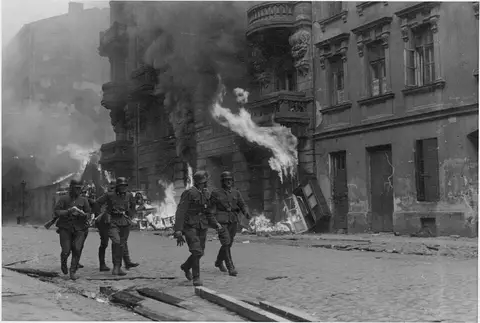
The Warsaw Ghetto Uprising began on April 19, 1943, when poorly armed Jewish fighters were initially able to push back the German troops. Command of the suppression of the uprising was taken by Jürgen Stroop, who described the operation as a "Grossaktion." Instead of the three days that had been planned, the fighting lasted almost a month. German units set buildings on fire to drive the hiding residents out of their hideouts. The uprising ended on May 16, 1943, with the symbolic blowing up of the Great Synagogue. During this period, more than 56,000 Jews were killed or deported to extermination camps. The Nazis documented this military operation extensively in order to prove the success of their policy of extermination.
A central document of this period is the so-called Stroop Report, a report that Stroop sent to his superiors and that was later compiled into a book. The report bears the title "The Jewish Quarter of Warsaw Is No More!" and, in addition to daily accounts of the course of the fighting, contains a collection of photographs referred to as the pictorial report. These images were intended to visually document the destruction of the ghetto and the subjugation of the Jewish population. Two copies of the report survive today, one at the Polish Institute of National Remembrance in Warsaw and one in the archives of the United States. Since 2017, the report has been part of UNESCO's Memory of the World Register and serves as historical testimony to the crimes.
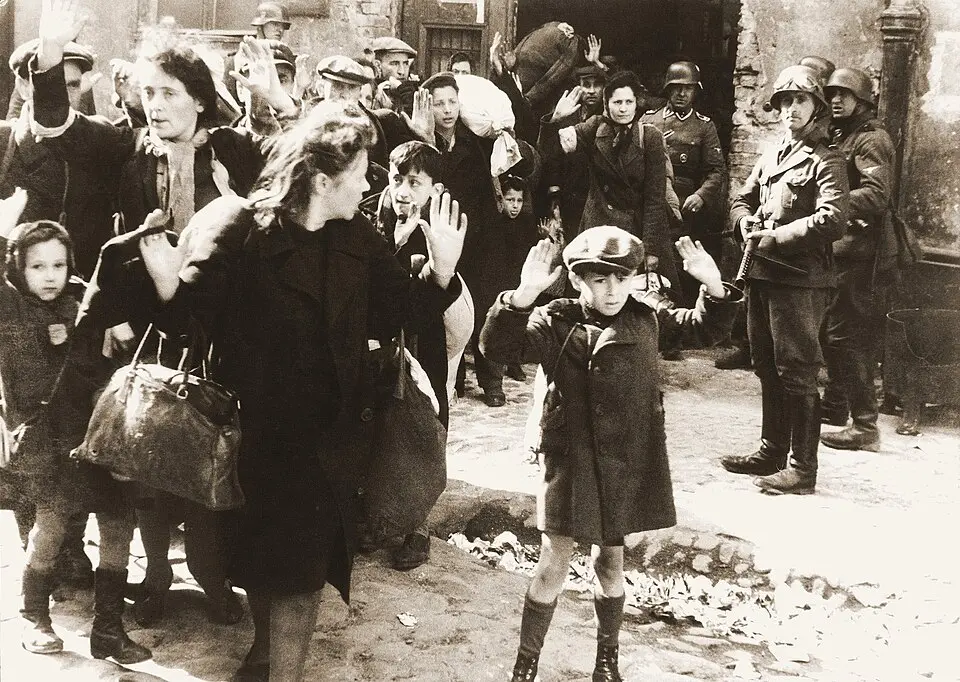
Among the photographs in the Stroop Report, one black-and-white image is particularly well known, often called the photo of the boy from the Warsaw Ghetto. The picture shows a group of arrested civilians being driven out of a building by German soldiers. In the foreground stands a small boy, set apart from the other people, who became the central focus of how the photo is perceived. The identity of the boy, as well as that of most of the other people pictured, has still not been established beyond doubt. The photographer is also unknown, and various theories exist about whether he belonged to propaganda companies or the security police. Only one of the German soldiers in the picture, Josef Blösche, has been clearly identified.
The composition of the photo was deliberately chosen to portray the power of the perpetrators and the powerlessness of the victims. The prisoners stand in a column, and many of them raise their hands to show their submission. The boy in the foreground looks fearfully toward the photographer, while the other faces show tension and sadness. A soldier to the right of the boy holds a submachine gun and looks directly into the camera, which gives the impression of a staged scene. The caption in the Stroop Report, "Forcibly pulled out of dugouts," fits poorly with the calm impression of the photograph, which suggests that the photo may have been taken in the first days of the uprising, before the houses were set on fire. The physical unharmed state of those depicted and the clear separation between perpetrators and victims make the image one of the most frequently used depictions of the Holocaust.
The reception history of the photo is long and multifaceted. The Stroop Report, and with it this photo, was already mentioned at the Nuremberg Trial of the Major War Criminals, although it was not among the evidence projected in court. In the 1960s, the image developed into an iconic symbol of the Holocaust. It was taken up in history books, documentaries, films, and the visual arts. The focus on the individual boy led to him becoming the "poster child of the Holocaust," a symbol of the innocence of the victims. Scholars and artists have analyzed the photo intensively, citing compositional aspects such as the placement of the boy at the golden ratio and the strong contrast between the figures as reasons for its wide circulation.
Despite its fame, the photo also raises questions about how history is perceived. It shows the Jews at the moment of defeat as passive victims, while the acts of resistance in the uprising are not visible. This depiction helps to partly reinforce the erasure of Jewish identity and history intended by the Nazis, by showing the victims only as the persecuted. In many textbooks and media, the connection to the ghetto uprising is often omitted, and the perpetrators are rendered invisible through passive constructions or crops that leave the soldiers out. This makes it easier not to examine one's own responsibility, or that of the majority population, more closely.
The identity of the boy in the photo is the subject of various claims that have not, however, been conclusively proven. Several people, including Artur Dąb Siemiątek, Israel Rondel, Tsvi Nussbaum, and Levi Zeilinwarger, have been named as possible candidates. Each of these claims, however, contains contradictions, whether regarding age, whereabouts, or appearance. The identity of the other prisoners is also partly unclear, although some people have been recognized by survivors as relatives. The only person identified beyond doubt is SS Rottenführer Josef Blösche, who was arrested after the war and executed for war crimes.
The photo of the boy from the Warsaw Ghetto remains a central image in the remembrance of the Holocaust. It is used in museums, memorials, and classrooms to illustrate the cruelty of the Nazi crimes. Its status as an icon rests on the emotional impact of the image, which, by depicting a single child, symbolizes the individual tragedy of the millions of victims. At the same time, it calls on us not to neglect historical context and to understand the complex circumstances of the ghetto uprising and the policy of extermination. The image is a powerful appeal to humanity and to the responsibility of future generations to keep the memory of the victims alive.
In art and public discourse, the photo continues to be received and interpreted. It serves as a starting point for discussions about the power of images, the role of photography in the writing of history, and the ethical questions surrounding the depiction of suffering. Artists and scholars use the image to question the mechanisms of propaganda and historical memory. Despite the many analyses, the photo remains a powerful and moving testimony to the past, one that deeply impresses visitors to museums and memorials and prompts reflection on the consequences of racism and violence.
At a glance
- Category
- Sight › Historic sites
- Rating
- no reviews yet · write a review
- Address
- —
Warsaw, Poland - District
- Midtown
- Phone
- —
- Website
- —
- —
- Coordinates
- 52.24611° N · 20.99583° E
- Data quality
- confidence 0.80
- Identifier
- ID cc60cd90-601…
Location & surroundings
Toggle layersRatings & comments
none yetNear Barrio judío de Varsovia
closest 5 per category · 2 kmSights
Restaurants
Museums
Hotels
More:Historic sites in Warsaw (704)Sights in Midtown (292)All sights in Warsaw (792)
259 places within 2 km loaded.
You need a free account to leave reviews and photos – that keeps comments genuine and lets you edit them later.