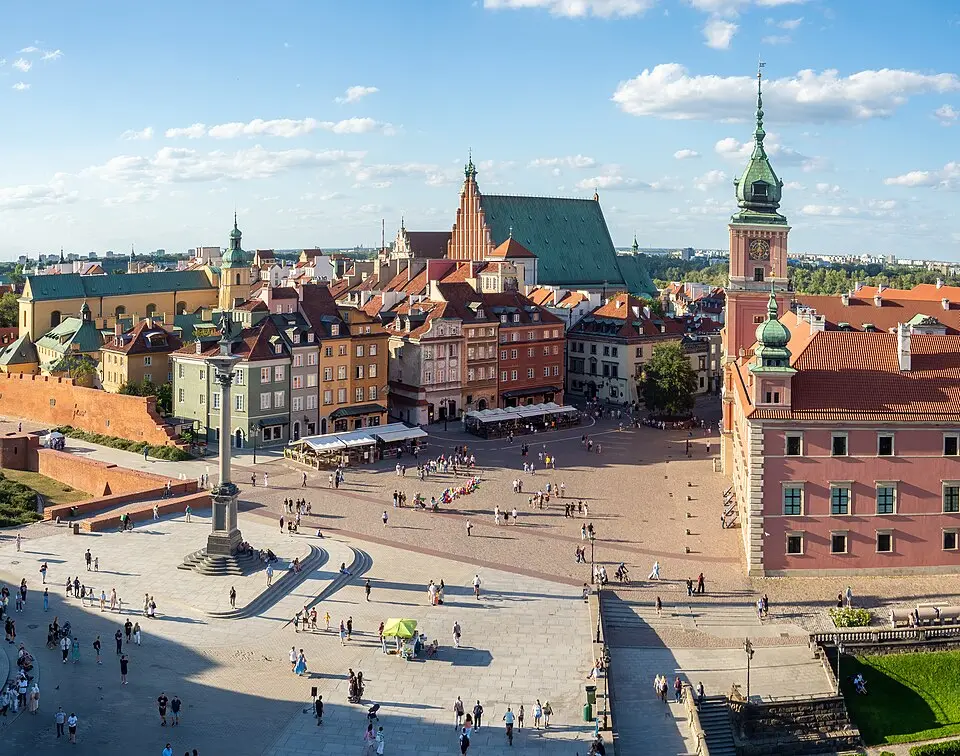
About Central Warsaw
Warsaw, the capital of Poland, spreads out along both banks of the Vistula in Masovian Voivodeship and forms the center of one of the country's largest metropolitan areas. As the political, economic, and cultural heart of Central and Eastern Europe, the city is home to numerous national institutions, universities, theaters, and museums. The historic city center sits on the left, western bank atop the steep Vistula escarpment, while the right bank is the district of Praga. This geographic location midway between the Carpathians and the Baltic Sea shaped the development of the metropolis, which today has more than 1.8 million residents and is the only Polish city with its own special legal status.
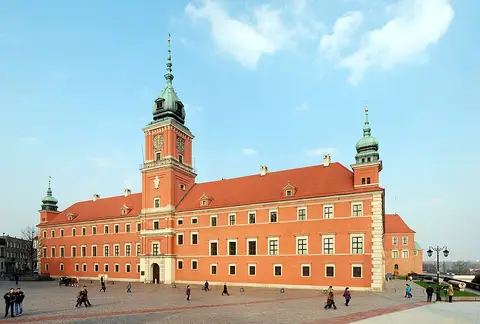
Warsaw's history reaches back to the 9th century, when the first fortified settlements arose in the area of what is now the city. The first written mention dates to 1241. Over the course of the Middle Ages, the city developed into an important trading hub, especially after the trade route from the Black Sea to the Baltic Sea was moved to the left bank of the Vistula. In 1334, Warsaw was granted Chełmno (Kulm) town rights, which encouraged merchants from Toruń to settle there and ushered in an economic boom. The Gothic St. John's Cathedral and the castle of the Masovian dukes, later the Royal Castle, date from this early period and still define the look of the Old Town today.
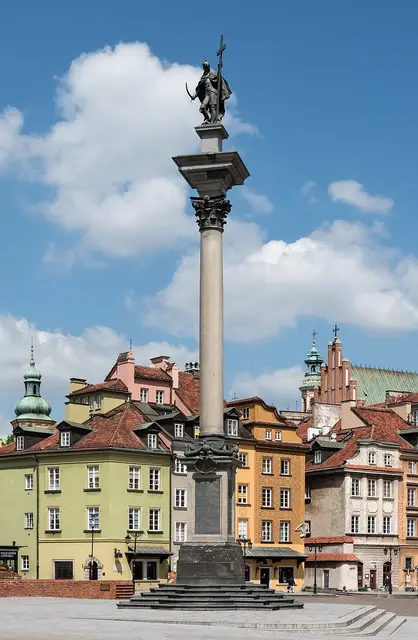
A decisive turning point came in 1596, when King Sigismund III Vasa moved the royal court to Warsaw. This marked the start of the era of the Polish-Lithuanian Commonwealth, in which Warsaw became the seat of the Sejm and of the free royal elections. Under the Vasa dynasty, the city experienced a cultural and architectural golden age in the early Baroque style. Magnificent aristocratic palaces, such as the Ossoliński Palace, were built along the Royal Way, and Sigismund's Column was erected as the first secular monument. This period ended, however, with the destruction of the city by Swedish troops during the so-called Swedish Deluge in the 17th century.
After independence was restored in 1918, Warsaw once again became the capital of Poland and experienced a new building boom in the interwar years. Modern government buildings, ministries, and embassies were constructed, and cultural life flourished. Prominent figures such as the writer Czesław Miłosz and the composer Frédéric Chopin, who was born near the city, were associated with Warsaw. This era came to an abrupt end with the German invasion of Poland in September 1939, which marked the start of World War II and plunged Warsaw into heavy fighting and a devastating period of occupation.
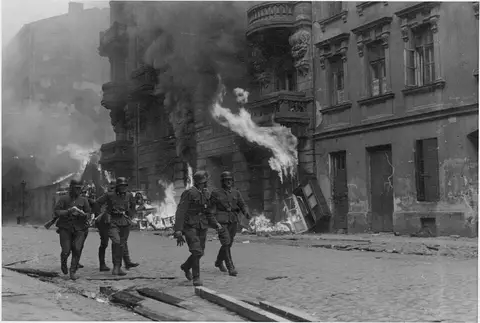
During World War II, the city suffered immense destruction. The Warsaw Ghetto, the largest in occupied Europe, was completely destroyed in 1943 after a courageous uprising by its Jewish residents. The Warsaw Uprising in August 1944, led by the Polish Home Army, was the largest resistance uprising against the occupiers in Europe. Despite the brave resistance of the population and the army, the city was systematically razed to the ground. The destruction was so severe that rebuilding after the war was one of the greatest challenges in Polish history.
The reconstruction of Warsaw's Old Town is considered exemplary and was added to the UNESCO World Heritage List in 1980. The Old Town was rebuilt in meticulous detail using historical records, paintings, and photographs. Today you can admire the Gothic St. John's Cathedral, the Royal Castle, and the distinctive townhouses around the Market Square. The Royal Way, which runs from the Old Town through the New Town to Ujazdów Castle, is lined with historic palaces and churches that recall the city's glittering past.
A particular highlight for visitors is Łazienki Park, which was developed during the Polish Enlightenment under King Stanisław August Poniatowski. The park contains several palaces, including the Palace on the Isle, and offers impressive views of the Vistula. The French-style gardens and the statue of Frédéric Chopin, often accompanied by music from passersby, make the spot a popular meeting place. The park is a testament to the Neoclassical era and a place to relax in the middle of the bustling metropolis.
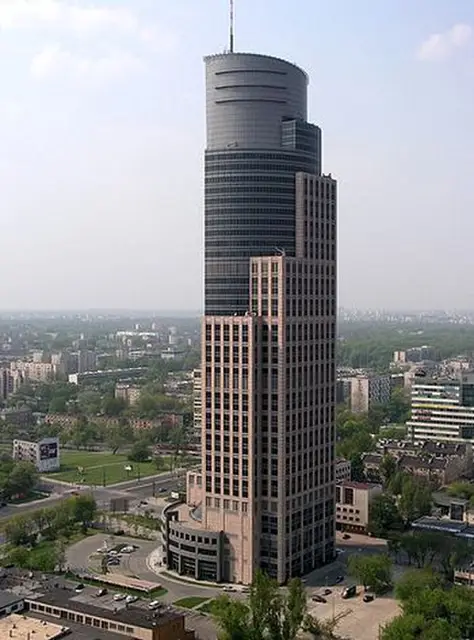
Modern Warsaw is a lively mix of historic sites and contemporary architecture. Marszałkowska Street, the city's commercial center in the 19th century, was greatly altered after the war, but today it is home to numerous shops, restaurants, and cultural venues. The Art Nouveau Philharmonic and the Grand Theater are important cultural anchors. The city is also home to international institutions such as the EU border agency Frontex and the OSCE Office for Democratic Institutions and Human Rights, underscoring its global importance.
Culturally, Warsaw is a melting pot of different influences. The city was home to many famous artists, writers, and scientists, including Marie Skłodowska-Curie, who was born in the New Town, and Henryk Sienkiewicz, the Nobel Prize winner in literature. The Warsaw Philharmonic and the Grand Theater offer a rich program of concerts and performances. Museums such as the National Museum and the Warsaw Rising Museum recall the city's eventful history and offer insights into Polish culture and identity.
Warsaw's climate is shaped by a transition zone between maritime and continental weather, with warm summers and cool, sometimes freezing winters. The average annual temperature is 47.3°F (8.5°C). The Vistula, which flows through the city, is navigable, although boat traffic is limited to smaller vessels. The city has a well-developed transportation network, including trams and buses that connect the various districts. The 18 districts, which have existed since the administrative reform of 2002, are integrated into a citywide administration.
Today, Warsaw is a dynamic metropolis that combines historical depth with modern life. The combination of the rebuilt World Heritage Old Town, the magnificent parks, and the vibrant cultural scene makes the city a fascinating destination. You can sense the resilience of the Polish people, which shows in the painstaking reconstruction of the historic buildings and the living memory of the victims of World War II. The city is a place of reflection, culture, and discovery that offers insights into the complex history of Central and Eastern Europe.
At a glance
- Category
- Sight › Historic sites
- Rating
- no reviews yet · write a review
- Address
- Rondo Romana Dmowskiego 28
02-306 Warsaw, Poland - District
- Midtown
- Phone
- —
- Website
- —
- —
- Coordinates
- 52.22982° N · 21.01173° E
- Data quality
- confidence 0.81
- Identifier
- ID 7abfcf50-77e…
Part of the tour
Warsaw in One Day: Old Town, Royal Route and City Center →Location & surroundings
Toggle layersRatings & comments
none yetNear Central Warsaw
closest 5 per category · 2 kmRestaurants
Museums
Hotels
More:Historic sites in Warsaw (704)Sights in Midtown (292)All sights in Warsaw (792)
300 places within 2 km loaded.
You need a free account to leave reviews and photos – that keeps comments genuine and lets you edit them later.