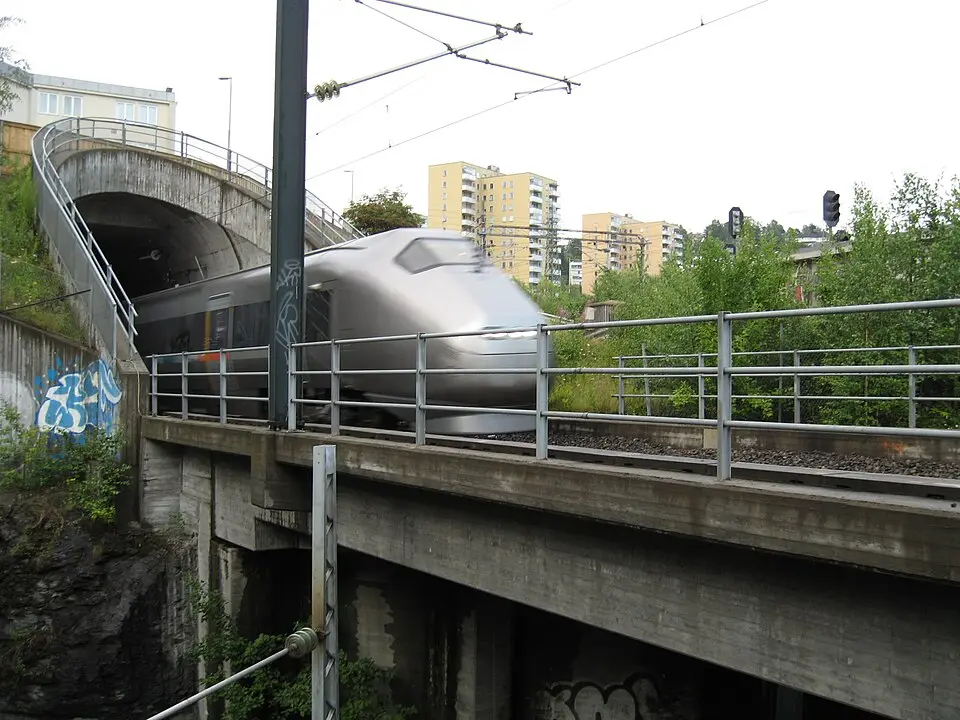
About Romerike Tunnel
The Romerike Tunnel, also known as Romeriksporten, is a single-bore railway link in Norway that connects Oslo with Lillestrøm. As part of the Gardermoen Line, it forms the first segment of the route that leads via Oslo Airport, Gardermoen to Eidsvoll. At 14.58 kilometers (9 miles) long, it is the second-longest railway tunnel in the country. The line is double-track and electrified, allowing speeds of up to 210 kilometers per hour (130 mph). Unlike the old, winding main line from 1854, the tunnel runs more directly, cutting the travel time between Oslo and Lillestrøm from 16 to 18 minutes down to just ten. This significantly increases the capacity of the network, since long-distance, regional, and airport express trains can bypass the old section.
Construction began in 1994, but the opening was considerably delayed. The tunnel was originally supposed to go into service on October 8, 1998, together with the new airport. However, unstable geological conditions in the Østmarka recreation area led to massive water ingress from several lakes, including Lutvann. These leaks not only damaged nearby homes but also lowered the water level of the lakes. Repairing the leaks and dealing with contaminated sealing materials caused substantial delays and cost overruns. Regular operations did not begin until August 22, 1999. During construction, more than three million tons of rock were excavated, and depending on the location, the tunnel runs between 6 and 120 meters (20 to 395 feet) below the surface.
For visitors and travelers, the tunnel matters above all as a fast means of transportation. The Flytoget express trains, as well as trains continuing onto the Dovre Line, use this route. Local trains on the Main Line and the Kongsvinger Line also pass through the tunnel, while the old main line is now used primarily for freight traffic and suburban commuter trains with intermediate stops. The technical design, including a special ventilation system to counteract natural buoyancy, underscores the engineering challenge of this project, which has fundamentally relieved the transport infrastructure north of Oslo.
At a glance
- Category
- Sight › Historic sites
- Rating
- no reviews yet · write a review
- Address
- —
Oslo, Norway - District
- Gamle Oslo
- Phone
- —
- Website
- —
- —
- Coordinates
- 59.90563° N · 10.79444° E
- Data quality
- confidence 0.82
- Identifier
- ID d05ad184-fe9…
Location & surroundings
Toggle layersRatings & comments
none yetNear Romerike Tunnel
closest 5 per category · 2 kmSights
Restaurants
Museums
Hotels
More:Historic sites in Oslo (377)Sights in Gamle Oslo (45)All sights in Oslo (394)
146 places within 2 km loaded.


You need a free account to leave reviews and photos – that keeps comments genuine and lets you edit them later.