Sight · Historic sites
Lysthuset på Nationaltheateret
Nationaltheatret, Johanne Dybwads plass 1, 0161 Oslo
About Lysthuset på Nationaltheateret
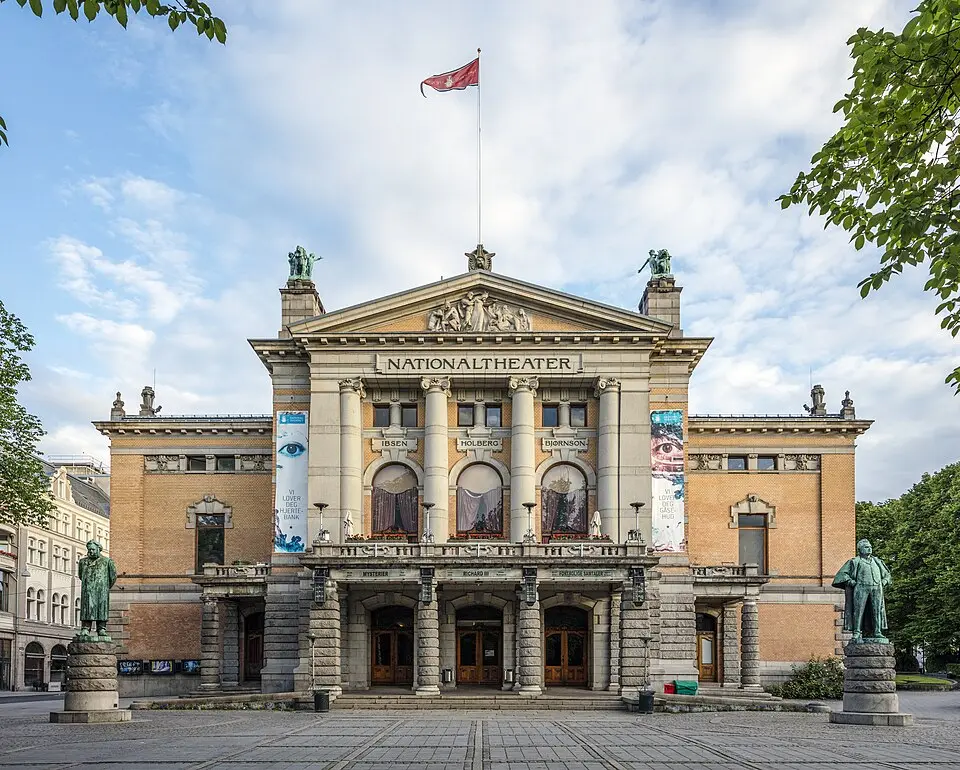
The Nationaltheatret in Oslo is Norway's most important spoken-word theater and a central place in the country's cultural identity. The building, which opened in 1899, was designed by the architect Henrik Bull and has been a protected landmark since 1983. It has made an international name for itself above all through its productions of classics, especially the dramas of Henrik Ibsen. But the promotion of contemporary drama has also played a key role in the theater's profile since the 1960s, and even more so since 1990. For visitors, the theater offers not only an impressive architectural setting but also a glimpse into Norwegian theater history, which is closely tied to the national independence movement.
The history of the building goes back to the Christiania Theater, which stood at Bankplassen from 1837. In the early decades, Danish actors and texts dominated, since the educated classes still regarded the Norwegian language as coarse. Only from the 1860s onward, in step with the growing national movement, did Norwegian gradually make its way onto the stage. The new Nationaltheatret, opened in 1899, followed logically from this development and inaugurated its doors with gala performances of works by Ludvig Holberg, Henrik Ibsen, and Bjørnstjerne Bjørnson. Notably, Edvard Grieg himself conducted the incidental music for one of Bjørnson's plays while the playwrights were present in person.
The theater's name has an interesting linguistic history. The building received its name during construction in the 1890s, and it is emblazoned beneath the tympanum on the front facade. Despite a spelling reform in 1917 that aimed to bring spelling closer to spoken pronunciation, the theater's management kept the older, more traditional form. This lent the institution, which helped shape the Norwegian nation, a solemn character. The first artistic directors, including Vilhelm Krag and Halfdan Christensen, presided over a golden age in which international works by authors such as August Strindberg and George Bernard Shaw were staged alongside Norwegian ones.
An important chapter in the theater's history is World War II. After the German occupation of Norway in 1940, the theater was initially converted into barracks. The occupying forces compelled guest performances by German theaters, which sparked acts of resistance. Actors went on strike, and some were arrested. In 1943, the theater caught fire during a sabotage action by the resistance movement, damaging the stage house. Another devastating fire broke out in 1980 during a performance. An exploding spotlight completely destroyed the stage house, although no one was hurt. The theater did not reopen until 1985, with a production of Ibsen's Peer Gynt.
Architecturally, the building follows German theater architecture of the late 19th century. Henrik Bull combined elements of Art Nouveau, Berlin Neoclassicism, and Neo-Rococo into a unified whole. The interior, including the furnishings and stucco work, harmonizes with the exterior. Well-known Norwegian painters such as Christian Krohg and Erik Werenskiold contributed to the decoration of the public areas. In front of the facade stand two statues by Stephan Sinding depicting Bjørnstjerne Bjørnson and Henrik Ibsen. On the north side, a statue of Ludvig Holberg, flanked by figures from his comedies, has stood since 1939.
The main stage, still in use today, is designed as a classic proscenium theater and is framed by a mighty gilded arch. The auditorium, originally laid out for more than 1,200 spectators, now seats 741 following the construction of the Amfiscenen. The orchestra pit holds 45 musicians, and the stage has been revolving since 1917. National and international classics are performed here, as well as theater for children and young audiences. The magnificent decor of the hall contributes greatly to the experience of the performances.
Besides the main stage, the Nationaltheatret has additional performance spaces. The Amfiscenen, opened in 1963 on the third floor, was the first secondary stage in a Norwegian main theater building. It is flexible in use and seats up to 230 visitors, depending on the seating arrangement. Performances of all genres as well as guest productions take place here. The former paint shop has served since 1983 as an intimate space for a maximum of 60 spectators and is an important forum for contemporary drama and poetry evenings. There is also the Bakscenen, which is used only sporadically when it is not needed as storage space for sets.
A special feature of the theater is the International Ibsen Festival, which has been held since 1990 and has taken place every two years since 2002. Ibsen productions from around the world are invited to Oslo and combined with the Nationaltheatret's own productions. The festivals are accompanied by international symposia. The Nationaltheatret has staged more than 3,000 performances of Ibsen's works worldwide, underscoring its central role in presenting the Norwegian playwright's oeuvre.
The theater has also established itself as a platform for contemporary Norwegian drama. Under artistic directors such as Arild Brinchmann, politically radical theater that took up social issues was promoted. In the 1990s, the theater contributed to the international success of the playwright Jon Fosse, whose works premiered here. The Samtidsfestivalen, which alternates with the Ibsen Festival, is devoted to contemporary drama from Norway and abroad.
The Torshovteatret is also affiliated with the Nationaltheatret. It opened in 1977 in a former library building. It grew out of an effort to establish a neighborhood theater in Oslo's eastern districts in order to reach a broader audience. The Torshovteatret is known for a popular yet politically engaged program. Its artistic direction lies in the hands of a group of actors who develop a shared aesthetic concept. The theater's round, circus-like stage has sparked many artistic and political discussions.
Today, the Nationaltheatret has set itself the goal of becoming a leading theater in Europe. It maintains partnerships with the national theaters of Denmark and Sweden as well as with theaters in West Africa. The ensemble consists of nearly 90 actors, who rank among the best in the country. The theater receives public funding and has sponsorship agreements with private companies. Kristian Seltun has led the theater since 2021. For visitors, the Nationaltheatret is not only a place of entertainment but also a historic monument that reflects Norway's cultural and political development. The combination of historic architecture, classic repertoire, and modern drama makes it a must-see for culture lovers in Oslo.
At a glance
- Category
- Sight › Historic sites
- Rating
- no reviews yet · write a review
- Address
- Nationaltheatret, Johanne Dybwads plass 1
0161 Oslo, Norway - District
- Sentrum
- Phone
- —
- Website
- —
- —
- Coordinates
- 59.91487° N · 10.73337° E
- Data quality
- confidence 0.69
- Identifier
- ID 3818dd0e-3ad…
Part of the tour
Oslo in a Day: Palace, Fortress, and Fjord Waterfront →Location & surroundings
Toggle layersRatings & comments
none yetNear Lysthuset på Nationaltheateret
closest 5 per category · 2 kmSights
Restaurants
Museums
Hotels
More:Historic sites in Oslo (377)Sights in Sentrum (35)All sights in Oslo (394)
271 places within 2 km loaded.
You need a free account to leave reviews and photos – that keeps comments genuine and lets you edit them later.