Discover Lithuania: Vilnius, the Curonian Spit, and Lakes
Travel guide · editorialA vacation in Lithuania takes you to the southernmost and largest of the three Baltic countries: Baroque church spires in Vilnius, shifting dunes on the Curonian Spit, and hundreds of lakes in the east. The country is compact and distances are short, so if you have a week, you can easily combine the capital, the coast, and the countryside.
Vilnius: Baroque Old Town and Užupis
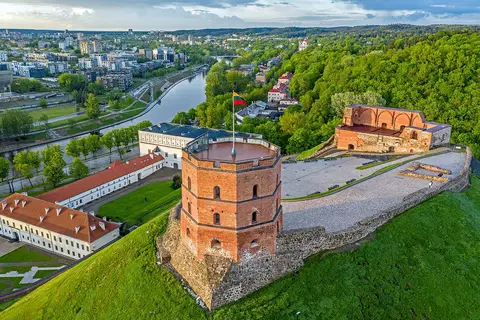
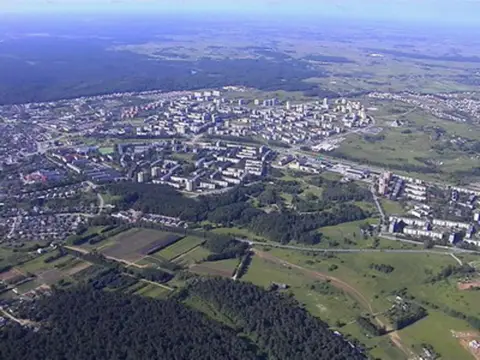
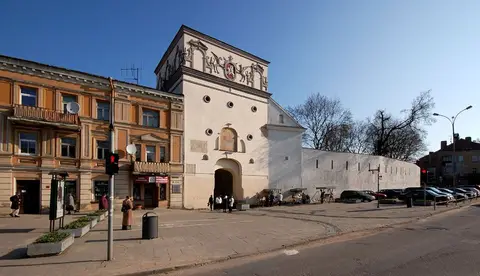
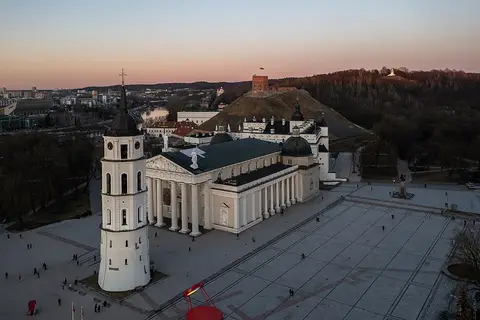
The Old Town of Vilnius is one of the largest surviving old towns in Eastern Europe and has been on the UNESCO list since 1994. Unlike in Riga or Tallinn, the look here is shaped not by brick Gothic but by the Baroque: white and pastel-colored churches, the university with its thirteen courtyards, the cathedral with its free-standing bell tower. From Gediminas Tower on Castle Hill you can take in the red rooftops. The Gate of Dawn, with its icon of the Virgin Mary, is a pilgrimage site for Catholics from Lithuania and Poland. Just across the little Vilnia River lies Užupis, a once run-down neighborhood that declared itself a "republic" in 1997, complete with its own constitution, which hangs on a wall in many languages. The Museum of Occupations and Freedom Fights, housed in the former KGB building, tells a more somber chapter. Until World War II, Vilnius was a center of Jewish life, the "Jerusalem of the North"; the Holocaust almost completely destroyed that world, and memorial sites and the Jewish Museum keep its memory alive.
Kaunas and the Interior
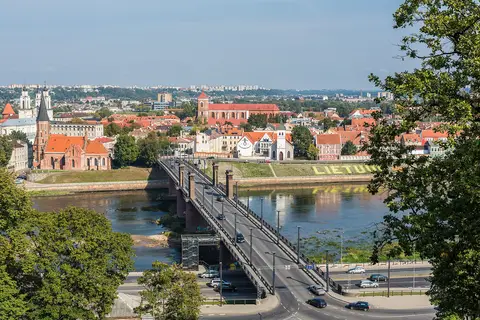
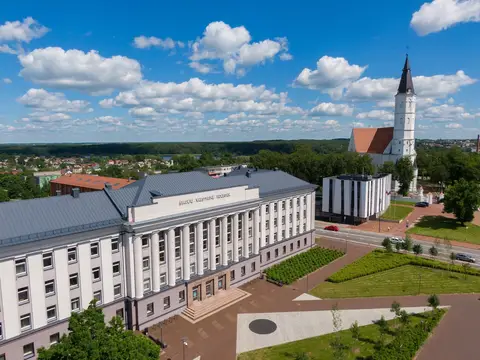
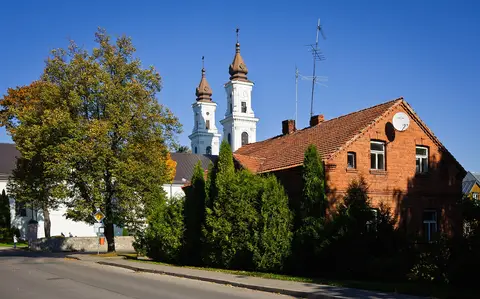
Kaunas, the second-largest city, was the provisional capital between the world wars because Vilnius then belonged to Poland. A remarkable amount of modernist architecture dates from that period and was named a World Heritage site in 2023: banks, cinemas, apartment buildings, and the Church of the Resurrection, whose roof you can climb. The pedestrian zone Laisvės alėja connects the old and new towns, and the castle stands at the confluence of the Nemunas and Neris rivers. Quirky is the Devil Museum, with more than 3,000 devil figures. About an hour's drive from Vilnius lies Trakai, with its red-brick island castle on Lake Galvė. The town is also home to the Karaites, a Turkic-speaking minority whose wooden houses always have three windows facing the street. Near Šiauliai in the north stands the Hill of Crosses, a hill on which pilgrims have placed more than 100,000 crosses over generations – Soviet authorities had it cleared several times, but the crosses always returned.
Curonian Spit, Klaipėda, and Palanga
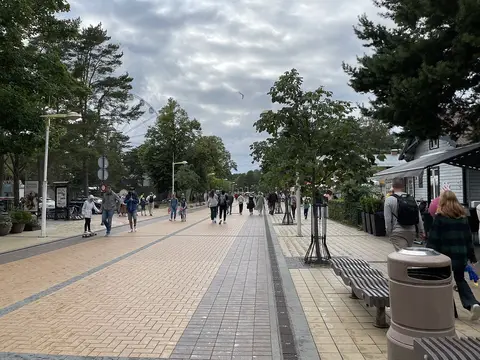
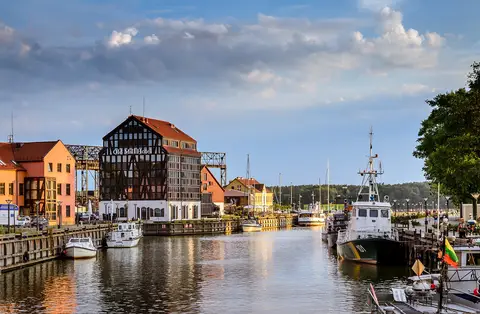
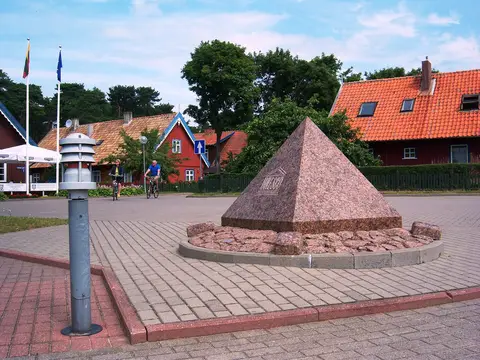
Among the best-known sights in Lithuania is the Curonian Spit, a 98-kilometer-long sand strip between the Baltic Sea and the lagoon, whose northern half belongs to Lithuania and whose southern half belongs to the Russian exclave of Kaliningrad. Tall shifting dunes, pine forests, and fishing villages with blue-and-brown wooden houses characterize the municipality of Neringa. In Nida stands the summer house of Thomas Mann, who spent the summers here from 1930 to 1932. The Parnidis Dune offers a view far across the lagoon. You reach the spit by ferry from Klaipėda, formerly Memel, whose Old Town has preserved half-timbered houses and old warehouses. Farther north lies Palanga, the country's liveliest seaside resort, with a long pier, an amber museum in the Tyszkiewicz Palace, and a broad sandy beach where half of Lithuania gathers in July.
Lakes, Forests, and Spa Towns
Most of the roughly 3,000 lakes lie in the east and south. Aukštaitija National Park near Ignalina is a paddling paradise with connected lakes and small villages that still have wooden bell towers. In the south, near the border with Belarus and Poland, lies Druskininkai on the Nemunas, a spa town with mineral springs, wellness hotels, and a year-round indoor ski slope. Nearby, Grūtas Park displays the Lenin and Stalin statues that were taken down from the country's squares after 1991. Dzūkija National Park is known for mushrooms and berries; in late summer, vendors stand along the roadsides with buckets full of chanterelles.
Lithuanian Cuisine
The best-known dish is cepelinai, large potato dumplings filled with ground meat or farmer's cheese, served with sour cream and bacon bits. In summer, šaltibarščiai is everywhere, a bright pink cold beet soup with kefir, cucumber, and dill, served with hot potatoes. With beer, people eat fried garlic bread, kepta duona. A legacy of the Karaites is kibinai, filled pastries you should try in Trakai. At celebrations there is šakotis, a tree cake baked on a spit over an open fire that looks like a fir tree. Lithuania also has a distinctive beer tradition, with farmhouse beers from the north around Biržai, some of which are still brewed according to old home recipes.
Getting There and Getting Around
The main airport is Vilnius (VNO); Kaunas (KUN) and, in summer, Palanga (PLQ) are also served, mainly by low-cost airlines. By car, it is about 560 miles (900 kilometers) from Berlin to Vilnius via Poland. There is a ferry connection from Kiel to Klaipėda. In recent years, direct trains have run again between Vilnius and Warsaw, with a change at the border; within the country, the railway connects Vilnius with Kaunas, Klaipėda, and Trakai reliably and inexpensively. For the coast and the national parks, a car is more practical. Lithuania is part of the Schengen Area and uses the euro.
Best Time to Visit Lithuania
The best time to visit Lithuania is from May to September. In July and August, temperatures climb to between 68 and 77°F (20 and 25°C), and it is high season on the Baltic coast. In June, people celebrate Joninės, the midsummer festival on June 23, with bonfires and flower wreaths. May and September are good months for city trips to Vilnius and Kaunas, when it is pleasantly warm but not crowded. Winter is cold, often with snow and temperatures around 23°F (minus 5°C), and the days are short. In early March, Vilnius hosts the Kaziukas Fair, a large crafts market where you can buy the typical palm bouquets made of dried flowers.