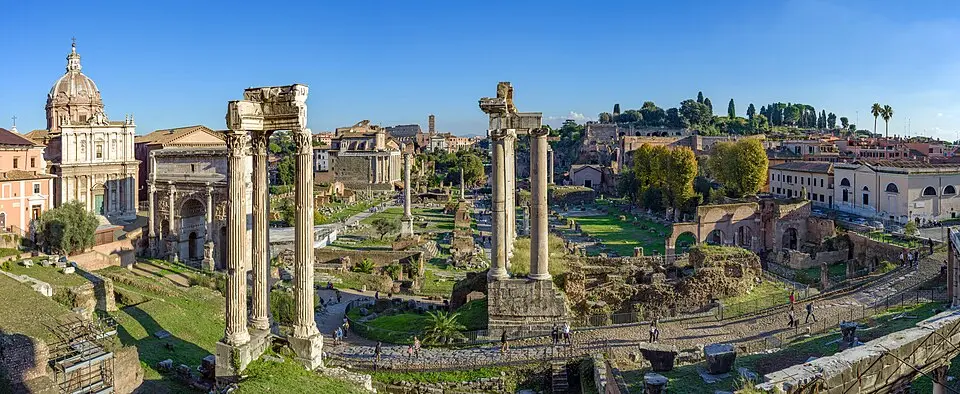
About Piazza del Foro
The Roman Forum in Rome is far more than just an archaeological site: it is the historic heart of the Eternal City and its oldest marketplace. Set in a natural hollow between three of the city's most important hills, the Capitoline, the Palatine, and the Esquiline, this spot was for centuries the center of political, economic, cultural, and religious life in ancient Rome. What looks today like a sprawling field of ruins was once a densely built-up area full of temples, basilicas, speakers' platforms, and monuments, where you could feel the pulse of Roman society. A visit here offers a unique chance to walk through the layers of history and step into the atmosphere of one of humanity's most powerful civilizations.
The history of this square reaches deep into the city's earliest days. The area was originally a marshy plain crossed by a stream and used by the early Latin settlers as a burial ground. Only the construction of the Cloaca Maxima, the great drainage system, made it possible to dry out the swamp and open up the area for urban use. Archaeological finds show that burials in this valley ended around 600 B.C., at about the same time the first paving was laid. This phase marks the transition from an unused valley to a defined urban space, which was integrated into the city's structure under Rome's early kings, in particular Lucius Tarquinius Priscus.
During the Roman Republic, the Forum became the decisive stage for politics. North of the main square lay the Comitium, the site of popular assemblies, directly adjoining the Curia, the Senate's meeting hall, and the Rostra, the famous speakers' platform. Here the great political decisions of the young republic were made and laws were proclaimed. The square was home to numerous honorary statues of distinguished citizens and generals, which underscores the growing politicization and the Forum's importance as a stage for political competition among the nobility. The ships' prows mounted on the Rostra served as visible proof of military victories and left a lasting mark on the look of the place.
With the end of the Punic Wars and access to enormous spoils of war, a period of lively building activity began in the second century B.C. Temples were renovated, and large basilicas such as the Basilica Aemilia and the Basilica Sempronia rose up, framing the square on its north and south sides. These buildings gave the Forum a firmer architectural structure and shifted its focus from a pure marketplace to a showpiece political stage. The use of the square was further defined by the construction of new buildings such as the Tabularium under Sulla, which served as a visual backdrop toward the Capitoline Hill and completed the architectural composition of the area.
The height of splendor and architectural design came in the imperial era, particularly under Augustus. The square was clad in marble and repaved in white travertine, giving it an appearance comparable to the Acropolis in Athens. Augustus used architecture skillfully to emphasize his power and his connection to the gods. New temples and triumphal arches, such as the Temple of Divus Julius, shaped the eastern side of the Forum and concealed older buildings such as the Regia. The strict rule that only people wearing togas could enter the square underscored the high representative claim and the dignity inherent in the place.
Although the so-called Imperial Forums were built later and took over some of its functions, the Roman Forum remained the spiritual and symbolic core of the city. It continued to serve as the setting for magnificent religious ceremonies and political events. Emperors such as Tiberius and Domitian added monuments of their own, and Domitian, by erecting a colossal equestrian statue in the middle of the square, temporarily reduced the surrounding buildings to mere scenery. Later emperors such as Septimius Severus and Diocletian shaped the Forum's appearance with further arches and speakers' platforms, reflecting the political importance of the site in late antiquity.
The last ancient structure erected on the Forum is the Column of Phocas, put up in A.D. 608 in honor of the Byzantine emperor Phocas. It marks the end of the ancient building phase in this area. In the Middle Ages the Forum slowly lost its central function, and many buildings fell into disrepair or were converted into churches, such as the Temple of Antoninus and Faustina, which became the church of San Lorenzo in Miranda. The ruins became a source of building material, and the area turned into a kind of quarry. In the 16th century the site was even used as a cow pasture, earning it the name Campo Vaccino, which remained in use until the 18th century.
The modern understanding of the Roman Forum began with the first systematic excavations in the 19th century. After the unification of Italy and the naming of Rome as its capital, almost all of the areas accessible today were excavated between 1871 and 1905. This work uncovered the great structures such as the basilicas, temples, and the Via Sacra, with a strong focus on restoring the state of the imperial era. Older or more recent layers were sometimes removed in order to reconstruct the image of classical Rome. These excavations made it possible to understand the topographical and architectural relationships of the ancient marketplace scientifically and to open it to the public.
Today millions of tourists visit the Roman Forum to see its impressive ruins. Among the most important sights are the Temple of Saturn, whose foundations and column bases are still visible, and the Temple of Castor and Pollux, whose Corinthian columns make a striking picture. The Temple of Antoninus and Faustina is considered one of the best-preserved temples of ancient Rome and shows the high quality of Roman architecture. The Curia Julia, the former Senate house, and the Rostra, the speakers' platform, are also important stops on the walk, recalling the political history of the city.
A special experience is the view of the Basilica of Maxentius, the largest Roman basilica, whose massive vaulted remains still hint at the size of the ancient building. The Via Sacra, the sacred road, connects the Forum with the Colosseum and was once the processional route for triumphant generals. Along this route you will find numerous other monuments, including the Arch of Septimius Severus and the Arch of Titus, which served as a model for the Arc de Triomphe in Paris. The Roman Forum is thus not only a place of history but a living open-air museum that lets you experience the complexity and richness of Roman culture in all its facets.
At a glance
- Category
- Sight › Historic sites
- Rating
- no reviews yet · write a review
- Address
- Via dei Fori Imperiali
00186 Rome, Italy - District
- Roma I
- Phone
- —
- Website
- www.italyguides.it
- —
- Coordinates
- 41.89236° N · 12.48515° E
- Data quality
- confidence 0.77
- Identifier
- ID b81aab1b-6f5…
Location & surroundings
Toggle layersRatings & comments
none yetNear Piazza del Foro
closest 5 per category · 2 kmRestaurants
Museums
Hotels
More:Historic sites in Rome (1,014)Sights in Roma I (642)All sights in Rome (1,312)
300 places within 2 km loaded.
Don't miss in Rome
All sights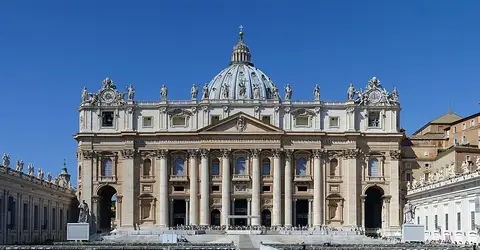 Historic sites01
The Dome at San Pietro Basilica
No address · Rome○ Website○ Phone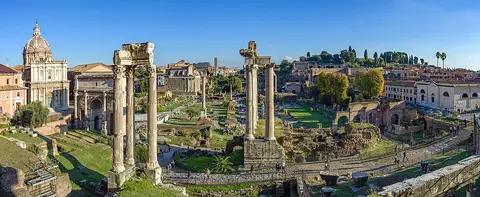 Historic sites02
Roman Forum
Via della Salara Vecchia, 5/6 · Rome● Website● Phone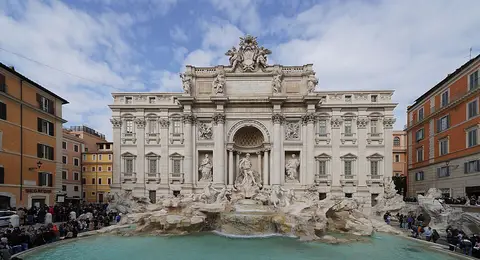 Historic sites03
Restauro Fontana di Trevi
Piazza di Trevi, 91 · Rome● Website○ Phone Monuments04
You need a free account to leave reviews and photos – that keeps comments genuine and lets you edit them later.