About Lapis Niger
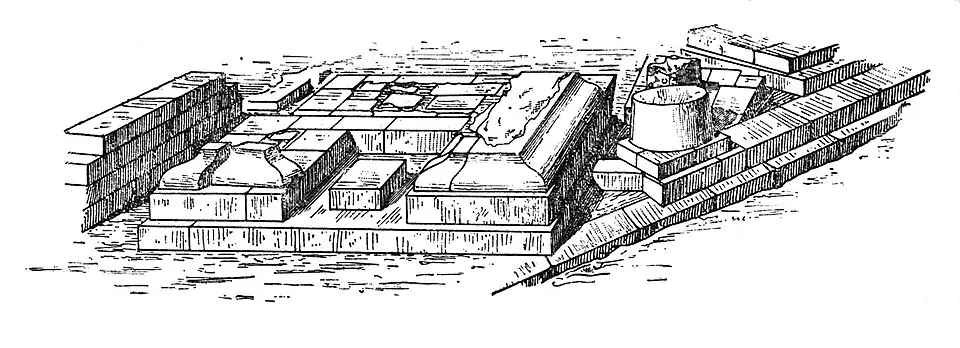
The Lapis Niger, which means "Black Stone" in Latin, is a historic site in the Roman Forum in Rome. It is a square area of black marble slabs located between the Arch of Septimius Severus and the Curia Julia, near the Republican speaker's platform, the Rostra. The name comes directly from these dark slabs, which are still visible today and cover an area of roughly 3.5 by 4 meters. The slabs range from 25 to 30 centimeters in thickness. Scholars heavily dispute the exact date of this upper covering, with proposals ranging from the 1st century B.C. to the 4th century A.D., but it marks a place of great historical and religious significance for ancient Rome.
The site was discovered in May 1899 by the Italian archaeologist Giacomo Boni. In his excavations, he not only uncovered the marble slabs on the surface but also found a much older building complex about 1.4 meters beneath them. This early Roman find consisted of the remains of an altar, probably belonging to the Volcanal, the sanctuary of the fire god Vulcan, along with a rectangular inscribed stone known as the Forum Cippus. Numerous other finds were also recovered, including votive offerings, small sculptures, pottery fragments, and the bones of cattle, sheep, and pigs, which point to ritual activity.
Archaeologists regard this underground complex as one of the last remnants of the old Comitium, an early assembly place that preceded the Roman Forum. The Comitium itself had grown out of an archaic cult site dating to the 8th or 7th century B.C., which stood at the center of public life in the earliest Rome. The fact that this sacred site was not destroyed when the Forum was later expanded, but was carefully covered with the striking black slabs, shows that it was still considered especially significant in later centuries. It was probably seen as a relic of Rome's own early history, even though the exact function of the remains beneath it was already unclear by that time.
Ancient written sources paint a multifaceted but often contradictory picture of the site's meaning. Various authors linked the monument to figures from Rome's mythical early history. According to the poet Horace, the tomb of the city's founder Romulus was said to lie in the Forum, and later commentaries place its exact location near the Rostra. Other sources, such as the lexicographer Sextus Pompeius Festus, suggested that either Faustulus, the foster father of the twins Romulus and Remus, or Hostus Hostilius, the grandfather of King Tullus Hostilius, was buried beneath the Lapis Niger. The historian Dionysius of Halicarnassus also mentioned a lion statue and an account of the deeds of Romulus near a sacrificial site of Vulcan.
The archaeological evidence, however, refutes the theory that this was a tomb or a political monument. The structural remains clearly belong to an altar. The statements in the ancient texts are therefore interpreted today as aetiologies, that is, mythical stories that later Romans devised to explain a venerable structure in the city center and an inscription they could not understand. Various inconsistent speculations seem to have circulated to explain the site, since a structure traditionally regarded as the tomb of Romulus would hardly have been simply paved over without some justification.
A central element of the site is the so-called Forum Cippus, a stele of dark tuff found beneath the marble slabs. It has a base of 47 by 52 centimeters and is broken off at the top, probably when the stone slabs above it were laid. The inscription on the stone is written in archaic Latin and follows a special writing pattern. The text runs "boustrophedon," meaning that the direction of writing alternates from line to line. A peculiarity of this cippus is that, with the exception of two lines, the text is written not horizontally from left to right or the reverse, but vertically, from bottom to top or top to bottom. This impractical layout may have had religious or ritual reasons.
The dating of the inscription is the subject of extensive scholarly debate. Recent research suggests that the stone can be dated to the 7th or 6th century B.C., still within the period of the Roman kings. This would make it one of the oldest surviving inscriptions in Latin. Other scholars, however, favor later dates, as late as the period after the Gallic sack of Rome in the 4th century B.C. A water basin found during excavations in 1955, which was filled in during the 6th century B.C., shortly before the altar of Vulcan was built, is considered reliable evidence for an early date. Since the foundation of the altar abuts that of the inscribed column, the cippus is considered older.
The text of the inscription contains remnants of a sacred law, the so-called lex sacra. Some words can be identified with certainty, including terms for "king" (rex), "herald" or "crier" (calator), and "draft animals" (iumenta). Interpreting the text is difficult, since many parts are missing and the restorations often rest on historical conjecture. One much-discussed reconstruction reads the text as a temple law regulating expiatory sacrifices by the king or a priest-king in a sacred grove. It is assumed that the ruler went there in a procession, with a herald sent ahead to purify the way. Despite these attempts at interpretation, the inscription as a whole remains hard to translate, as it largely resists any clear and complete reading.
At a glance
- Category
- Sight › Historic sites
- Rating
- no reviews yet · write a review
- Address
- Via dei Fori Imperiali
00186 Rome, Italy - District
- Roma I
- Phone
- —
- Website
- —
- —
- Coordinates
- 41.89269° N · 12.48499° E
- Data quality
- confidence 0.81
- Identifier
- ID 22a9ad80-b50…
Location & surroundings
Toggle layersFAQ about Lapis Niger
quick answersWhat is the Lapis Niger in Rome?
The Lapis Niger, Latin for "Black Stone," is a historic site in the Roman Forum in Rome. It is a square area of black marble slabs measuring about 3.5 by 4 meters (roughly 11.5 by 13 feet), located between the Arch of Septimius Severus and the Curia Julia, near the Rostra. The slabs are 25 to 30 centimeters thick and are still visible today.
Who discovered the Lapis Niger, and what was found beneath it?
The Italian archaeologist Giacomo Boni discovered the Lapis Niger in Rome in May 1899. About 1.4 meters beneath the marble slabs, he came across a much older complex of structures containing the remains of an altar, probably belonging to the Volcanal, the sanctuary of the fire god Vulcan, as well as a four-sided inscribed stone, the Forum Cippus. Also found were votive offerings, small sculptures, pottery fragments, and animal bones from cattle, sheep, and pigs, which point to ritual activity.
How old is the Lapis Niger?
The exact age of the black marble covering of the Lapis Niger in Rome is hotly debated among scholars. Proposed dates range from the 1st century B.C. to the 4th century A.D. The complex beneath it is considered one of the last remnants of the ancient Comitium, which developed from an archaic cult site of the 8th or 7th century B.C.
Is the tomb of Romulus located beneath the Lapis Niger?
That has never been proven, since the ancient sources on the Lapis Niger in Rome contradict one another. According to the poet Horace, the tomb of the city's founder Romulus was at the Forum, while later commentaries place it near the Rostra. The lexicographer Sextus Pompeius Festus, by contrast, suggested that Faustulus, the foster father of Romulus and Remus, or Hostus Hostilius, the grandfather of King Tullus Hostilius, was buried there.
What can you see around the Lapis Niger?
Around the Lapis Niger in the Roman Forum in Rome, numerous ancient sites lie within just a few meters. travelguide195 lists, among others, the Comizio (about 10 meters away), the Rostra (about 23 meters), the Column of Phocas (about 27 meters), the Arch of Septimius Severus (about 30 meters), and the Umbilicus Urbis (about 33 meters). Also nearby are the Lacus Curtius (about 39 meters), the Curia Julia (about 41 meters), and the Milliarium Aureum (about 54 meters).
Ratings & comments
none yetNear Lapis Niger
closest 5 per category · 2 kmRestaurants
Museums
Hotels
More:Historic sites in Rome (1,014)Sights in Roma I (642)All sights in Rome (1,312)
300 places within 2 km loaded.
Don't miss in Rome
All sights Historic sites01
The Dome at San Pietro Basilica
No address · Rome○ Website○ Phone Historic sites02
Roman Forum
Via della Salara Vecchia, 5/6 · Rome● Website● Phone Historic sites03
Restauro Fontana di Trevi
Piazza di Trevi, 91 · Rome● Website○ Phone Monuments04
You need a free account to leave reviews and photos – that keeps comments genuine and lets you edit them later.