About Domus Flavia
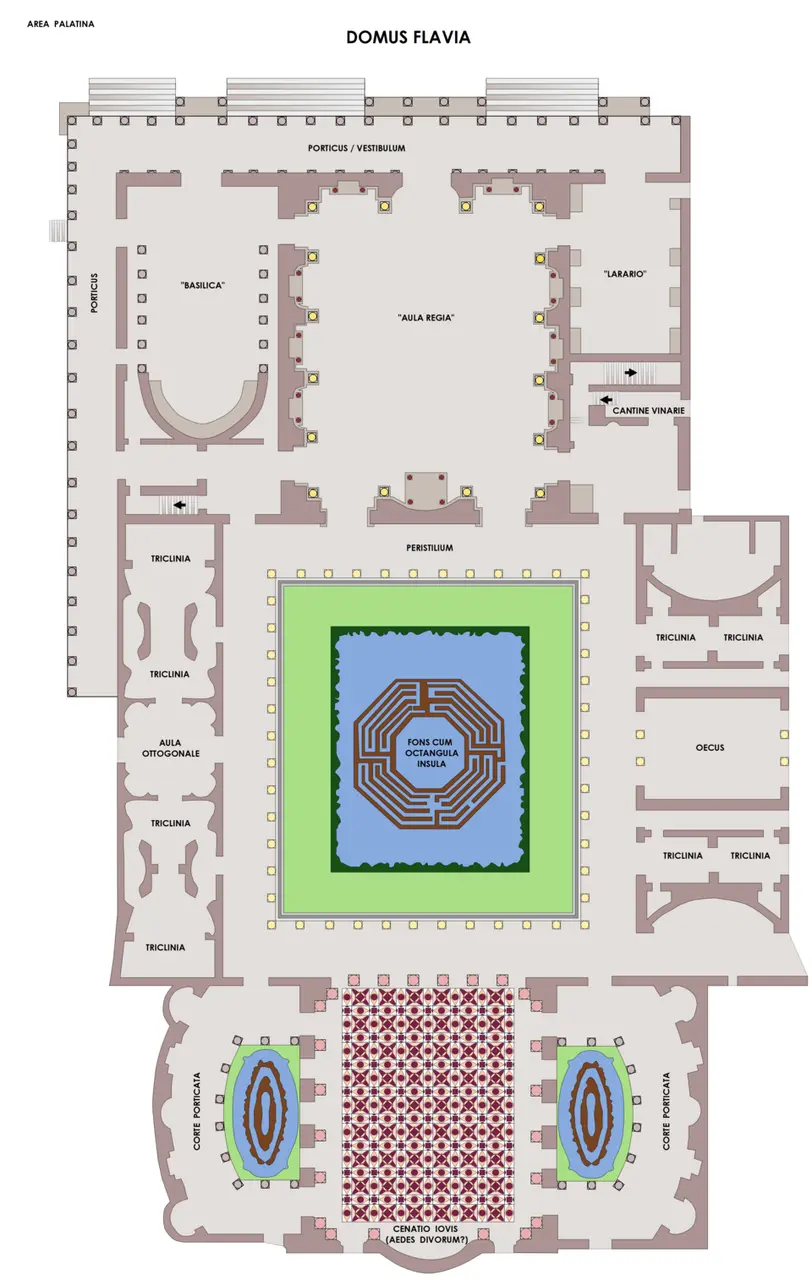
The Domus Flavia was the ceremonial wing of the Flavian imperial palace on the Palatine Hill in Rome. It was built at the end of the first century under Emperor Domitian, after a devastating fire in the year 80 destroyed the earlier buildings. To make room for the sprawling project, the hollow between the hill's two summits was filled in, which is why remains of older structures such as the House of the Griffins and the Aula Isiaca are still well preserved today. The building housed mainly lavish reception rooms, while the emperor's living quarters lay in an adjoining section. On the north side was a terrace from which the emperor could show himself to the people. Behind it stood a three-aisled basilica for administrative business, the enormous Aula Regia with its marble floor and Phrygian columns, and a small lararium. Beyond the throne room lay a spacious peristyle that led to a dining hall overlooking elliptical fountains. Today, the surviving brick walls of this historic site continue to shape the skyline of the Roman city.
At a glance
- Category
- Sight › Historic sites
- Rating
- no reviews yet · write a review
- Address
- Via di S. Gregorio, 30
00186 Rome, Italy - District
- Roma I
- Phone
- +390669984443
- Website
- —
- —
- Coordinates
- 41.88870° N · 12.48659° E
- Data quality
- confidence 0.59
- Identifier
- ID b21e34f5-674…
Location & surroundings
Toggle layersFAQ about Domus Flavia
quick answersWhat is the Domus Flavia in Rome?
The Domus Flavia is the ceremonial part of the Flavian imperial palace on the Palatine Hill in Rome. It was built at the end of the first century under Emperor Domitian, after a devastating fire in the year 80 destroyed the earlier buildings. While this section mainly held lavish reception rooms, the emperor's living quarters were located in an adjoining section.
What rooms were there in the Domus Flavia?
The Domus Flavia on the Palatine Hill in Rome included several large reception rooms. On the north side was a terrace from which the emperor could show himself to the people, followed by a three-aisled basilica for administrative matters, the enormous Aula Regia with its marble floor and Phrygian columns, and a small lararium. Behind the throne room lay a spacious peristyle, which led to a dining hall overlooking elliptical fountains.
Why are older buildings preserved beneath the Domus Flavia?
To build the Domus Flavia in Rome, the hollow between the two peaks of the Palatine was filled in, which preserved older structures beneath it. That is why remains such as the House of the Griffins and the Aula Isiaca are still well preserved today. The surviving brick walls of the Domus Flavia itself continue to shape the city's skyline.
What can you visit around the Domus Flavia?
Around the Domus Flavia on the Palatine Hill in Rome, numerous other ancient sites lie close together. travelguide195 lists, among others, the Orti Farnesiani al Palatino at about 32 meters, the Museo Palatino at about 42 meters, the Domus Transitoria at about 59 meters, and the Temple of Apollo Palatinus at about 75 meters away. Also nearby are the Domus Augustana (about 83 meters), the House of Livia (about 100 meters), the Aula Isiaca con Loggia Mattei (about 101 meters), and the Domus of Augustus (about 124 meters).
Where is the Domus Flavia, and are there restaurants nearby?
The Domus Flavia is located on the Palatine Hill in the Roma I district of Rome, at Via di S. Gregorio, 30. travelguide195 lists around 31 restaurants within 500 meters, so you can grab a bite to eat in the area before or after your visit.
Ratings & comments
none yetNear Domus Flavia
closest 5 per category · 2 kmSights
Restaurants
Museums
Hotels
More:Historic sites in Rome (1,014)Sights in Roma I (642)All sights in Rome (1,312)
300 places within 2 km loaded.
Don't miss in Rome
All sights Historic sites01
The Dome at San Pietro Basilica
No address · Rome○ Website○ Phone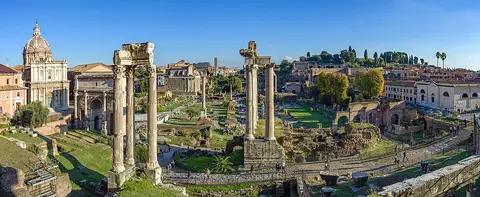 Historic sites02
Roman Forum
Via della Salara Vecchia, 5/6 · Rome● Website● Phone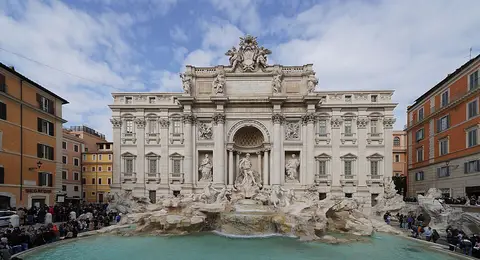 Historic sites03
Restauro Fontana di Trevi
Piazza di Trevi, 91 · Rome● Website○ Phone Monuments04
You need a free account to leave reviews and photos – that keeps comments genuine and lets you edit them later.