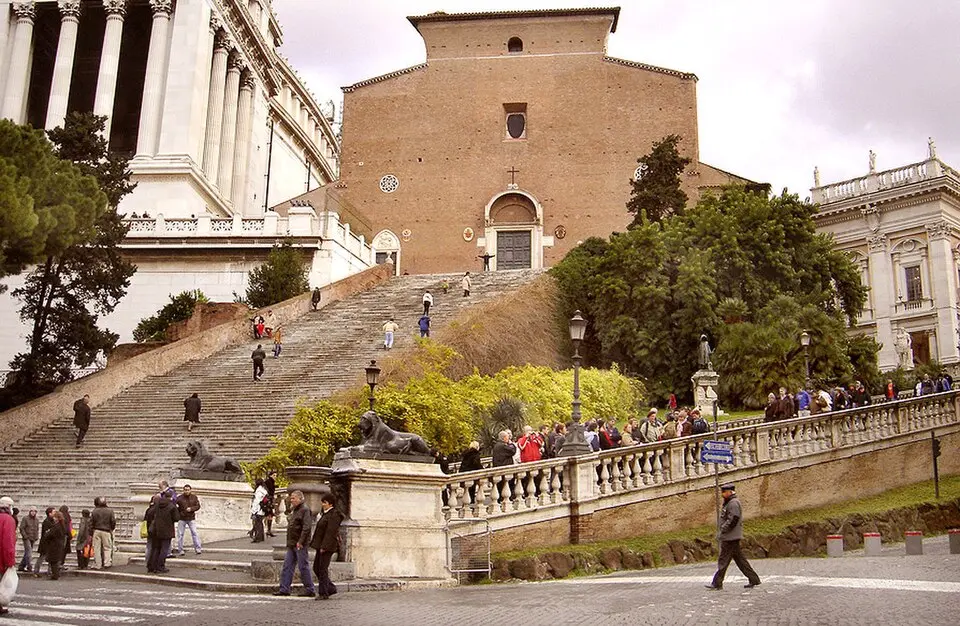
About Clivio Capitolino
The Capitoline Hill, or Capitol for short, is one of the seven classic hills of Rome and served in antiquity as the religious and political center of power in the city. Geographically, it lies northwest of the Palatine and consists of gray-green tuff. The hill has two summits: the southern one is called the Capitolium and the northern one the Arx, and both rise to nearly the same height above sea level. A saddle lies between them, while the slope down to the Campus Martius to the northwest is steep. According to Roman tradition, the name derives from the skull of a legendary Etruscan king found on the site, though modern scholars regard the exact origin of the word as disputed. In the archaic period, the place was still named after the Tarpeian Rock, before the name came to be used for the entire hill.
In antiquity, the southern summit was the site of Rome's most important temple, dedicated to the Capitoline Triad of Jupiter, Juno, and Minerva. This sacred precinct, the Area Capitolina, was surrounded by a wall and housed numerous smaller shrines and altars in addition to the main temple. This is where the triumphal processions of victorious generals began, with sacrifices made at the altar of Jupiter Soter, and where the consuls solemnly took up their offices. The northern summit held the citadel and the Temple of Juno Moneta, which was also linked to Roman coin minting. The legend of the sacred geese is famous: they saved the city from a Gallic assault by noticing the nighttime attack and waking the guards. At the southern tip of the hill stood the Tarpeian Rock, from which condemned prisoners were executed by being thrown down.
Today, Capitoline Square (Piazza del Campidoglio), designed by Michelangelo, defines the look of the site. The square was laid out in the 16th century, after the pope asked the artist to put the ruins in order following the Sack of Rome and to prepare the square for the visit of Emperor Charles V. Michelangelo planned a trapezoidal space that turns away from the old center at the Roman Forum and faces the new center, the Vatican. Thanks to the surrounding palaces, the layout feels both open and enclosed. In the middle of the square stands a copy of the equestrian statue of Marcus Aurelius. The original survived the metal-hungry Middle Ages only because it was mistaken for a statue of the first Christian emperor, Constantine, and was moved to a museum in the 1980s because of air pollution. Remnants of the ancient world are also visible on the square, such as the statue of Roma, which originally depicted Minerva, flanked by figures symbolizing the Nile and the Tiber.
The buildings that frame the square now house important institutions. The Palazzo Senatorio, which holds Rome's city hall, stands on the foundations of the ancient Tabularium, Rome's state archive. The other two palaces, the Palazzo dei Conservatori and the Palazzo Nuovo, are part of the Capitoline Museums. Here, visitors experience a blend of ancient history and Renaissance architecture. The square serves as a symbol of Rome's self-image as the head of the world, a concept Michelangelo took up in his design and which the popes later adopted as well. During the Neoclassical era, the name Capitol was also applied to other buildings, such as the seat of the U.S. Congress in Washington, though there it was the ancient temple, not the hill itself, that served as the model.
At a glance
- Category
- Sight › Historic sites
- Rating
- no reviews yet · write a review
- Address
- Via Monte Tarpeo, 42
00186 Rome, Italy - District
- Roma I
- Phone
- —
- Website
- —
- —
- Coordinates
- 41.89235° N · 12.48360° E
- Data quality
- confidence 0.65
- Identifier
- ID 47b47020-890…
Location & surroundings
Toggle layersRatings & comments
none yetNear Clivio Capitolino
closest 5 per category · 2 kmSights
Restaurants
Museums
Hotels
More:Historic sites in Rome (1,014)Sights in Roma I (642)All sights in Rome (1,312)
300 places within 2 km loaded.
Don't miss in Rome
All sights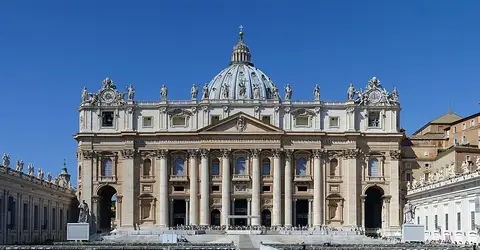 Historic sites01
The Dome at San Pietro Basilica
No address · Rome○ Website○ Phone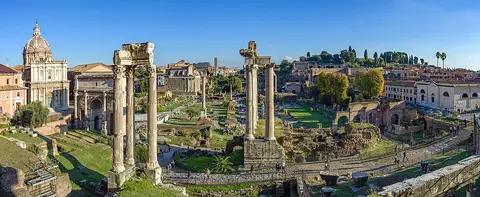 Historic sites02
Roman Forum
Via della Salara Vecchia, 5/6 · Rome● Website● Phone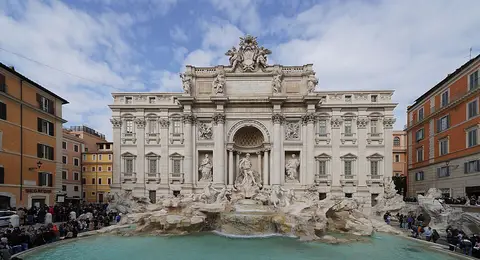 Historic sites03
Restauro Fontana di Trevi
Piazza di Trevi, 91 · Rome● Website○ Phone Monuments04
You need a free account to leave reviews and photos – that keeps comments genuine and lets you edit them later.