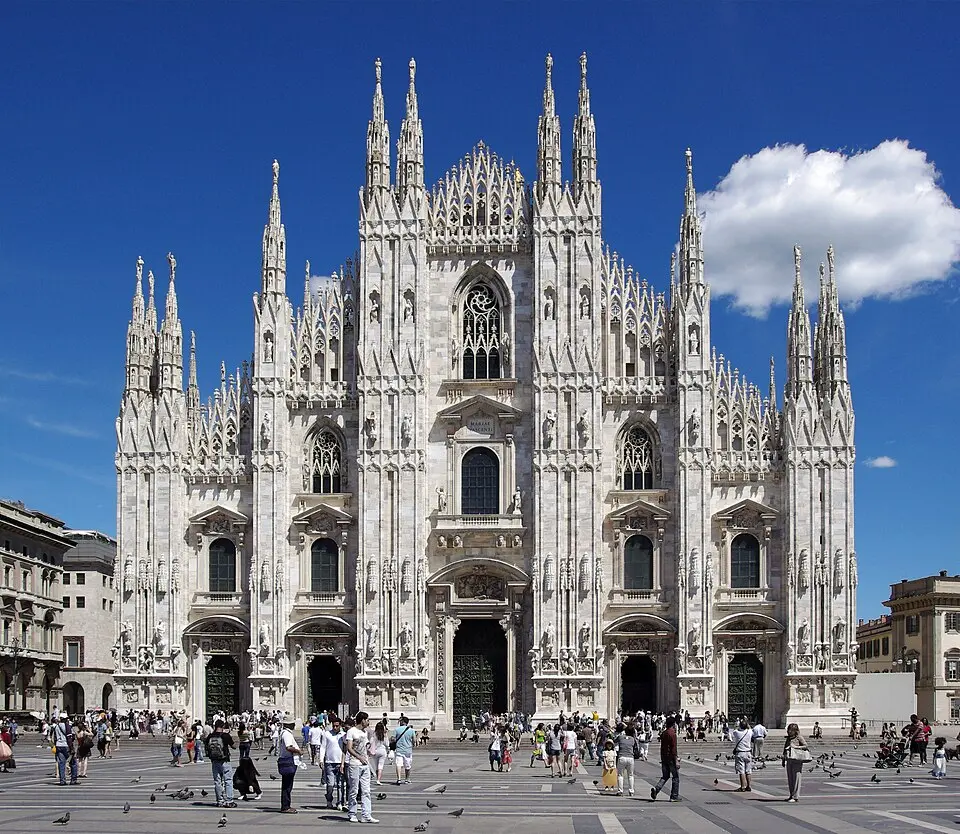
About Guglie del Duomo
Milan Cathedral, officially called the Cattedrale Metropolitana della Natività della Beata Vergine Maria, is the Roman Catholic cathedral of the Archdiocese of Milan and one of the largest churches in the world by area. The monumental building stands on a site that was already home to an early Christian church and a Roman basilica in the fourth century, both of which were destroyed, altered several times over the centuries, and finally demolished. The present cathedral was begun in the Gothic style in 1386 on the initiative of Bishop Antonio Saluzzo and the city's ruler, Gian Galeazzo Visconti. Its construction was heavily shaped by politics: the people of Milan wanted the new project to underscore their central position within the Visconti domain, while the ruler himself set up his court in Pavia.
The building history of the cathedral was marked by tensions between the city administration and the Visconti dynasty. Gian Galeazzo Visconti tried to turn the cathedral into a dynastic mausoleum, but met with strong resistance from the citizens and the cathedral works administration. This conflict led the Visconti to launch a building project of their own in Pavia. Until 1402, Italian, French, and German master builders worked on the cathedral, and Lombard traditions soon prevailed, without completely displacing the influence of French and German Gothic. The building material, marble from the quarries of Candoglia on Lake Maggiore, was transported via Milan's canals and marked with a special label that allowed it to be imported duty-free.
Completing the cathedral took several centuries. The crossing tower caused serious structural problems and was not finished until 1500, under cathedral architect Giovanni Antonio Amadeo. When Bishop Charles Borromeo consecrated the cathedral in 1572, the west end was still closed off provisionally with a brick wall. Various 16th-century façade designs calling for a Roman Renaissance style were only partly carried out. In the 17th and 18th centuries, construction advanced only slowly, even though work focused on the façade. It was not until Napoleon, who had himself crowned King of Italy in the cathedral in 1805, ordered it that the façade was continued in the neo-Gothic style and completed in 1813.
The exterior of the cathedral is characterized by its rich sculptural decoration. The side walls, dating from the 15th to the 18th centuries, are broken up by rhythmically arranged buttresses and tall windows. More than 2,000 statues and 135 pinnacles adorn the façade, offering an overview of the sculptural art of different eras and countries of origin. A special attraction for visitors is the walkable roof, reached by stairs or an elevator. From there you get a close-up look at the cathedral's stonemasonry as well as a wide panorama over Milan and, on clear days, as far as the Alps.
The octagonal crossing tower, built in the 15th and 16th centuries, is topped by the gilded statue of the Assumption of Mary, visible from far away and known locally as La Madonnina. The statue was made from a copper-sheet model and put in place in 1774. It is an important symbol of the city and is celebrated in Milan's unofficial city anthem. The façade has five portals leading inside. The bronze doors of the main portal show scenes from the life of Mary and combine elements of neo-Gothic and Art Nouveau. The other portals are devoted to various themes such as the peace of Christianity, the life of Saint Ambrose, and the history of the cathedral.
Inside, the cathedral has a regular floor plan in the shape of a Latin cross. The five aisles of the nave, the three-aisled transept, and the choir follow fixed proportions, with the central nave and the crossing twice as wide as the side aisles. The elevation, with the slight stepping of heights typical of Lombard architecture, feels rather squat and dimly lit. The vaults are supported by 52 clustered piers whose capitals are decorated with niches and figures of saints. The floor, laid in its present form beginning in 1585, consists of white, red, and black marble slabs and other stones arranged as colored inlays.
The cathedral's furnishings include numerous art treasures and historical objects. The left side aisle holds altars from the 16th to 19th centuries, including marble slabs with figures of the apostles and the wooden cross that Charles Borromeo carried during the plague of 1576. The right side aisle houses sarcophagi of saints and benefactors as well as windows created in the 15th century by artists from Flanders, Lombardy, and the Rhineland. In the left transept stands the Trivulzio Candelabrum, a masterpiece of early Gothic bronze casting from the Rhineland or Lorraine, made around 1200 and depicting biblical and secular scenes.
The choir was remodeled in the early Baroque style in the second half of the 16th century. The high altar is surrounded by a ciborium in the form of a round temple, supported by four bronze angels. Above the altar is a statue of the triumphant Christ. During Easter season, a teardrop-shaped paschal candelabrum is hung above the altar, and once a year a Holy Nail of the Cross is lowered from the vaulted ceiling in a cross-shaped reliquary. Beneath the high altar lies the circular crypt, built in 1606. From here you reach the Scurolo di San Carlo, an octagonal chapel that holds the mortal remains of Saint Charles Borromeo in a crystal urn.
The cathedral treasury preserves valuable relics and artworks, including a silver capsule that Ambrose of Milan received from the pope in the 4th century. Another special feature of the cathedral is the horizontal brass meridian line set into the floor. Sunlight passes through a small hole in the vault and falls on this line, forming a spot of light that moves over the course of the year and thus serves as a solar calendar. The cathedral's organ, made up of several sections played from a single console, is one of the largest in the world, with a great number of stops and pipes. The cathedral is not only a religious center but also an important cultural and historical landmark of Milan, fascinating visitors with its architecture, history, and art treasures.
At a glance
- Category
- Sight › Monuments
- Rating
- no reviews yet · write a review
- Address
- —
Milan, Italy - District
- 1
- Phone
- —
- Website
- —
- —
- Coordinates
- 45.46406° N · 9.19167° E
- Data quality
- confidence 0.73
- Identifier
- ID b1f3de86-62a…
Location & surroundings
Toggle layersRatings & comments
none yetNear Guglie del Duomo
closest 5 per category · 2 kmSights
Restaurants
Museums
Hotels
More:Monuments in Milan (69)Sights in 1 (254)All sights in Milan (573)
300 places within 2 km loaded.
You need a free account to leave reviews and photos – that keeps comments genuine and lets you edit them later.