About Rooftop Duomo Milan
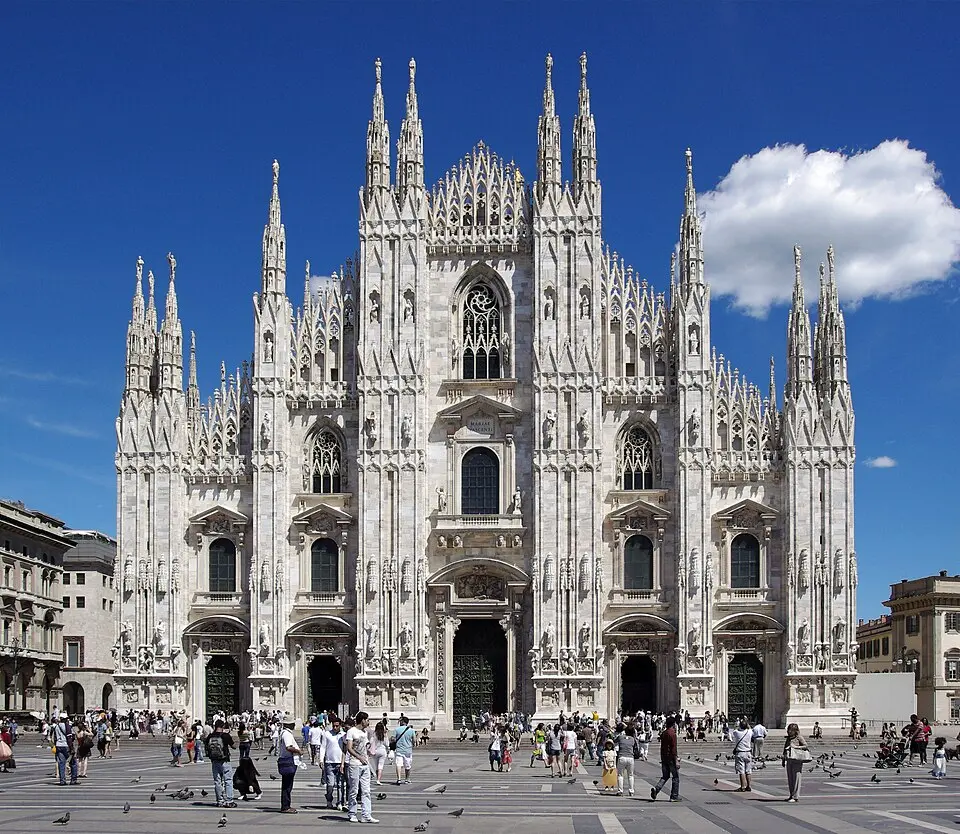
Milan Cathedral, officially known as the Cathedral of the Nativity of the Blessed Virgin Mary, is the religious and architectural heart of the Lombard metropolis. As the seat of the Archbishop of Milan and one of the largest churches in the world by area, it has embodied the history, political ambition, and artistic wealth of the city for centuries. Construction began in 1386 in the Gothic style, and the monument still bears witness to its long building history today. Although the final consecration took place as early as 1572, the structure was not yet fully completed at that point. The cathedral received its present facade, visible from far away, only in the Napoleonic era, which reflects the complex development of the building from the late Gothic through the Renaissance to the Neo-Gothic.
The history of the cathedral is inseparably linked to the political powers of Milan. The project was initiated by the city's ruler, Gian Galeazzo Visconti, who wanted to underline his authority through the construction, since he had established his court in Pavia. This led to tensions with the citizens of Milan, who wanted to preserve their autonomy and resisted the Visconti ambition to turn the cathedral into a dynastic mausoleum. This conflict resulted in the founding of the Certosa di Pavia as the dynasty's exclusive burial place. Over the course of construction, Italian, French, and German master builders took turns, with Lombard traditions ultimately prevailing, though without completely displacing the influence of northern Alpine Gothic. The building material, marble from the quarries of Candoglia, was transported via the Milan canals and gave the structure its characteristic light appearance.
The exterior of the cathedral is a masterpiece of sculpture. The facade and side walls are adorned with more than two thousand statues and 135 pinnacles, offering an overview of the artistic development of different eras and countries of origin. Rhythmically arranged buttresses and tall windows structure the facade, while the top of the crossing tower is crowned by a gilded copper statue of the Assumption of Mary. This figure, popularly known as La Madonnina, is a landmark of the city visible from far and wide and was put in place in 1774. The five portals of the facade tell biblical and historical stories through their bronze doors and reliefs, with Neo-Gothic and Art Nouveau elements combining into a masterfully modeled overall composition.
The climb to the cathedral roof, for which a fee is charged, offers visitors a special experience. Whether you take the staircase with 158 steps or the more convenient elevator, you reach walkable rooftops that give you a unique look at the details of the stonemasons' craft. From here, a panorama opens up over the entire city of Milan, and on clear days the view extends to the peaks of the Alps. This view makes the roof one of the most popular viewpoints in the city and lets you see the monumental structure of the cathedral from an unusual perspective.
Inside, the cathedral presents a space of great regularity and solemn atmosphere. The floor plan forms a Latin cross, with the vaults supported by 52 clustered piers. These piers are fitted with distinctive, tall capitals that house niches with statues of saints. The floor, laid in its present form beginning in 1585, consists of white, red, and black marble slabs and creates a high-contrast surface. The lighting is rather sparse, which gives the interior a compact, contemplative feel typical of Lombard architecture.
The cathedral's furnishings include numerous art treasures and relics. In the left aisle you will find altars with important works, including a wooden cross that Charles Borromeo carried during the plague of 1576. The right aisle houses sarcophagi of saints and benefactors as well as stained-glass windows created in the 15th century by artists from Flanders, Lombardy, and the Rhineland. In the transept you can see the Trivulzio Candelabrum, a masterpiece of early Gothic bronze casting from the 13th century that depicts biblical and secular scenes. The choir is surrounded by a wooden choir screen that frames the high altar with its ciborium and bronze angels.
Beneath the high altar lies the circular crypt, built in 1606 by Pellegrino Tibaldi. From here you reach the Scurolo di San Carlo, an octagonal chapel that houses the mortal remains of Saint Charles Borromeo in a crystal urn. The lining of silver reliefs depicting the life of the saint dates from the 19th century. The cathedral also provides access to archaeological excavations that reveal the remains of earlier buildings, including the former baptistery, where Saint Augustine was also baptized.
The cathedral treasury preserves further precious objects, including a silver capsule that Ambrose of Milan received from the pope in the 4th century. Another special feature is the brass meridian line set into the floor, which serves as a solar calendar. Sunlight falls through a small hole in the vault onto this line and marks true noon, with the spot of light moving across the floor over the course of the year. The cathedral's organ, which consists of several separate organs and has over 169 stops, is one of the largest in the world and was comprehensively redesigned in the 1980s.
Milan Cathedral is not only a place of worship but also a cultural symbol that has been taken up again and again in literature and film. It stands for the union of faith, history, and art that shapes Milan's identity. Here you experience a building that has grown over centuries and whose details, from the fine sculptures on the facade to the sacred furnishings inside, call for a deeper engagement with European cultural history. The cathedral remains a living testament to human creativity and spiritual striving that still draws people from all over the world today.
At a glance
- Category
- Museum › History museums
- Rating
- no reviews yet · write a review
- Address
- —
Milan, Italy - District
- 1
- Phone
- —
- Website
- —
- —
- Coordinates
- 45.46438° N · 9.19139° E
- Data quality
- confidence 0.86
- Identifier
- ID 1abb5641-086…
Location & surroundings
Toggle layersRatings & comments
none yetNear Rooftop Duomo Milan
closest 5 per category · 2 kmSights
Restaurants
Museums
Hotels
More:Museums in 1 (110)All museums in Milan (209)
300 places within 2 km loaded.
You need a free account to leave reviews and photos – that keeps comments genuine and lets you edit them later.
Massive, impressive and slightly mad: the cathedral is a late Gothic confection in white marble, festooned with spires and statues. You can admire the facade free from the piazza; getting inside or onto the roof involves three separate queues that may take over an hour, unless you book online. First locate the ticket office: it's along the street on the cathedral's south flank but has been known to wander, with various pop-up outlets. Here you queue #1 to pick up a number to queue #2 for the ticket desks. Buy your ticket, which will be for a specific time slot that day. When that time approaches (and off-peak it could be immediate) join queue #3 at the cathedral door for security and ticket check. There's a tedious list of what is and isn't allowed. Despite this list, shorts which end just above the knee are indeed allowed. Short-shorts are prohibited. Small backpacks are allowed (there is a bag check station). The interior is just as impressive as outside, though if you hate it you'll be in distinguished company. The problem was that construction went on in fits and starts for over 500 years, with every ruler adding bits or disliking previous work. Then in 1805 the conquering Napoleon said "Get this finished tout de suite , and my treasury will pick up the bill" and lo! it was finished. (Though he never paid up.) The Crypt of St Charles is entered within the cathedral, no extra fee, it closes around 17:00. The Baptistery of St John (extra fee) is within the cathedral. The roof (extra fee) can be reached by a lift or by 250 steps. The museum (included in ticket, closed W) is in the adjacent Church of St Gottard in Corte. It displays the story of the construction, with walk-in wooden models, façade designs from several centuries, sculptures and more.
Source: Wikivoyage, „Milan/Centro Storico“ · authors per page history · CC BY-SA 4.0 · as of 2/4/2024