About Hafen Genua
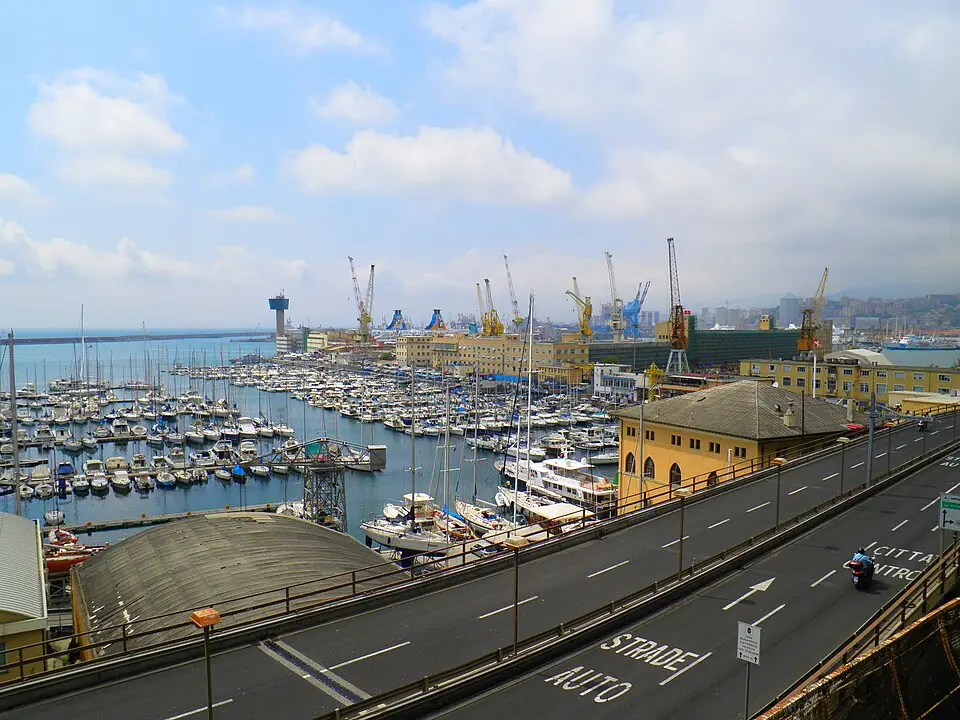
The Port of Genoa profoundly shapes both the cityscape and the history of the Ligurian capital. As the largest seaport in Italy by area, it stretches across a vast stretch of waterfront, from the Foce district in the east to Voltri in the west. Its strategic location at the northernmost point of the Ligurian Sea makes the port a central hub for trade with the heavily industrialized hinterland of northern Italy and the rest of Europe. Despite natural barriers such as the Apennines and the Alps, which make inland shipping difficult, the port is superbly connected by a dense network of highways and railway lines. It also has its own airport, whose runway was built directly into the harbor basin, making the logistical link between air and sea freight unique.
The roots of the port go back to antiquity. The site was already settled in the Neolithic period, and from the fifth century B.C. a permanent settlement developed, inhabited by a mixed population of Ligurians, Etruscans, and Greeks. After being destroyed in the Second Punic War, the town was rebuilt and grew into a regional trading center. In the Middle Ages, the small port town repeatedly became a target of Saracen raids, which prompted the Genoese to build up a powerful naval force. In the eleventh century, this fleet played a decisive role in the liberation of Sardinia and Corsica as well as in the First Crusade. The naval battles against Pisa and Venice in the late thirteenth century secured Genoa's dominance in the Mediterranean and the Black Sea, making the port a central military and economic base of the maritime republic.
The present-day appearance of the old harbor, the Porto Antico, is the result of centuries of expansion. In the High Middle Ages, a first lighthouse was built on the promontory of San Benigno, the forerunner of the famous Torre della Lanterna. Around 1250, landfill created a pier known as the Molo Vecchio, which formed a sheltered bay for the city's many boats. This bay, whose name may derive from the word for herd or pen, was the nucleus of today's port. Alongside the naval arsenal, the Palazzo San Giorgio was also built here; it later became the seat of the important financial institution Banco di San Giorgio and now houses the port authority. In the sixteenth century, the architect Galeazzo Alessi left a lasting mark on the port and completed the expansion of the old harbor, which was then one of the most important trading platforms in Europe.
After the decline of the republic in the eighteenth century and the Napoleonic occupation, the port went through a period of reconstruction under the Kingdom of Sardinia-Piedmont. The old quays were too small and the harbor basin too shallow for the modern ships of the day, leading to inefficient unloading procedures. Between 1820 and 1860, the port was therefore thoroughly modernized. A milestone was the opening of one of Italy's first dry docks in 1851, along with the construction of an extensive rail connection linking Genoa with Turin, Lombardy, and other regions. The opening of the Suez Canal in 1869 ended the isolation of the Mediterranean and brought a new boom to Genoese trade, financed by generous private donations and state funds.
In the twentieth century, the port expanded sharply to the west, since the natural harbor offered no further room for growth. The hill of San Benigno, which had once squeezed the city toward the bay, was largely leveled in the 1920s and 1930s to make room for the new industrial port in Sampierdarena. The excavated earth was also used to build the new harbor mole, which acts as a breakwater. During World War II, the port was heavily damaged by 86 bombing raids, but reconstruction proceeded quickly, and the damage was largely repaired by the end of the 1940s. In the 1960s, Genoa opened the first container terminal in the Mediterranean, launching the port's specialization in modern logistics.
Today the port is divided into several functional areas. The eastern part near Foce is home to marinas, dry docks for ship repairs, and the fairgrounds where the international boat show takes place. The heart of the port for visitors is the restored Porto Antico, which since the 1990s has been transformed under the direction of architect Renzo Piano into a lively center for tourism and culture. Here you will find a large aquarium, the Galata Maritime Museum, a convention center, and several marinas. The historic Stazione Marittima now serves as a cruise terminal, and the entire area is geared toward passenger and ferry traffic.
The western part of the port is dominated by industrial facilities. In front of the Sampierdarena district lie the piers and basins of the industrial port, named after former Italian colonies. Container ships, freighters, and tankers are handled here. An important site is the Fincantieri shipyard in Sestri Ponente, which lies between the airport and the oil port and also builds cruise ships. At the far western end is the large container terminal in Voltri-Pra', which operates as a separate port and has its own marina and a regatta course. This diversity makes the port one of the most versatile in Italy, as goods of all kinds are handled here and ships are built, repaired, and modernized.
For visitors, the Port of Genoa offers a fascinating mix of maritime history and modern infrastructure. The Torre della Lanterna, the city's landmark, towers over the hill of San Benigno and offers sweeping views of the port facilities and the Ligurian Sea. The Diga Foranea mole protects the port as a breakwater and is an impressive structure. The waterfront, characterized by the Sopraelevata Aldo Moro elevated highway, invites leisurely strolls and connects the historic old town with the modern port districts. In the museums and attractions of the Porto Antico, you can experience Genoa's maritime tradition, while the marinas and ferry traffic underscore the bustling character of the working seaport.
The port's future is defined by further modernization and adaptation to ever-larger ships. Plans include rebuilding the eastern part of the mole to widen the Bocca di Levante harbor entrance, as well as expanding the Fincantieri shipyard with a large construction dock. These projects are intended to secure the port's competitiveness and strengthen its role as a gateway to Europe. Despite the industrial dominance, the Porto Antico remains the cultural and tourist heart of the port, keeping the rich history of the Maritime Republic of Genoa alive and offering insight into the importance of the sea to the city's history.
At a glance
- Category
- Sight › Historic sites
- Rating
- no reviews yet · write a review
- Address
- —
Genoa, Italy - District
- Centro Ovest
- Phone
- —
- Website
- www.porto.genova.it
- —
- Coordinates
- 44.40417° N · 8.90417° E
- Data quality
- confidence 0.83
- Identifier
- ID cba7bad5-8d9…
Location & surroundings
Toggle layersFAQ about Hafen Genua
quick answersWhat is the Port of Genoa?
The Port of Genoa is the largest seaport in Italy by area and a historic site in the Centro Ovest district of the Ligurian metropolis of Genoa. It stretches from the Foce district in the east to Voltri in the west and lies at the northernmost point of the Ligurian Sea. With its highways, railway lines, and its own airport, whose runway was built right in the harbor basin, it is a central hub for trade with northern Italy and Europe.
How old is the Port of Genoa?
The roots of the Port of Genoa go back to antiquity, and the site was even settled in the Neolithic period. Starting in the fifth century B.C., a permanent settlement of Ligurians, Etruscans, and Greeks arose here, which was rebuilt after its destruction in the Second Punic War. In the Middle Ages, the port became the military and economic base of the Republic of Genoa, which secured its dominance in the Mediterranean and the Black Sea through naval battles against Pisa and Venice in the late 13th century.
What can you see in the Porto Antico, the old port of Genoa?
In the Porto Antico, the old port of Genoa, you'll find buildings from several centuries of harbor history. These include the Palazzo San Giorgio, once the seat of the financial institution Banco di San Giorgio and now the headquarters of the port authority, as well as the Molo Vecchio pier, which was built up around 1250. A well-known landmark is the Torre della Lanterna lighthouse, whose predecessor was built in the High Middle Ages on the headland of San Benigno. In the 16th century, the architect Galeazzo Alessi completed the expansion of the old port.
What can you visit around the Port of Genoa?
Around the Port of Genoa, there are several historic sites and palaces less than a kilometer away. travelguide195 lists the Abbazia di San Benigno about 311 meters away, the Villa Grimaldi about 933 meters away, and the Villa Imperiale Scassi palace about 988 meters away.
Are there restaurants near the Port of Genoa?
Yes, you'll find a few places to eat near the Port of Genoa. travelguide195 lists about 6 restaurants within 500 meters of the port in Genoa's Centro Ovest district.
Ratings & comments
none yetNear Hafen Genua
closest 5 per category · 2 kmSights
Restaurants
Museums
Hotels
More:Historic sites in Genoa (172)Sights in Centro Ovest (24)All sights in Genoa (254)
171 places within 2 km loaded.
Don't miss in Genoa
All sights Historic sites01
Port of Genoa
No address · Genoa● Website○ Phone Historic sites02
Palazzi dei Rolli
Via Garibaldi · Genoa● Website○ Phone Historic sites03
Le Strade Nuove and system of Palazzi dei Rolli
Via Balbi, 2 · Genoa○ Website○ Phone Palaces04
You need a free account to leave reviews and photos – that keeps comments genuine and lets you edit them later.